
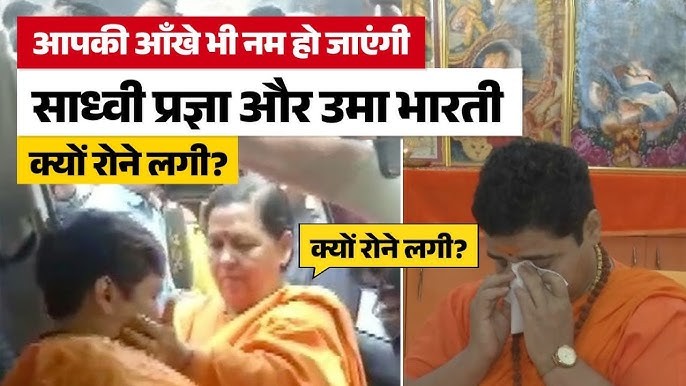
Emotional Moments in Bhopal: Uma Bharti Meets Sadhvi Pragya After Malegaon Blast Verdict
Introduction: A Hug That Echoed Beyond Politics
A poignant moment unfolded in Bhopal as former Madhya Pradesh Chief Minister and senior BJP leader Uma Bharti met Sadhvi Pragya Singh Thakur after the court’s verdict in the Malegaon blast case. The scene was filled with raw emotion — Sadhvi Pragya, a sitting BJP MP from Bhopal, broke down in tears upon seeing Uma Bharti, embracing her with deep emotion. For many, it wasn’t just a reunion of two political figures — it was a symbolic gesture marking a long and painful journey of a woman who spent years in jail under serious terror allegations.
This meeting was not only about personal relief and political vindication but also a reflection of the undercurrents running through Indian politics today — the clash between ideology and justice, the role of narrative in terror cases, and the emotional cost borne by individuals caught in the storm.
In this blog, we take a deep look at the Malegaon blast case, the journey of Sadhvi Pragya Singh Thakur, the legal outcome, and the emotional and political implications of this powerful moment in Bhopal.
1. Background of the Malegaon Blast Case
The Malegaon blast occurred on September 29, 2008, in Malegaon, Maharashtra — a communally sensitive town. The bomb explosion near a mosque killed six people and injured over 100. What followed was one of the most politically controversial investigations in India’s counter-terrorism history.
Initially, suspicions fell on Islamist groups, as was common in previous cases. However, the Maharashtra ATS (Anti-Terrorism Squad) later made a sensational revelation — that Hindu extremists were involved. Among the accused were names that shook the nation: Lt. Col. Prasad Purohit, Sadhvi Pragya Singh Thakur, and others.
For the first time, the term “saffron terror” entered India’s political vocabulary, triggering fierce debates. The arrest of Sadhvi Pragya Singh Thakur, a woman ascetic associated with Hindu spiritual groups, sparked nationwide discussion, polarizing public opinion.
2. The Ordeal of Sadhvi Pragya: From Accused to Parliamentarian
Sadhvi Pragya Singh Thakur’s journey has been nothing short of tumultuous. After her arrest, she spent nearly nine years in prison, including significant time under medical distress. During her incarceration, she alleged custodial torture and ill-treatment by investigators. Her release on bail in 2017 was a turning point — not just legally, but politically.
In 2019, the BJP fielded her as a Lok Sabha candidate from Bhopal, pitting her directly against Congress veteran Digvijaya Singh. Despite the controversy surrounding her candidature, she won with a huge margin — becoming a symbol of “resistance” against what many BJP supporters saw as the Congress-led UPA’s attempt to malign Hinduism under the guise of counterterrorism.
3. The Verdict That Changed Everything
In August 2025, the special NIA court finally delivered its verdict in the long-drawn Malegaon blast case. While some accused were convicted, Sadhvi Pragya Singh Thakur was acquitted due to lack of evidence. The court observed that her motorcycle was used in the blast, but the prosecution failed to prove her direct involvement in the conspiracy.
This verdict was monumental. For supporters, it was proof of her innocence after a decade of suffering. For critics, it raised questions about the handling of the investigation and the prosecution’s failure to secure strong evidence.
4. Uma Bharti’s Visit: A Gesture of Solidarity
After the verdict, Uma Bharti — a towering figure in the BJP and a spiritual-politician herself — paid a personal visit to Sadhvi Pragya at her residence in Bhopal. The emotional gravity of the meeting was palpable.
As soon as Uma Bharti entered, Sadhvi Pragya stood up, folded her hands, and hugged her. Overcome with emotion, she began to cry — not just with relief, but with the weight of years spent under suspicion and hostility. Uma Bharti, visibly moved, comforted her like an elder sister — praising her resilience and expressing deep anguish over the injustice she endured.
The video of this emotional moment soon went viral on social media. Supporters called it a “mother-daughter” moment, a healing embrace after a long battle with defamation and disgrace.
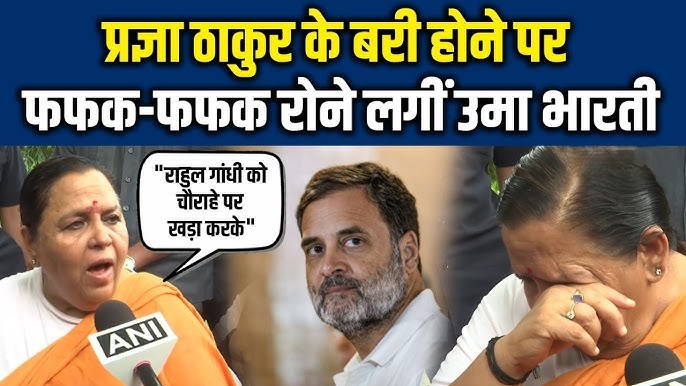
5. What Uma Bharti Said: “An Apology Is Owed”
In her remarks to the media, Uma Bharti didn’t mince words. She said:
“The pain Sadhvi Pragya endured is unimaginable. The people and leaders who targeted her with terms like ‘saffron terror’ owe her an apology. They didn’t just target a person — they targeted an entire tradition, an entire dharma.”
Her statement was both emotional and political. It was a direct dig at Congress leaders who had used the term “Hindu terror” or “saffron terror” in the past, most notably Digvijaya Singh and former Home Minister P. Chidambaram.
6. Political Repercussions of the Meeting
The emotional meeting between Uma Bharti and Sadhvi Pragya isn’t just a personal moment — it has political messaging layered into it.
- For the BJP, it reinforces their narrative that the UPA-era investigations were politically motivated.
- For Congress, it renews criticism over their use of the term “saffron terror”.
- For neutral voters, it reopens debates on the fairness of anti-terror investigations in India.
The BJP has already begun using the court verdict and this meeting to bolster its claims of Hindu victimhood and to unite its base around a theme of religious pride and injustice.
7. The Emotional Weight of Justice Delayed
Sadhvi Pragya’s breakdown during the meeting was a moment of catharsis. For over a decade, she had carried the label of a terrorist. The legal system moved slowly, the public discourse was often toxic, and her physical health deteriorated in custody.
In interviews after her acquittal, she expressed gratitude to those who stood by her but also anger towards those who, in her view, persecuted her without evidence. She has often alleged that she was targeted because she represented Hindu ideology.
For her, Uma Bharti’s visit was more than solidarity — it was validation from a veteran who herself had faced imprisonment in the Ayodhya movement.
8. Gender and Ideology: A Double Burden
Sadhvi Pragya’s case is unique not just because of its legal complexity, but because she was a woman, a sadhvi, and a political figure. Her image was used to define an entire ideological narrative — a rarity in a nation where most terror-related accused are men.
Her supporters claim she was victimized because she didn’t fit the stereotype — she was a woman ascetic with right-wing ideology, and thus an easy target for liberal and secular circles who wanted to equate all religious extremism.
Her tears during Uma Bharti’s visit reflected that burden — of being a symbol, a political pawn, and a woman fighting against all odds.
9. Congress’s Response: “Respect the Verdict, But Let’s Not Forget the Facts”
Following the verdict and the emotional public response, the Congress party issued a carefully worded statement. They said:
“We respect the court’s verdict, but we also want to remind the nation that it was the investigative agencies under previous governments that brought the case forward. Let’s not forget that the victims of the blast still await justice.”
This statement indicates the party’s attempt to balance respect for judiciary with damage control over its previous stance on ‘Hindu terror’.
10. Media Coverage: Sentiment vs. Scrutiny
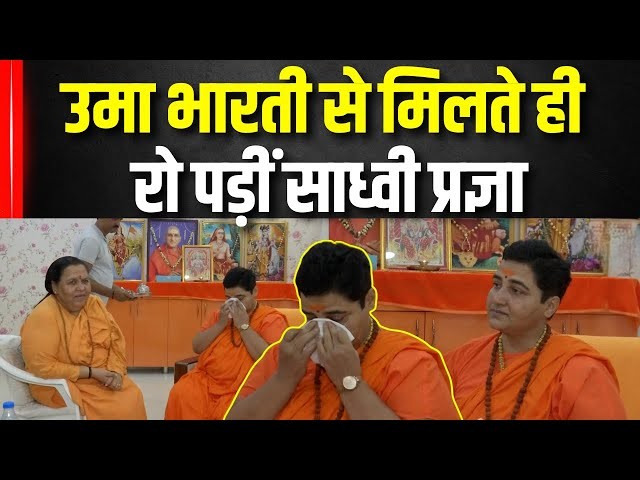
The video of Sadhvi Pragya crying in Uma Bharti’s arms quickly became prime-time material. Some channels framed it as a moment of “vindicated devotion,” while others reminded audiences of the larger questions surrounding the Malegaon case:
- Why did the prosecution fail to secure convictions for all accused?
- Was the evidence flawed from the beginning?
- Did political pressure influence the investigation?
These questions remain open, but the focus of the media has shifted — from the facts of the case to the emotional narrative of Sadhvi’s endurance and redemption.
11. What’s Next for Sadhvi Pragya?
Now that she has been acquitted, Sadhvi Pragya is expected to play a more prominent role in BJP’s Hindutva-centric politics. She has often courted controversy with provocative statements, but her public image may undergo a transformation — from a “controversial MP” to a “victim-turned-victor”.
Uma Bharti’s visit is likely to further elevate her stature within the party and among its ideological base.
12. Conclusion: A Moment Etched in Political Memory
The image of a tearful Sadhvi Pragya being embraced by Uma Bharti will remain etched in the political memory of the nation for years to come. It captures not just the conclusion of a legal chapter, but the deeply emotional and ideological undertones of a case that divided public opinion.
In a democracy, justice is not only about courts — it is also about perception, emotion, and memory. This moment in Bhopal combined all three.
As India moves towards the next general elections, this case and its emotional aftermath are bound to feature prominently in campaign speeches, media debates, and ideological clashes.
Whether one agrees or disagrees with the court’s decision, the tears of Sadhvi Pragya remind us that behind every political narrative, there are real people — carrying real pain, waiting for closure.
read more latest news

