

“G for Ganesh or G for Donkey?”: CM Yogi Adityanath’s Scathing Attack on Samajwadi Party in Moradabad.
Introduction: A Political Storm Brews in Moradabad
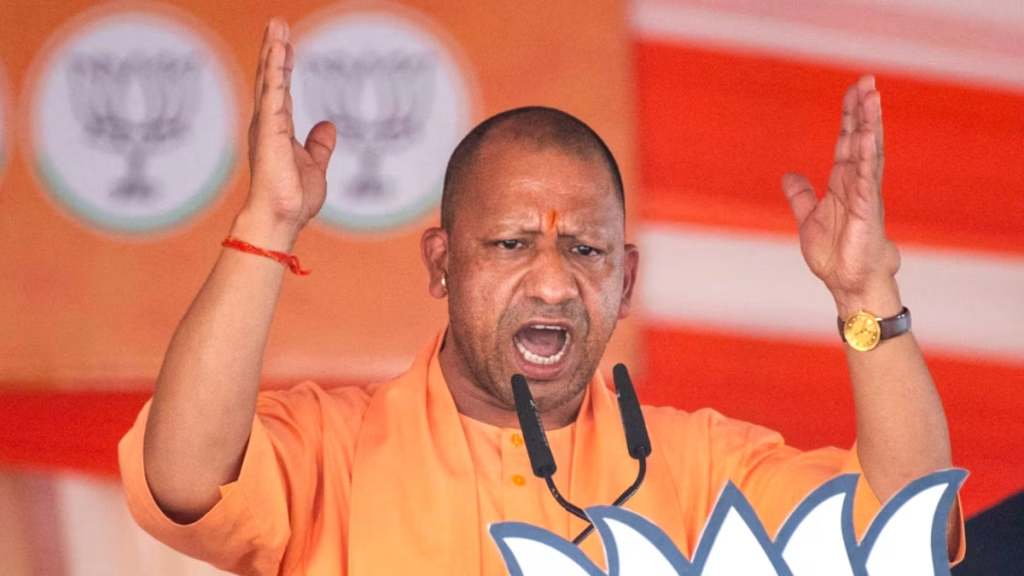
In a politically charged atmosphere ahead of upcoming elections, Uttar Pradesh Chief Minister Yogi Adityanath unleashed a blistering verbal attack on the Samajwadi Party (SP) during his rally in Moradabad. Addressing a large crowd, CM Yogi didn’t hold back in accusing the SP of promoting regressive values among children. His remark — “We taught children ‘G for Ganesh’, they taught ‘G for Gadda (donkey)’” — ignited a storm in political circles and once again highlighted the deeply polarised political landscape in the state.
This statement wasn’t just a jibe; it was a calculated political message aimed at positioning the Bharatiya Janata Party (BJP) as a party of cultural pride, tradition, and values, while painting the SP as regressive and disconnected from Indian ethos. Let’s delve deeper into the speech, the political context, and the ripples it created.
The Context of CM Yogi’s Visit to Moradabad
Moradabad, often considered the heart of Western Uttar Pradesh politics, has seen a historic tug of war between SP, BJP, and other regional players. CM Yogi’s visit to Moradabad wasn’t just another rally — it was a strategic move. With elections on the horizon, the BJP is attempting to consolidate its base in the region where caste arithmetic and community sentiments play a significant role.
Yogi Adityanath’s address in Moradabad was part of a larger campaign to energize the BJP cadre, woo backward caste voters, and appeal to nationalist sentiments. His remarks were aligned with the BJP’s narrative of nationalism, cultural pride, and ‘sanskaars’ (values), contrasting with what the party paints as the SP’s ‘goonda raj’ and lack of developmental vision.
“G for Ganesh, G for Gadda” – More Than a Rhyme
The line that made headlines — “We taught children ‘G for Ganesh’, they taught ‘G for Gadda’” — wasn’t an off-the-cuff comment. It was a rhetorical masterstroke, designed to achieve multiple objectives:
- Cultural Assertion: By referencing Lord Ganesh, the deity symbolizing wisdom and success, Yogi was reinforcing the BJP’s cultural and religious identity. It’s a direct appeal to Hindu sentiments and traditional values.
- Mocking the Opposition: The term “G for Gadda” (donkey) was not used in a vacuum. It harkens back to an earlier episode where former CM Akhilesh Yadav used the term “donkey” in a derogatory reference during the 2017 elections, saying he won’t follow the “donkeys of Gujarat” — a jibe that BJP had not forgotten.
- Educational Values: Yogi’s claim suggests that under the BJP, education is infused with cultural identity, whereas under SP, it lacked direction or seriousness.
- Media Amplification: The statement was designed to go viral — short, controversial, and easy to remember. It did exactly that.
The Political Reactions: SP, Congress, and Others Respond
Unsurprisingly, the SP hit back hard. Party spokespersons accused Yogi of lowering the dignity of the CM’s post by indulging in childish rhetoric. Akhilesh Yadav, while not directly responding, shared a sarcastic post on social media quoting Tagore: “A mind all logic is like a knife all blade — it cuts the hand that uses it.”
The Congress Party also criticized the CM’s remarks, calling them a “distraction from real issues” like unemployment, inflation, and farmers’ distress.
Political analysts, meanwhile, observed that the remark was yet another example of how election campaigns in India have shifted from policy debates to clever soundbites and cultural symbolism.
Language and Culture in Political Messaging
CM Yogi’s reference to the English alphabet may appear trivial on the surface, but it reflects a deeper cultural assertion. By replacing textbook alphabets with religious figures, the BJP is attempting to root education in Indian tradition. It’s not a new idea; RSS-backed schools and institutions have been promoting similar pedagogical methods for decades.
However, critics argue that education should be based on logic, science, and inclusivity, not mythology and religious preference. The SP claims that such moves polarize children’s learning and push a religious agenda.
The BJP, on the other hand, argues that it’s about reviving cultural pride — why should children learn “A for Apple” when they can learn “A for Arjun” or “G for Ganesh”?
Rewriting the Alphabet: A Trend?
Yogi Adityanath’s remarks weren’t an isolated statement. Several educational experiments backed by BJP-ruled states have tried to ‘Indianize’ the school curriculum. For example:
- Rajasthan proposed an alphabet book featuring Indian freedom fighters and deities.
- Gujarat had similar attempts to align early education with Hindu cultural icons.
- In Madhya Pradesh, “V for Vivekananda” replaced “V for Van”.
Supporters see this as decolonizing education; critics see it as saffronizing it.
BJP vs SP: Clash of Ideologies
This episode is just another chapter in the ongoing ideological war between BJP and SP. While BJP thrives on nationalism, cultural revival, and law-and-order narratives, the SP often takes the secular, socialist, and caste-based empowerment route.
Yogi’s “G for Ganesh” remark, when juxtaposed with SP’s “G for Gadda”, reflects this stark divide — a clash between cultural conservatism and a more populist, caste-based politics. It also shows how education itself has become a battleground of ideology.
Public Reaction: Divided But Engaged
The public reaction to the CM’s remarks has been mixed, but undeniably loud:
- BJP supporters applauded the statement as a “truth bomb” exposing the SP’s shallowness.
- SP loyalists ridiculed it as “nursery-level politics”.
- Neutral citizens, especially educators, expressed concern over how politics was now shaping even pre-school education.
Memes flooded social media. WhatsApp groups buzzed with voice notes repeating the line in different accents. News channels ran the clip on loop, bringing TRPs and clickbait headlines.
The Power of Political Soundbites
Indian politics has entered an era where a single phrase can dominate headlines for days. From “Maa, Maati, Manush” to “Abki Baar Modi Sarkar”, from “Suit Boot Ki Sarkar” to “Chowkidar Chor Hai”, politics now runs on catchphrases.
Yogi Adityanath’s “G for Ganesh” joins this hall of fame. Whether or not it wins votes, it certainly wins attention.
A Look at Yogi Adityanath’s Larger Strategy
The Moradabad speech is part of a larger narrative that CM Yogi has been building:
- Law and Order: Positioning BJP as the bringer of peace in a once riot-prone region.
- Cultural Revivalism: Building temples, promoting Sanskrit, celebrating festivals at state level.
- Welfare Schemes: Citing free rations, housing, and Ujjwala gas connections.
- Contrast with SP Rule: Highlighting SP-era crime rates, corruption, and “parivarvaad” (dynasty politics).
This remark fit seamlessly into this broader message: “We are the protectors of Indian culture. They are the mockers of it.”
Will It Impact Voter Sentiment?
Voter sentiment in Uttar Pradesh often swings on emotional and identity-based issues. While this one remark may not shift an entire electorate, it adds to a cumulative narrative that BJP is carefully building. In a region where perception matters as much as performance, such statements resonate far beyond rally grounds.

Opposition’s Challenge: Counter Without Overreacting
The biggest challenge for SP is not to fall into the trap. Overreacting to such remarks often ends up giving BJP more airtime and legitimacy. Instead, SP needs to pivot the conversation to governance issues — jobs, inflation, education quality, etc.
But Akhilesh Yadav, too, is not a stranger to political theatrics. In fact, during the 2017 campaign, he had mocked the Gujarat tourism ad featuring donkeys — a comment that may have backfired and contributed to BJP’s sweeping victory.
Education As a Political Weapon
Education is no longer just an administrative issue; it’s a political weapon. From curriculum design to textbook content, everything is being debated on ideological grounds. Yogi’s alphabet remark is the latest example of how even preschool content is not free from the political tug-of-war.
The central question remains: Should early childhood education be based on religion and tradition, or on secular, scientific values?
Conclusion: The Battle Between Ganesh and the Donkey
CM Yogi Adityanath’s speech in Moradabad, particularly his “G for Ganesh” comment, has set the tone for a no-holds-barred political campaign. It is sharp, symbolic, and rooted in cultural assertion. Whether it brings electoral dividends or not, it has once again shown that in today’s India, even the alphabet can become a battlefield for ideology.
The war of narratives is on. On one side stands “G for Ganesh” — tradition, values, and religion. On the other side is “G for Donkey” — mockery, populism, and retort. In the end, the voter will decide which alphabet they want their future generations to learn from.
Read more latest news

