
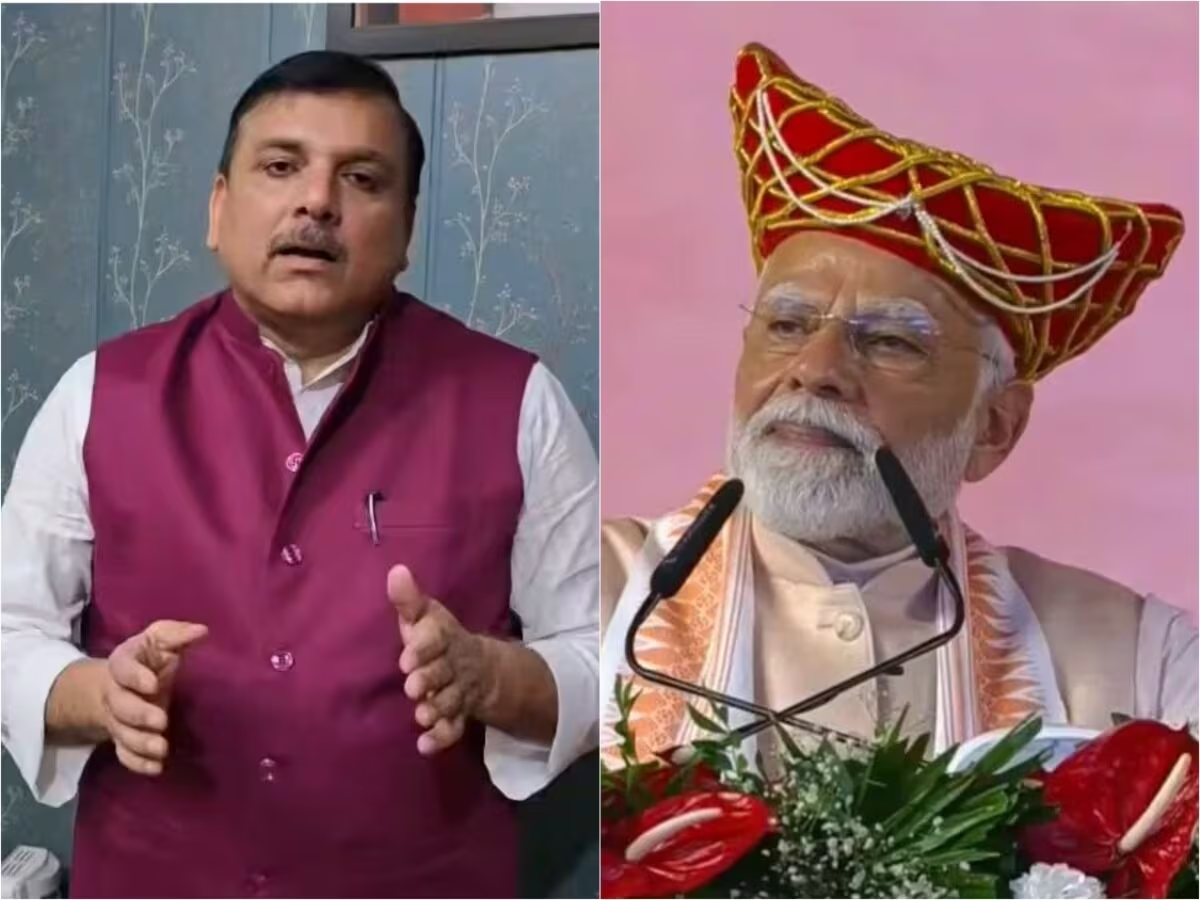
AAP MP Sanjay Singh’s Scathing Attack on PM Modi: “Demonetization Claimed Lives, GST Increased Taxes, Yet People Celebrated”
Introduction
AAP MP Sanjay Singh’s statement on the GST and demonetization issue targeted PM Modi. Indian politics is never short of fiery debates, sharp allegations, and contrasting narratives. In recent years, few issues have left as strong a mark on the country’s socio-economic and political fabric as demonetization (2016) and the implementation of the Goods and Services Tax (GST) in 2017. These two landmark decisions of the Narendra Modi-led NDA government are often projected by the ruling party as revolutionary reforms aimed at cleansing the economy, fighting black money, and bringing India into the era of “one nation, one tax.”
But on the other side, critics and opposition leaders argue that both moves caused more pain than progress for the common people. One such prominent voice has been AAP Rajya Sabha MP Sanjay Singh, who has consistently questioned the Modi government’s economic policies. In his latest statement, Sanjay Singh once again targeted PM Modi, saying:
- “Demonetization claimed many lives, yet people celebrated it.”
- “In 2017, GST was introduced, taxes were increased, and this too was celebrated.”
This blog takes a deep dive into Sanjay Singh’s statement, the history and aftermath of demonetization and GST, the political narrative built around these policies, and their impact on India’s economy and society.
The Context of Sanjay Singh’s Statement
Sanjay Singh is known for his fiery speeches and outspoken criticism of the BJP government. In his latest remarks, he pointed to two of the Modi government’s most high-profile economic decisions:
- Demonetization (November 8, 2016) – When PM Modi announced at 8 PM that ₹500 and ₹1000 notes would no longer be legal tender. The aim was to flush out black money, eliminate counterfeit currency, and curb terror financing.
- GST (Goods and Services Tax, July 1, 2017) – Marketed as “One Nation, One Tax,” GST replaced a complex web of indirect taxes with a single tax regime.
Sanjay Singh’s argument is rooted in the human and economic costs of these decisions. He claims that demonetization not only caused chaos but also led to hundreds of deaths due to long queues, lack of access to cash, and disruptions in livelihoods. Similarly, he says GST was supposed to simplify taxation but instead burdened small traders, increased compliance costs, and led to higher taxes on many goods and services.
His biting remark that people “celebrated” both policies despite their negative impacts points to his belief that propaganda, emotional appeals, and political spin overshadowed the ground reality.
Demonetization 2016 – A “Surgical Strike” or a “Man-Made Disaster”?
The Announcement
On November 8, 2016, Prime Minister Modi addressed the nation to declare that ₹500 and ₹1000 notes (which formed 86% of the currency in circulation) would cease to be legal tender from midnight. People were given limited time to deposit old notes in banks or exchange them for new ones.
The stated objectives:
- Eradicate black money
- Stop terror funding
- Destroy counterfeit currency
- Push India toward digital transactions
The Immediate Impact
The aftermath was chaotic and dramatic:
- Long queues outside banks and ATMs.
- Severe cash shortages, especially in rural India.
- Weddings, small businesses, and daily wage earners were the worst hit.
- Multiple reports of people dying in queues or because they couldn’t access cash for medical emergencies.
RBI’s Data and Opposition’s Criticism
In 2018, the Reserve Bank of India (RBI) reported that 99.3% of the demonetized notes had returned to the banking system, meaning almost no black money was destroyed.
This fueled criticism that demonetization failed to achieve its core objective. Leaders like Rahul Gandhi, Manmohan Singh, and Arvind Kejriwal called it the “biggest scam in independent India.”
Sanjay Singh echoed the same criticism, highlighting not only the economic disruption but also the human tragedy associated with demonetization.
GST 2017 – “One Nation, One Tax” or “One Nation, Many Confusions”?
The Launch
On July 1, 2017, GST was launched at midnight in a grand event at Parliament, attended by top leaders and dignitaries. PM Modi and then-President Pranab Mukherjee hailed it as a historic reform.
GST subsumed multiple taxes like VAT, excise duty, and service tax into one tax, aiming to reduce corruption, end tax cascading, and unify the Indian market.
The Problems
Despite its promise, GST implementation faced serious hurdles:
- Multiple tax slabs (0%, 5%, 12%, 18%, 28%) created confusion.
- Frequent changes in rules frustrated businesses.
- Small traders and MSMEs (Micro, Small, and Medium Enterprises) complained about complex filing systems.
- Many essential items became costlier, burdening the middle class and poor.
Sanjay Singh highlighted this contradiction: instead of reducing the tax burden, GST led to higher rates on several goods and services, thereby increasing people’s financial struggles.
Why Did People “Celebrate” These Policies?
One of the most thought-provoking parts of Sanjay Singh’s statement is that despite the pain caused by demonetization and GST, people celebrated them.
Reasons for Public Endorsement:
- Emotional Pitch by PM Modi – Modi presented demonetization as a “patriotic duty” and a “surgical strike on black money.” People felt they were participating in nation-building.
- Hope for Justice – The poor believed the rich and corrupt would be punished.
- Strong Narrative Control – BJP’s communication strategy painted critics as “anti-national” or “protectors of black money.”
- Media Amplification – A large section of media portrayed both moves as historic and revolutionary.
- Blind Faith in Leadership – Modi’s personal popularity and image as a “decisive leader” made people endure hardship with patience.
Economic Consequences of Demonetization and GST
Demonetization Fallout
- GDP growth slowed down in subsequent quarters.
- Informal sector suffered huge losses.
- Jobs were lost in construction, textile, and small-scale industries.
- Digital transactions increased, but largely in urban areas.
GST Challenges
- Initial GST revenue collections were below expectations.
- Small traders faced compliance stress with multiple returns.
- Frequent changes created instability.
- However, over time, GST collections stabilized, and it is now a major revenue source for both Centre and States.
Political Implications
Despite strong criticism, BJP won the 2017 Uttar Pradesh elections with a landslide. This shows that political narratives often outweigh economic pain.
For the opposition, demonetization and GST became symbolic of Modi’s flawed policies. For BJP, they became symbols of “tough decisions for the nation.”
Sanjay Singh’s latest attack fits into this long-running narrative battle.
AAP’s Stand on Economic Issues
The Aam Aadmi Party (AAP), led by Arvind Kejriwal, has positioned itself as a party of governance reforms, education, health, and common man’s issues. AAP leaders like Sanjay Singh often highlight how Modi government’s economic policies disproportionately hurt the poor, traders, and small businesses.
His remarks are not just economic critiques but also political positioning—AAP wants to project itself as the true voice of the common man.
Conclusion
Sanjay Singh’s sharp attack on PM Modi over demonetization and GST is more than just a political jibe. It revives the debate on whether these “historic decisions” were actually economic blunders that caused immense suffering.
While the government continues to defend demonetization as a move that increased digital transactions and GST as a unifying tax system, opposition leaders like Sanjay Singh argue that the human and economic costs far outweighed the benefits.
The most striking part of his statement remains the irony he pointed out—that despite lives lost, businesses destroyed, and taxes increased, people celebrated these moves. This, in his view, is a testament to how propaganda and emotion can triumph over reality.
As India heads into new elections, the legacy of demonetization and GST will continue to be a political battlefield, shaping narratives and influencing voters.
Read More latest news

