
Introduction
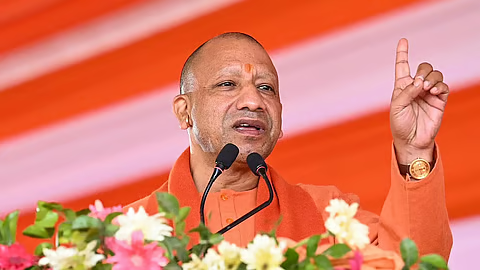
In late September 2025, during a state-level workshop in Lucknow titled “Atmanirbhar Bharat – Swadeshi Sankalp,” Uttar Pradesh Chief Minister Yogi Adityanath made several sweeping historical claims that immediately drew attention in media and public discourse. Among the most provocative was his assertion that:
“When Islam first attacked India … by the year 1100 AD, the Hindu population was 60 crores. And when the country gained independence in 1947, the Hindu population was only 30 crores. Tell me, should our population have increased or decreased in these 800-900 years?”
According to the CM, the decline was not merely due to conflict but also due to famine, disease, torture, and systemic impacts under successive invaders. He tied the demographic claim with broader arguments: that foreign invaders also damaged agricultural productivity, that India’s economic output declined, and that even today “some people” carry a foreign mentality by dividing society on caste, region, or language lines.
This event and these claims raise many questions:
- What exactly did Yogi say, in full context?
- Is there historical evidence to support such demographic shifts?
- Why make such statements now—and what purpose do they serve politically?
- How have historians, demographers, and commentators reacted?
- What are the risks and implications when political leaders invoke contested history in public discourse?
In this blog, I will reconstruct the event, unpack the claims one by one, examine historical and demographic data, explore the motivations and potential consequences, and reflect on the broader phenomenon of using “history as narrative” in politics.
The Event in Lucknow: What Yogi Said
The Occasion
The gathering was a state workshop on Atmanirbhar Bharat – Swadeshi Sankalp organized by the BJP in Lucknow. It was intended to champion self-reliance, indigenous production, and economic nationalism.
At the event, Yogi made a wide-ranging address, touching on historical decline, economic revival, social unity, and contemporary threats. His remarks about demographics and history became the most widely reported.
Key Claims and Statements
Here are the major claims Yogi made, in paraphrase and direct quotes, as reported:
- Demographic decline of Hindus (60 crores → 30 crores):
- “By the year 1100, the Hindu population in India was 60 crores. And when the country gained independence in 1947, the Hindu population was only 30 crores.”
- He asked rhetorically whether the population should have increased or decreased in those 800–900 years.
- He claimed that this decline happened “not only by killing by invaders” but also through hunger, disease, torture, and other consequences.
- Decline of agriculture and economy:
- He asserted that under foreign rule, agricultural productivity dropped.
- He said that many sectors of production suffered and that India’s economy was “rendered poor.”
- On unity, divisiveness, and foreign mindsets:
- He compared “some people dividing the country on caste, language, region” to the mindset of foreign rulers, accusing them of fostering social divisions.
- He said such people were continuing the legacy of historical divide-and-rule strategies.
- Swadeshi, Self-Reliance, and Use of India’s Wealth:
- Yogi linked his historical narrative to contemporary policy: promoting the Swadeshi movement, emphasizing that wealth generated in India should stay in India.
- He argued that if India’s wealth goes abroad, it might be used to fuel “terrorism, militancy, naxalism, anarchy” in the country.
- India’s contributions to world economy:
- He claimed that three centuries ago, India’s share in the world economy was 25 %.
- He also evoked the idea that before colonization India was a great producer and agricultural power.
These comments, especially the demographic claim, have attracted both support and sharp criticism given their historical claims and implications.

Examining the Claims: What Does History & Demography Say?
Because Yogi’s speech makes a bold numeric claim about population, any serious assessment must engage with demographic, historical, and methodological issues. I’ll treat the key claim (Hindu population halving over 800–900 years) first, and then the related claims about agriculture and economy.
The Core Claim: Hindu Population from 60 Crores to 30 Crores
1. What does “crore” here mean, and is the baseline realistic?
- In Indian usage, 1 crore = 10 million.
- So 60 crores = 600 million; 30 crores = 300 million.
Yogi is effectively saying that in 1100 AD, Hindu population in what is now India (or perhaps the subcontinent) was ~600 million, and by 1947 it was ~300 million.
2. Constraints and plausibility: Historical population estimates
Population historians and scholars have long debated premodern population sizes. The further back you go, the sparser reliable data becomes. Some relevant points:
- In 1000 AD, the total population of the entire Indian subcontinent (which includes present-day India, Pakistan, Bangladesh, parts of Afghanistan) is generally estimated to be much lower than 600 million. Many estimates place the total population of South Asia (not just Hindus) in the order of 100–200 million, rather than several hundred million.
- For example, historian Angus Maddison (in his historical GDP/population estimates) suggests that in 1000 AD, the population of India (or South Asia) was in the low hundreds of millions, not several hundreds of millions.
- Estimating a religious breakdown (Hindu vs Muslim vs others) for medieval centuries is even more speculative, given limited reliable data on conversion, migration, mortality, etc.
Thus, using 600 million (i.e. 60 crores) as the Hindu population in 1100 AD is extremely difficult to support with scholarly consensus.
3. Population growth dynamics: Should it rise or fall?
In premodern societies, population growth is typically slow but positive unless disrupted by wars, famines, epidemics, mass migration, or other catastrophes. Over centuries, one would generally expect (in absence of continuous extreme negative shocks) population to increase.
To assert that a population halved over nearly a millennium implies consistent or repeated severe negative shocks or sustained decline—in contrast with most demographic trajectories.
4. Mortality, conflict, disease, migration, and conversions
Yogi’s argument hinges on attributing this decline to invasions, violence, famine, disease, religious persecution, etc. While these factors certainly existed at times, the question is: were they sufficient in magnitude, frequency, and duration to reverse centuries of expected growth?
- Wars, invasions, and conquests certainly caused destruction in specific regions for certain periods.
- Famine, disease, and social disruption also took heavy tolls, especially in premodern times.
- There were also episodes of religious conversion, interreligious conflict, forced migration, and population displacement.
But the burden of proof is high to show that cumulatively they were enough to halve a population over centuries.
5. Population in 1947 and religious breakdown
At the time of Independence (1947), the Indian census and demographic data are more reliable. The total population of British India (including present-day India, Pakistan, and Bangladesh) was roughly 390–400 million. The Hindu population in undivided India was indeed large, but to claim that it was only 300 million (30 crores) as opposed to 600 million earlier is an assertion that might conflict with the more moderate estimates of growth and demographic transitions.
Thus, while a decline due to episodic catastrophes is plausible in specific eras or regions, the claim of a precise halving over 800–900 years lacks strong empirical foundation based on current historical/demographic consensus.
Claim 2: Decline of Agriculture, Productivity, and Economy
Yogi also tied the demographic argument to economic decline: that under “foreign invaders,” agricultural yields dropped, industry suffered, and India’s former greatness was eroded.
- There is historical evidence that much of precolonial Indian economy was vibrant: India’s relative share of world GDP in earlier centuries is often cited as significant (some estimates suggest 25% of world production in certain eras) — though such estimates are debated.
- The shift under colonialism, especially between the 18th–19th centuries, undoubtedly had disruptive economic effects—deindustrialization, land revenue extraction, resource drain, infrastructure neglect, etc.
- However, attributing sustained decline over the entire medieval and early modern period exclusively to “foreign invasion” oversimplifies complex processes: internal conflicts, state failure, climate changes, local dynastic decline, administrative inefficiencies, and technological changes all played roles.
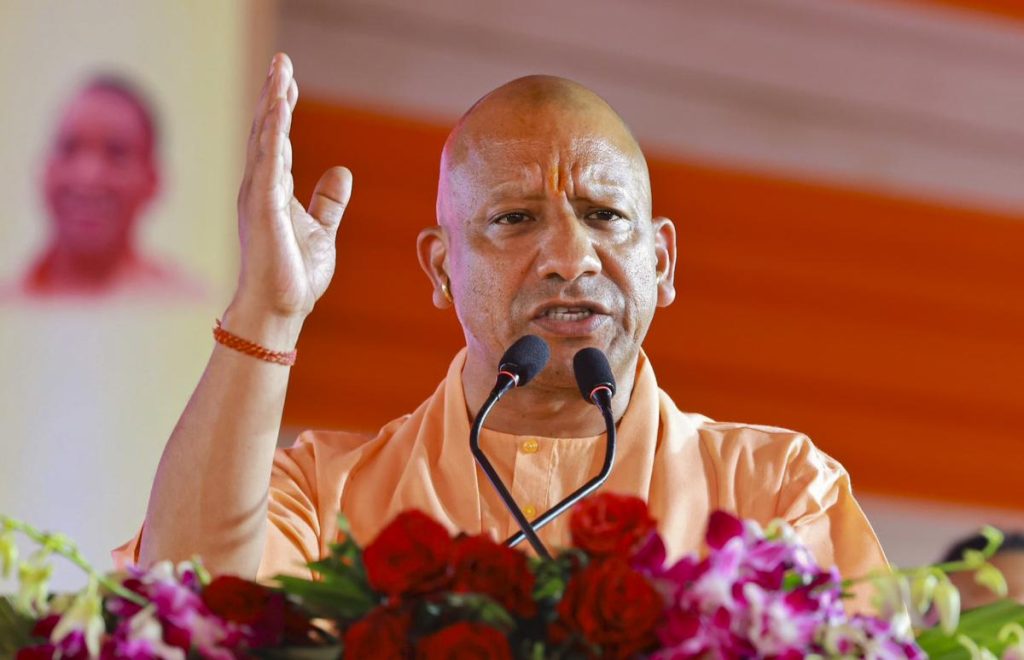
So while the broad theme (India’s economy suffered under foreign and colonial rule) resonates with many historians, the sweeping narrative that ties demographic halving, agricultural decline, and productivity drop in a linear and deterministic way is far too simplistic.
Other Claims: Division, Identity, and Contemporary Continuities
Yogi’s rhetoric about divisions (caste, region, language) being akin to “foreign mindsets” or legacy of “divide-and-rule” is political framing. He suggests that those who perpetuate social divisions today are heirs to those historical colonial/invader strategies.
This is not a unique political device: many political actors use historical narratives to frame modern social cleavages as externally imposed or legacy of colonialism. The risk is that it delegitimizes modern internal critique or pluralism by casting it as “foreign influence.”
Motives and Context: Why Make These Claims Now?
When a political leader makes sweeping historical claims, it’s instructive to ask: to what end? Some contextual motivations may help explain why Yogi chose this line of argument now.
1. Political Mobilization and Identity
- In a state like Uttar Pradesh, where identity politics are potent, invoking a narrative of historical victimhood and revival can mobilize core supporters and appeal to Hindu majoritarian sentiment.
- Framing a narrative of deprivation, loss, and revival can bolster the legitimacy of policies framed as restitution, protection, or revival (temple reconstructions, cultural programs, etc.).
- The demographic framing (that Hindu numbers declined due to historical injustice) suggests a moral imperative for “recovery” or “reclamation.”
2. Linking History to Policy: Swadeshi and Self-Reliance
By placing the narrative of historical decline in the same speech as calls for Swadeshi (indigenous industry) and Atmanirbhar Bharat (self-reliant India), Yogi is connecting the historical with the contemporary:
- If colonial or foreign rule caused economic drain, then the path to recovery is reclaiming domestic production, keeping wealth within India, and resisting external dominance.
- The narrative justifies economic nationalism and protectionism by suggesting that prior dependency harmed India’s sovereignty.
3. Countering Criticism with Historical Legitimacy
By evoking grand historical claims, political leaders sometimes try to confer moral or intellectual legitimacy. If one can frame oneself as the defender or restorer of tradition, culture, and identity, that can help counter critics who label these moves as sectarian or parochial.
4. Narrative Framing and Media Visibility
Bold or controversial statements generate media attention, stimulate debate, and keep the speaker in the spotlight. This is especially useful in politically charged environments, elections, or intra-party positioning.
Reactions: Support, Criticism, and Analysis
Unsurprisingly, Yogi’s claims elicited a wide spectrum of reactions—from strong support to sharp critique—from historians, opposition leaders, social commentators, and media analysts.
Supportive Voices
- Among his supporters and certain ideological circles, the speech was seen as a bold articulation of a long-silenced narrative of historical injustice and Hindu resilience.
- Some accepted the demographic claim without demanding empirical proof, viewing it more as a symbolic or rhetorical device than a literal history lesson.
- Political allies emphasized the need to reclaim economic independence and resist cultural dilution.
Critical and Scholarly Voices
- Historians and demographers pointed out that the numeric claim is not backed by credible population estimates or historical studies.
- Some commentators accused the CM of oversimplification and distortion of complex historical processes.
- Others worried about the communal implications: tying demographic decline to “invaders” inevitably frames religious and social identities in adversarial terms.
Media and Opinion Pieces
- Media outlets highlighted the sensational nature of the claim (Hindu population halved) and fact-checked its plausibility. For example, LiveMint carried a headline: “Yogi Adityanath’s BIG claim: Hindu population of India halved between 1100 and 1947 due to foreign rule.” mint
- NDTV reported the link to foreign invasions and colonial rule. www.ndtv.com
- Deccan Herald ran coverage pointing out the claim about decline from 60 to 30 crores. Deccan Herald
- Others reminded readers that premodern population data is speculative, and thus numeric claims must be treated cautiously.
Political Opposition
- Leaders from rival parties criticized the speech as communal or as a distortion of history for political ends.
- They called for restricting political speeches from making unverifiable historical claims that could inflame social divisions.
Risks, Implications, and the Use of History in Politics
When political figures invoke contested history, especially with bold numeric claims, several risks and effects follow.
1. Polarization and Communal Tension
Framing demographics in terms of “us vs them,” invoking “invaders” vs “natives,” can reinforce communal identities and antagonism. It can be used to justify exclusionary political agendas or communal mobilization.
2. Erosion of Credibility
If claims are subsequently challenged and shown to be historically weak, it may undermine the speaker’s credibility among educated and critical audiences. Over time, repeated exaggeration can erode trust in political discourse.
3. Reductive Narratives of History
History is complex, multidimensional, and contingent. Policies, identities, and social realities cannot be solely explained by binary frameworks (invaders vs natives). When oversimplified, these narratives can obscure internal social dynamics, reforms, pluralism, and nuanced continuity.
4. Weaponization of History
Historical narratives become tools of political power: who controls the dominant version of history often influences which policies are legitimized, which communities are prioritized, and which stories get ignored or marginalized.
5. Undermining Academic Discourse
Constant politicization of history can chill scholarly debate or distort academic standards. Researchers may come under pressure to validate politically preferred versions of history.
A Tentative Assessment
While Chief Minister Yogi Adityanath’s speech in Lucknow reverberated widely, my assessment is:
- The demographic claim (Hindu population halved over 800–900 years) is not grounded in credible historical or demographic consensus. It is almost certainly a rhetorical exaggeration or symbolic claim rather than a reliable historical fact.
- The broader narrative—that India’s economic and agricultural capacities were damaged by invasions, colonialism, resource extraction, and external dependence—has base in historical scholarship, though always subject to nuance, regional variation, and internal dynamics.
- Politically, the speech serves multiple functions: mobilizing identity, providing moral narrative for Swadeshi/self-reliance agenda, framing opponents as agents of division, and asserting historical legitimacy.
- The rhetorical linking of historical grievance to contemporary policy is potent but carries the risk of deepening polarization and oversimplifying multifaceted realities.
Going Forward: What to Watch
Given that this speech is likely to be cited frequently in public discourse and politics, here are areas to monitor:
- Fact-checking and scholarly pushback: Will historians and demographers publish detailed critiques or rebuttals? Are there academic studies already contesting or supporting parts of the claim?
- Political deployment: Will this narrative be used in campaigns, school textbooks, state policy proclamations, or heritage initiatives?
- Social reaction and backlash: Could communities feel attacked or misrepresented, leading to protests or counter-narratives?
- Media framing: How do national, regional, and international media interpret or challenge this narrative over time?
- Educational impact: Will textbooks, curricula, or public memory institutions (museums, memorials) adopt versions of this narrative?
- Policy linkage: Will the Swadeshi/self-reliant India agenda be further justified or shaped using historic “loss and revival” narratives?
Conclusion
Yogi Adityanath’s claim in Lucknow—that in 800–900 years, the Hindu population of India was halved due to foreign invasions—is bold, emotionally charged, and strategically potent. It fuses identity, grievance, restoration, and policy in a single frame. But when held up against historical and demographic scrutiny, the particular numerical claim lacks credible support and seems more rhetorical than empirical.
Nevertheless, the event is significant not because of its literal truth but because it marks how history is being used as political narrative in India today. It signals how leaders may try to reshape public memory, mobilize identity, and legitimize contemporary agendas through contested versions of the past.
The challenge for scholars, media, and civil society is to resist simplistic binaries and demand nuance. Historical discourse must be grounded in evidence, not propaganda; and policy must be informed by inclusive and plural visions, not exclusionary nostalgia.
Read more latest news

