

Debate Over the UGC New Anti-Discrimination Rules Intensifies Across Indian Campuses
The debate over the UGC’s newly introduced anti-discrimination rules has taken center stage across universities and colleges in India. From prestigious central universities in Delhi to state-run institutions in other parts of the country, students, teachers, and administrators are actively engaging in discussions, protests, and policy reviews. What began as an attempt to ensure inclusivity and equal opportunity in higher education has now evolved into a complex national conversation involving questions of fairness, constitutional values, academic autonomy, and social justice.
At the heart of this issue lies the debate over UGC’s intention to curb discrimination while maintaining merit-based systems in educational institutions. As student groups voice concerns over what they describe as “reverse discrimination,” the Union Government has stepped in to clarify its position. Union Education Minister Dharmendra Pradhan has addressed these concerns, emphasizing that the rules are meant to strengthen equality, not undermine it.
Understanding the New UGC Anti-Discrimination Rules
To fully grasp the debate over UGC, it is essential to understand what the new anti-discrimination rules entail. The University Grants Commission (UGC), India’s apex body for regulating higher education, introduced revised guidelines aimed at preventing discrimination based on caste, religion, gender, region, language, or socioeconomic background.
These rules mandate the establishment of Equal Opportunity Cells (EOCs) in all higher education institutions. They also require universities to create grievance redressal mechanisms, ensure transparency in admissions and faculty recruitment, and promote inclusive campus environments. The UGC argues that these measures are necessary to align Indian universities with constitutional principles of equality and dignity.
However, the debate over UGC intensified when several student organizations claimed that the new rules could be misused, leading to unfair advantages for certain groups and undermining meritocracy.
Student Protests and Campus Reactions
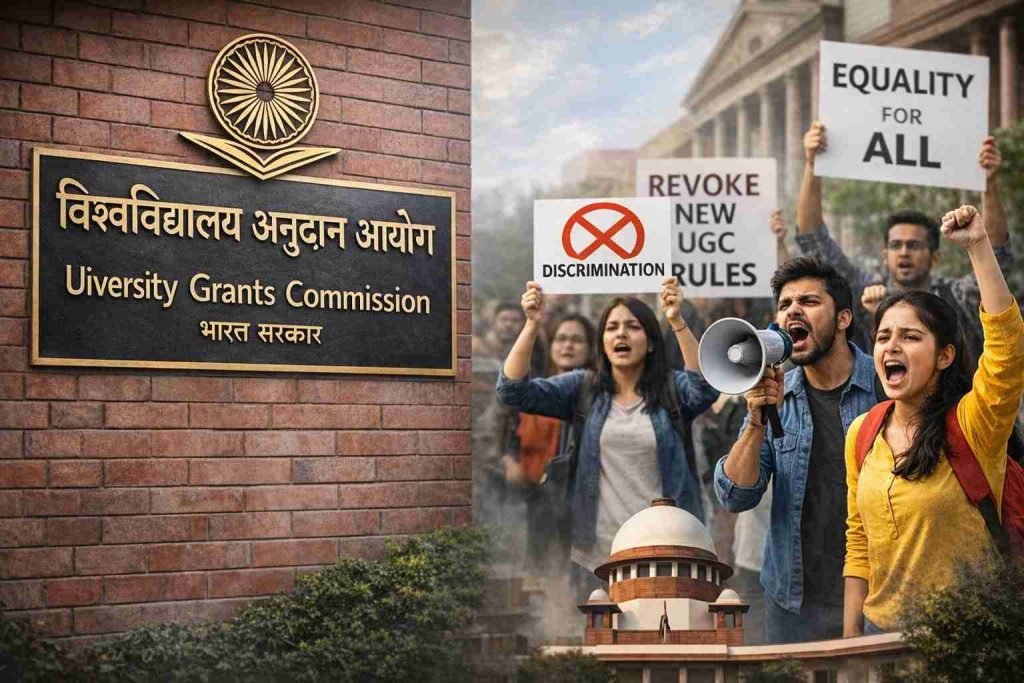
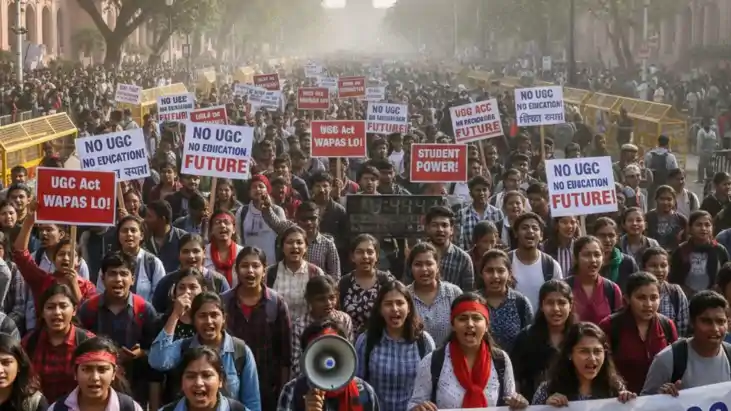
Across multiple campuses, the debate over the UGC has manifested in the form of protests, sit-ins, and heated discussions. In Delhi, students from various universities have organized demonstrations, alleging that the rules could create divisions rather than unity.
Some student leaders argue that while discrimination must be addressed, the new framework lacks clarity and safeguards against misuse. According to them, the debate over the UGC is not about opposing inclusivity but about ensuring balanced implementation.
In contrast, other student groups have welcomed the new rules, stating that discrimination—both overt and subtle—remains a harsh reality on campuses. For them, the debate over the UGC highlights long-standing structural inequalities that need urgent correction.
Allegations of Reverse Discrimination
One of the most contentious aspects of the debate over the UGC is the allegation of reverse discrimination. Critics argue that in attempting to protect marginalized communities, the rules may unintentionally disadvantage students from general or unreserved categories.
These critics claim that academic performance, research potential, and teaching excellence might be overshadowed by identity-based considerations. The debate over the UGC has thus raised a critical question: Can social justice and merit coexist without conflict?
Supporters of the rules counter these claims by asserting that merit cannot be viewed in isolation from social context. They argue that the debate over the UGC reflects discomfort with sharing academic spaces more equitably rather than genuine concerns about standards.
Dharmendra Pradhan Clarifies Government Stand
Amid the growing debate over the UGC, Union Education Minister Dharmendra Pradhan stepped forward to clarify the government’s stance. Addressing the media and stakeholders, he emphasized that the new anti-discrimination rules are rooted in constitutional values and aim to create a level playing field for all students.
Pradhan stated that the debate over the UGC should not be misinterpreted as a clash between merit and equality. According to him, the government firmly believes that inclusivity strengthens academic excellence rather than diluting it.
He also assured students and faculty that the rules would be implemented with sensitivity and transparency. Any grievances regarding misuse would be addressed through proper institutional mechanisms, he said, urging stakeholders not to politicize the debate over the UGC.
Role of Universities and Administrations
University administrations now find themselves at the center of the debate over UGC. Vice-chancellors and academic councils are tasked with implementing the guidelines while maintaining campus harmony.
Many universities have begun organizing workshops and town hall meetings to explain the rules to students and faculty. These initiatives aim to reduce misinformation fueling the debate over the UGC.
However, challenges remain. Some institutions lack the infrastructure or trained personnel to effectively run Equal Opportunity Cells. This has added another layer to the debate over the UGC, highlighting the need for capacity building and resource allocation.
Faculty Perspectives on the New Rules
Faculty members across disciplines have expressed mixed reactions, further enriching the debate over the UGC. Some professors view the rules as a progressive step that acknowledges the lived realities of marginalized students.
Others worry that excessive regulation could compromise academic freedom. For them, the debate over the UGC raises concerns about administrative overreach and potential interference in academic decision-making.
Despite differing opinions, there is consensus among many educators that discrimination—whether systemic or individual—must be addressed decisively. The debate over the UGC has thus prompted introspection within academic circles.
Legal and Constitutional Dimensions
The debate over the UGC also has significant legal implications. Legal experts have weighed in, noting that the rules align with Articles 14, 15, and 21 of the Indian Constitution, which guarantee equality and protection from discrimination.
However, questions remain about enforcement and interpretation. Could the rules lead to an increase in litigation? Will courts be asked to adjudicate disputes arising from alleged misuse? These questions add complexity to the debate over the UGC.
Media’s Role in Shaping Public Opinion
Media coverage has played a crucial role in amplifying the debate over the UGC. Television debates, opinion columns, and social media discussions have brought the issue into the national spotlight.
While some media outlets have focused on student protests and allegations of reverse discrimination, others have highlighted stories of marginalized students who benefited from similar protections. This diversity of narratives has shaped how the debate over the UGC is perceived by the public.

Political Responses and Opposition Views
Opposition parties have also weighed in on the debate over the UGC, accusing the government of either doing too little or overstepping its authority. Some leaders have expressed solidarity with protesting students, while others have urged caution and dialogue.
The government, meanwhile, maintains that the debate over the UGC should remain focused on educational reform rather than political point-scoring.
Impact on Students’ Mental Health and Campus Climate
An often-overlooked aspect of the debate over the UGC is its impact on students’ mental health. Prolonged uncertainty, protests, and polarized discussions can create stressful campus environments.
Counselors and student welfare bodies have called for constructive dialogue to ensure that the debate over the UGC does not lead to hostility or alienation among students.
Long-Term Implications for Higher Education
Looking ahead, the debate over the UGC may have lasting implications for India’s higher education system. If implemented effectively, the rules could foster more inclusive campuses and improve access for underrepresented groups.
Conversely, poor implementation could deepen divisions and erode trust. The outcome of the debate over the UGC will likely influence future policy decisions in education and beyond.
Need for Dialogue and Consensus
As the debate over the UGC continues, experts emphasize the importance of dialogue. Students, faculty, administrators, and policymakers must engage in open discussions to address concerns and refine the rules.
Dharmendra Pradhan’s call for constructive engagement reflects the government’s desire to move beyond confrontation. Ultimately, the debate over the UGC offers an opportunity to reimagine higher education as both excellent and equitable.
Conclusion
The debate over the UGC’s new anti-discrimination rules underscores the complexities of balancing equality, merit, and institutional autonomy. While student protests and allegations of reverse discrimination have highlighted genuine concerns, the government’s clarification has reaffirmed its commitment to inclusive education.
As campuses across India continue to grapple with these changes, the debate over the UGC serves as a reminder that education policy is not just about rules and regulations—it is about shaping the values and future of the nation.
Only through dialogue, transparency, and mutual respect can the debate over the UGC lead to meaningful reform that benefits all stakeholders in India’s vibrant and diverse academic landscape.
Read more latest news

