
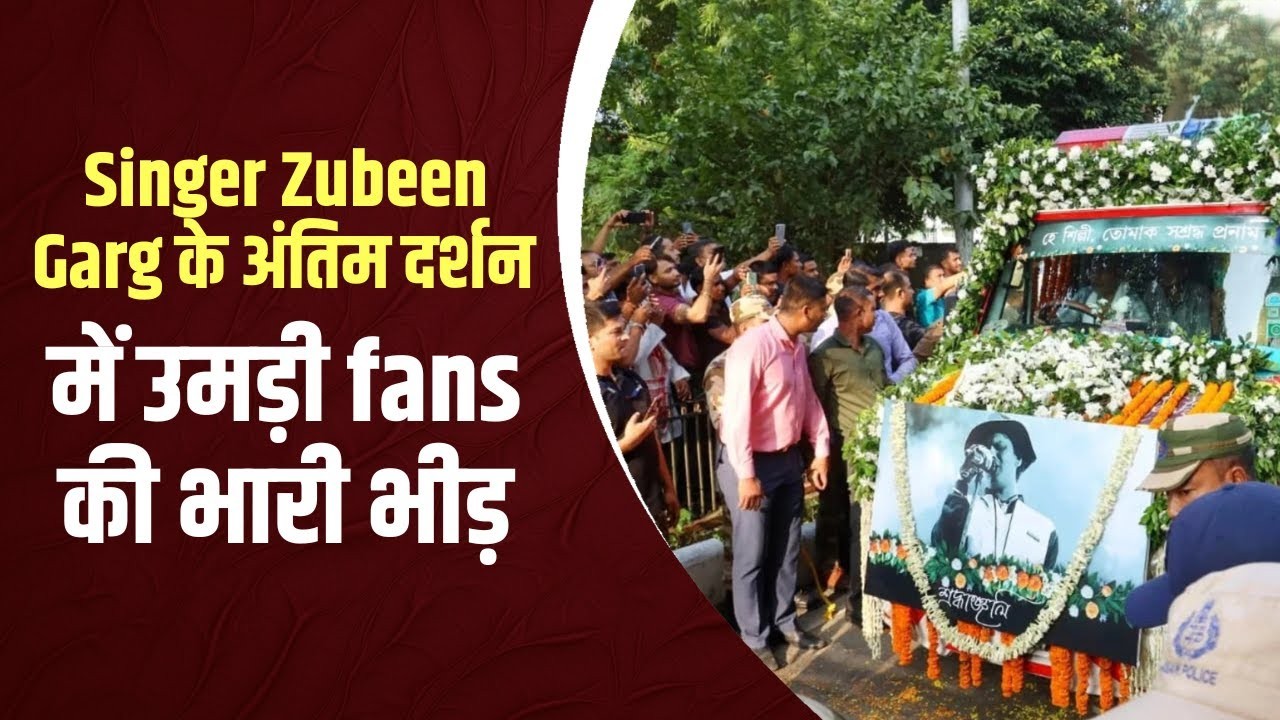
Last Farewell to Singer Zubeen Garg: A Sea of Emotions as Assam Bids Goodbye to Its Musical Legend.
Introduction
Last farewell to singer Zubeen Garg… A huge crowd has gathered to bid goodbye to their idol. Music has the power to transcend boundaries, touch hearts, and create legacies that outlive lifetimes. In Assam, one name has echoed through households, tea gardens, cultural events, and college corridors for decades—Zubeen Garg. Fondly called the “Heartthrob of Assam” and “Xopunor Manuh” (the man of dreams), Zubeen was not just a singer; he was an institution, an emotion, and a cultural icon.
On the day of his final farewell, a huge crowd gathered in the streets of Guwahati, silencing traffic and suspending everyday life. It was not just a funeral—it was the last chapter of a cultural saga that shaped modern Assamese identity. Men, women, children, and even the elderly came out in thousands, braving the scorching sun and long waits, just to catch a glimpse of their idol one last time.
This blog pays tribute to Zubeen Garg’s extraordinary journey, the farewell that turned into a people’s festival of grief, and the legacy he leaves behind.
The Man Behind the Legend
Born on 18 November 1972 in Jorhat, Assam, Zubeen Garg was a multi-talented personality. He was not only a playback singer but also a composer, lyricist, actor, director, and philanthropist. His father Mohini Mohan Garg and mother Ily Borthakur nurtured his passion for music, and from an early age, Zubeen was destined for greatness.
Zubeen’s rise was meteoric. His Assamese album Anamika became an instant hit in the 1990s, establishing him as a household name. Later, his Bollywood breakthrough with the song “Ya Ali” from the film Gangster (2006) catapulted him to national fame. The song became a youth anthem and remains one of the most loved tracks of its era.
But for Assam, Zubeen was more than just a Bollywood star. He recorded thousands of Assamese songs, penned soulful lyrics, acted in films, and actively participated in regional cultural movements. He was equally at home singing in Assamese, Hindi, Bengali, Tamil, Telugu, Marathi, Nepali, and more.
The Day of Farewell
The day of Zubeen’s farewell was unlike any other in Assam’s recent memory. Streets were flooded with people—students in uniforms, office-goers who took leave, housewives carrying flowers, and villagers who traveled miles just to be part of history.
The body of Zubeen Garg, draped in the Assamese gamosa (traditional cloth symbolizing respect), was carried in a grand procession. The vehicle was adorned with flowers, pictures, and speakers playing his timeless melodies. Songs like “Ya Ali”, “Moi Eti Zazabor”, and “Mayabini Ratir Xur” floated in the air, turning grief into collective remembrance.
People showered petals, waved the Assamese flag, and chanted slogans:
- “Zubeen da amar hou!” (Zubeen da, you are immortal!)
- “We love you Zubeen!”
- “Long live the voice of Assam!”
It was not a silent mourning—it was a thunderous celebration of a life that touched millions.

Emotional Scenes
The visuals of Zubeen’s last rites were heart-wrenching yet deeply moving:
- Family and Friends – His wife Garima Saikia Garg, close relatives, and fellow artists were seen breaking down as they performed the rituals.
- Fans in Tears – Many young fans collapsed in emotion, some even refusing to believe that their idol had passed away.
- Cultural Tributes – Bihu dancers, dhol players, and folk artists performed during the procession as a mark of respect.
- Political Leaders and Celebrities – Ministers, opposition leaders, and Bollywood personalities paid tribute, calling Zubeen the “bridge between Assam and the world.”
Even those who never met him in person felt the weight of personal loss. For many Assamese families, Zubeen’s songs had been the soundtrack of weddings, picnics, heartbreaks, and festivals.
Zubeen Garg’s Musical Legacy
Zubeen’s discography is so vast that it is nearly impossible to list it all. He sang in over 40 languages and recorded more than 30,000 songs, a feat achieved by very few singers globally.
Some highlights of his career:
- Bollywood Fame
- Ya Ali (Gangster, 2006)
- Dil Tu Hi Bata (Krrish 3, 2013)
- Ya Ali Reham Ali (various remixes and versions)
- Assamese Classics
- Mayabini Ratir Xur
- Ei Mon Jochona
- Moi Eti Zazabor
- Pakhi Pakhi Mon
- Bengali and Regional Songs
- Gained a massive fan following in West Bengal and Bangladesh with romantic ballads and folk adaptations.
- Film Industry Contributions
- Acted in Assamese films like Dinabandhu, Mission China (which he also directed), and many more.
- Philanthropy Through Music
- He often organized concerts to raise funds for flood victims in Assam and other humanitarian causes.
Zubeen: The People’s Voice
What made Zubeen unique was not just his music but his deep connection with people. Unlike many celebrities who stayed aloof, Zubeen remained accessible. He often mingled with fans, performed free shows for causes, and never hesitated to speak his mind on social issues.
He actively raised his voice for:
- Flood Relief in Assam – Year after year, he donated and raised money.
- Regional Identity – He was vocal about protecting Assamese culture and language.
- Youth Empowerment – Encouraging aspiring singers and artists to dream big.

Reactions Across Assam and Beyond
The news of Zubeen Garg’s passing triggered a wave of grief not just in Assam but across India and even among Assamese diaspora worldwide.
- In Guwahati – Markets shut down voluntarily, and cultural institutions lowered their flags.
- In Delhi & Mumbai – Assamese student unions held candle marches.
- In Bangladesh – Fans organized musical tributes, showing his cross-border influence.
- On Social Media – Hashtags like #ZubeenLivesOn and #GoodbyeZubeen trended globally.
The Irreplaceable Loss
Assam has produced legendary singers like Bhupen Hazarika, Jayanta Hazarika, and now Zubeen Garg. With his departure, many fear a vacuum in Assamese music that cannot be easily filled.
Cultural critics noted:
- Bhupen Hazarika was the voice of Assamese struggles and identity.
- Zubeen Garg was the voice of Assamese youth and aspirations.
Together, they defined eras of cultural pride. Zubeen’s passing marks the end of a golden chapter.
What Zubeen Garg Means to Assam
For Assam, Zubeen was not just an entertainer. He was:
- A Cultural Ambassador – Bringing Assamese songs to global platforms.
- A Social Worker – Using fame for humanitarian causes.
- A Symbol of Hope – Inspiring small-town youths to achieve greatness.
Children in Assam grew up trying to sing like him. For many, he was the first introduction to the power of music. His humility and eccentric personality made him both relatable and larger than life.
The Eternal Voice
As the funeral pyre was lit, chants of “Zubeen da amar hou!” echoed. The fire consumed the body, but the spirit of Zubeen Garg lives on in his countless songs. His voice will continue to play in Assamese homes, tea gardens, cafes, and hearts for generations.
Legends never truly die—they transform into eternal voices that guide the cultural soul of a people. Zubeen Garg’s last farewell was proof that he belonged not just to his family but to millions who claimed him as their own.
Conclusion
The final farewell to Zubeen Garg was not merely a funeral—it was a people’s festival of remembrance, a display of how deeply music can intertwine with life and identity. He may no longer walk among us, but his songs will echo wherever Assamese hearts beat.
From “Ya Ali” to “Moi Eti Zazabor”, from Bollywood fame to grassroots activism, Zubeen’s life was a melody of passion, struggle, and triumph. Assam’s tears and chants on his farewell day proved one thing beyond doubt: Zubeen Garg was not just a singer; he was a phenomenon who will live forever.
Read more latest news

