

What is GST 2.0?
Before diving into what gets cheaper, it’s essential to understand what “GST 2.0” refers to. Essentially, this is a major overhaul / rationalisation of the Goods & Services Tax regime in India. Key features include:
- Simplified tax slabs: The earlier set of 5%, 12%, 18%, 28% (plus additional “cesses” on certain items) is being changed. Now the standard structure is mostly two slabs — 5% and 18% — with a third, higher slab of 40% for “sin” goods and luxury items.
- Elimination or reduction of tax rates on many items previously taxed at 12% or 28%.
- Exemptions (i.e., 0% GST) on a limited but important set of items (mainly food staples, basic bread items, etc.).
GST 2.0 came into force from 22 September 2025. That date coincided with Navratri, and was chosen partly to overlap a festive consumption period.
With that background, here are the specifics of what is becoming cheaper under these reforms.
What Will Become Cheaper Under GST 2.0
The government of PM Modi has identified a wide range of products and services that will see reduced tax burdens, leading to lower retail/consumer prices (assuming makers / retailers pass on the benefits). Below are the major categories, with examples.
| Category | What items are affected | Tax change | Why it matters / how much cheaper |
|---|---|---|---|
| Food & Essential Grocery Items | Staples / breads / dairy etc. – UHT milk, paneer (chhena), “roti, paratha, parotta, chapati” etc. Packaged foods like butter, ghee, cheese, sausages, pasta, sauces, jams, ketchup, chocolate, biscuits, breakfast cereals, dry fruits etc. Namkeen, bhujiya, mixtures etc. | Many items are moving from 12% or 18% GST down to 5%, or even from 5% to 0% (exempt) in case of basic breads / staple food items. | For consumers, this means everyday grocery bills go down. If for example someone buys a kilo of butter, or regular snacks etc., those savings add up. Also festivity periods (e.g., Diwali, Navratri) could see more pronounced benefits. |
| Household / FMCG Essentials | Items like hair oil, toilet soaps, shampoos, toothpaste, toothbrushes, shaving cream, etc. Also tableware, kitchenware, small utensils etc. | These were typically in the 12% or 18% slabs; many are down to 5%. | These are recurring household expenses, so even small percentage drops will make a difference over time. |
| Healthcare & Medicines / Medical Devices | Life-saving / critical medicines, diagnostic kits, design‐corrective items like spectacles / goggles, medical grade oxygen, thermometers etc. | Many of these move from 12% to either 5% or 0% in some cases. | This can reduce medical out-of-pocket costs for many, especially those with chronic or serious illnesses. |
| Household Durables / Appliances / Consumer Electronics | Items like air conditioners, dishwashers, large TVs, refrigerators, other home appliances etc. | Many of these are shifting from 28% down to 18%. | For big-ticket household items, this is a substantial saving. Even a few percentage points on a high-value appliance can be thousands of rupees. |
| Automobiles & Transport | Small cars: petrol / CNG under 1200cc, diesel under 1500cc; motorcycles up to 350cc; three‐wheelers etc. | These move from the prior 28% slab to 18%. | For buyers of compact cars, or those buying 2/3 wheelers, this reduces one of the major cost components (tax). Likely to increase affordability and demand. |
| Construction / Housing Inputs | Cement and similar materials; marble, granite; building materials etc. Items needed for construction and housing inputs. | These are moving from 28% or higher slabs to 18% (or some even from 12% to 5%, depending on the item). | Reduces the cost of construction and housing—both for developers and end buyers. Could also moderate the rise in real‐estate prices somewhat. |
| Education Supplies | School / education essentials: notebooks, pencils, erasers, maps, globes etc. | These are moving to nil / 0% GST from previously taxed slabs. | For families with children, reduces cost of schooling materials; especially helpful for low‐ and middle-income families. |
What PM Modi / Govt Have Claimed / Promised
Several statements from PM Modi and related government sources emphasize:
- That the GST rationalisation is aimed at benefiting the common man, farmers, MSMEs (Micro, Small, Medium Enterprises) etc.
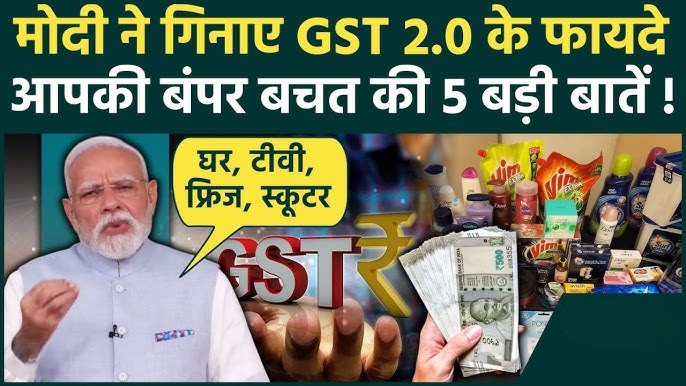
- “Sabka muh meetha hoga” (“everyone’s mouth will be sweet”) was a phrase used by Modi when announcing that many sweets, confectioneries, mass-consumption items like ghee, jam, ice cream etc will become cheaper.
- The government has asserted that through simplification, consumers will see real savings in bills (groceries, home appliances, groceries, autos).
Examples of Price Cuts Already Announced / Observed
To move beyond theory, here are some observed / officially announced price reductions / savings:
- Namkeen & Sweet Industry (Indore example): Many namkeen items, sweets, bakery goods that earlier fell under higher slabs have moved to 5%. For some namkeen like Ratlami sev, laung sev, etc., the dropout in GST has led to a price reduction of Rs 20-30 per kg in certain cases.
- Automobiles: Maruti Suzuki has announced cuts on models like Alto, Swift, Brezza etc., passing on the reduced GST to customers. Some price drops are up to ₹1.29 lakh.
- Electricity bills: In Madhya Pradesh, for consumers using ~300 units, savings of about ₹60 per month are expected due to removal of certain compensation cesses (though some GST on coal increased, net effect is a drop) once the billing adjustments settle in.
- Packaged drinking water (Rail Neer, etc.): Prices have been reduced. Example: one-litre bottles reduced from ₹15 to ₹14; half-litre from ₹10 to ₹9.
Estimating the Impact
How much will ordinary households or consumers benefit? It depends on what one buys. Some observations and estimates:
- Goods which are used frequently (daily essentials, snacks, toiletries) will have small per‐item savings, but over time (monthly grocery + household budget) these can add up significantly.
- Big‐ticket purchases (appliances, small cars) will see larger absolute savings because the base price is higher. For example, moving from 28% to 18% tax reduces tax component by ~10% of the value. On a car worth ₹8-10 lakh, that’s sizeable.
- For middle class and poorer households, the biggest relief is likely from food & essential items + school supplies + medicines.
The government has said these reforms, along with income tax changes, will result in savings of about ₹2.5 lakh crore for citizens.
What Remains To Be Seen / Challenges
While many items are slated to become cheaper, there are several caveats:
- Passing on the benefits
For price cuts to reach consumers, manufacturers / distributors / retailers must reduce their MRP / selling price. Sometimes they may retain old price margins, or slow to adjust. - Cost of inputs & supply chain issues
Tax is only one part of cost. Transport, raw materials, energy costs, labour can still keep prices high. Reductions might be partly offset by other cost increases (inflation, logistic costs etc.). - Effect of higher slabs on “sin / luxury” goods
While many everyday items get relief, goods considered luxury or “demerit” (e.g. aerated drinks with sugar, high-powered motorcycles, expensive cars, tobacco / pan masala etc.) face steeper taxes (40%). For people purchasing or consuming those, costs will go up. - Timing of changeover / billing system delays
Some savings may take time to reflect (e.g. power bills, where fuel purchase adjustments have delays). Also, older stock, packaging, inventories with old GST may complicate or delay visible changes. - Variation across states
Since in India GST is a Central + State tax (CGST + SGST), implementation / notifications by states could affect how quickly rate changes are enforced or how adjustments happen.
Conclusion: What This Means for the Average Consumer
For a family buying groceries, buying daily toiletries, occasional appliances, maybe a small car – GST 2.0 brings good news. The tax burden on many essential and semi-essential items is lowering, meaning more disposable income, or the same budget buying more.
For purchases like car, bikes under certain engine sizes, household appliances, the savings are more significant. Schools supplies and medicines also contribute to relief.
However, for luxury / sin goods, the tax burden increases, which is by design (both to discourage overconsumption, raise revenue, and keep equity).
If the government, industry, and retailers ensure that MRPs and store price tags are revised properly, the benefits can reach people swiftly.
Read more latest news

