

CM Yogi Adityanath Explains the Meaning of ‘Ram Rajya’ During Bihar Campaign: “Only NDA Can Bring This”
In the heat of the CM Yogi Bihar election campaign, Chief Minister CM Yogi Adityanath once again brought the theme of cultural nationalism and good governance to the forefront. Addressing a massive rally in the heart of Bihar, CM Yogi passionately explained the real essence of ‘Ram Rajya’, declaring that only the NDA (National Democratic Alliance) can bring such a system to life in modern India. His speech was not just political—it carried a philosophical and emotional undertone, connecting deeply with the cultural roots of Indian society.
This statement, while rooted in spiritual symbolism, also carried a strong political message. As Bihar gears up for another high-stakes election, CM Yogi Adityanath’s articulation of ‘Ram Rajya’ seeks to remind voters of the BJP’s core ideology—development with dharma, governance with morality, and leadership rooted in cultural integrity.
Understanding the Context of CM Yogi’s Remark
The Bihar elections have always been a political battleground where the narrative of governance, caste, and identity plays out intensely. Amid the opposition’s constant attacks on the NDA government, Yogi Adityanath’s intervention is designed to bring a sense of clarity and emotional connect.
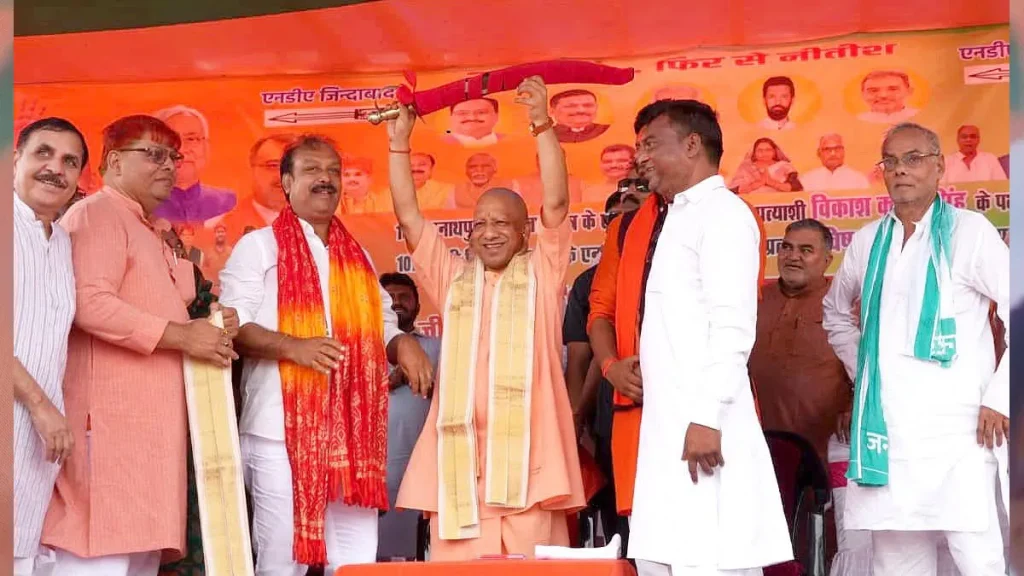
Standing before thousands of supporters waving saffron flags, CM Yogi said,
“Ram Rajya is not about temples and rituals alone. It’s about justice, equality, welfare, and development for all. It’s about a government that treats every citizen like Lord Ram treated his subjects—with fairness, love, and responsibility. And only NDA can bring such Ram Rajya in Bihar.”
The crowd erupted in cheers as the Uttar Pradesh CM linked spiritual heritage with political reality.
‘Ram Rajya’: The Ideological Foundation
To understand the depth of CM Yogi’s remark, it’s essential to revisit what ‘Ram Rajya’ truly means. In Hindu philosophy and in Indian political thought since independence, Ram Rajya is symbolic of an ideal state—a vision of governance based on truth, justice, prosperity, and inclusivity.
Mahatma Gandhi himself often referred to Ram Rajya not as a theocratic system but as a form of moral governance, where rulers serve selflessly and people live harmoniously.
CM Yogi Adityanath, representing the BJP’s Hindutva ideology, has consistently argued that the concept of Ram Rajya aligns perfectly with Prime Minister Narendra Modi’s vision of “Sabka Saath, Sabka Vikas, Sabka Vishwas”.
In this way, CM Yogi’s statement during the Bihar campaign is not isolated—it’s part of a larger narrative of moral politics and developmental nationalism.
Why CM Yogi’s Statement Matters in Bihar’s Political Landscape
Bihar is not just another state—it’s a political laboratory where every ideology, alliance, and leadership style has been tested. From the days of Jayaprakash Narayan’s movement to Lalu Prasad Yadav’s “social justice” politics and Nitish Kumar’s “sushasan” (good governance), Bihar’s politics has seen constant transformation.
Now, as the NDA attempts to regain momentum amid a strong opposition led by the RJD-Congress alliance, CM Yogi Adityanath’s campaign has become a major factor.
His use of religious symbolism combined with developmental messaging appeals to multiple voter bases—youth, women, farmers, and even those seeking moral governance.
CM Yogi said,
“Ram Rajya means safety for women, respect for the poor, development for villages, and punishment for criminals. When NDA is in power, you can sleep peacefully. When jungle raj returns, fear takes over.”
This statement clearly draws a contrast between the NDA’s governance model and what the BJP often calls the “misrule” of previous RJD governments.

‘Jungle Raj’ vs. ‘Ram Rajya’: The Political Contrast
In Bihar, the term ‘Jungle Raj’ is politically loaded—it represents an era of lawlessness and crime that the BJP and JD(U) often associate with RJD’s earlier rule.
By presenting ‘Ram Rajya’ as the opposite of ‘Jungle Raj’, CM Yogi Adityanath masterfully turns the ideological narrative in favor of the NDA.
The BJP’s messaging has been consistent:
- ‘Jungle Raj’ = chaos, corruption, and caste politics.
- ‘Ram Rajya’ = discipline, development, and justice.
This contrast helps the NDA frame itself as the protector of law and order, an image that Yogi Adityanath himself embodies through his governance in Uttar Pradesh.
The Developmental Dimension of Ram Rajya
Yogi’s articulation of Ram Rajya was not purely spiritual. He linked it directly with infrastructure, welfare, and education, emphasizing that Bihar can only progress when peace and order are maintained.
He listed multiple development schemes launched by the central government—such as Pradhan Mantri Awas Yojana, PM Kisan Samman Nidhi, Ujjwala Yojana, and Ayushman Bharat—and described them as “steps toward Ram Rajya.”
“When every poor family gets a roof over their head, when no mother has to cook with smoke, when every youth has a job opportunity—that is Ram Rajya. And this is what PM Modi and the NDA are doing.”
Through this, Yogi sought to connect ancient ideals with modern welfare policies, reinforcing the BJP’s narrative that it doesn’t just talk about cultural pride—it delivers real change.
Cultural Symbolism in Bihar’s Campaign
Bihar, a land deeply tied to India’s spiritual and cultural roots, responds strongly to religious imagery and moral narratives. The BJP has always used this connection effectively, invoking historical and mythological references to rally public emotion.
In invoking Lord Ram, Yogi is not just appealing to religious sentiment—he’s tapping into the idea of moral order and just governance, something many voters yearn for.
At the same time, the NDA campaign in Bihar has smartly blended Hindutva with pragmatism—celebrating faith while emphasizing jobs, roads, safety, and welfare.
Opposition’s Response: A Clash of Narratives
Predictably, Yogi Adityanath’s statement drew criticism from the opposition parties. RJD spokespersons accused the BJP of diverting attention from real issues like unemployment and inflation by talking about religious concepts.
RJD leader Tejashwi Yadav responded,
“People don’t want lectures on Ram Rajya; they want employment and education. The youth of Bihar need opportunities, not slogans.”
The Congress also echoed similar sentiments, claiming that Yogi’s remarks were an attempt to polarize voters along religious lines.
However, the BJP maintains that Ram Rajya is not about religion—it’s about governance and accountability.
Yogi Adityanath’s Role in the NDA’s Bihar Strategy
CM Yogi has emerged as one of the NDA’s star campaigners. His speeches resonate beyond UP, appealing to the broader Hindi heartland sentiment.
In Bihar, he symbolizes strong leadership, administrative control, and cultural pride—qualities the NDA wants to highlight as contrasts to the opposition.
By using the concept of Ram Rajya, Yogi not only reinforces the BJP’s ideological base but also projects the alliance as morally upright and development-oriented.
This combination of faith and progress, devotion and delivery, is the foundation of the NDA’s electoral messaging.
Historical Parallels: Ram Rajya as a Political Vision
Since the early years of Indian politics, ‘Ram Rajya’ has been invoked by multiple leaders—from Gandhi to Vajpayee. Each leader interpreted it differently.
- Mahatma Gandhi saw it as a moral and ethical democracy, where the weakest are protected.
- Atal Bihari Vajpayee used it to symbolize honest governance and cultural confidence.
- Yogi Adityanath now extends it to mean strong, disciplined, and development-driven administration.
This evolution shows how the concept remains timeless, adaptable to contemporary needs while rooted in eternal values.
Bihar’s Response: Faith Meets Development
Reports from ground-level campaigns suggest that Yogi’s message has struck a chord, especially in rural and semi-urban areas. Voters relate to the moral undertone of Ram Rajya but also appreciate the government schemes tied to it.
In areas where law and order and corruption remain key concerns, Yogi’s assertion that “only NDA can bring Ram Rajya” resonates strongly.
For many, it’s not just about religion—it’s about trust, security, and hope for better governance.
The Larger Message: From Ayodhya to Bihar
Yogi’s statement comes at a time when Ayodhya’s Ram Mandir construction has become a national symbol of cultural revival. Linking Bihar’s governance goals with the ideals of Ram Rajya ties together faith, nationalism, and governance in one emotional narrative.
It also aligns perfectly with PM Modi’s broader vision of ‘New India’, where infrastructure and spirituality coexist.
Thus, Yogi’s campaign message carries both symbolic and practical weight—it assures voters of development, law, and justice, while invoking pride in India’s civilizational ethos.
Conclusion: The Political Philosophy of Ram Rajya
When Yogi Adityanath said,
“Only NDA can bring Ram Rajya,”
he was not just making an election promise—he was outlining a philosophy of governance rooted in cultural integrity and modern progress.
In his vision, Ram Rajya represents:
- A state free from corruption and fear.
- Justice and opportunity for all citizens.
- Economic growth aligned with moral responsibility.
- Leadership that serves rather than rules.
As Bihar moves closer to elections, the battle lines are clear: between Ram Rajya and Jungle Raj, development and decay, faith and fear.
For the NDA, Yogi Adityanath’s message may become one of the most defining themes of this campaign—an appeal not just to religion, but to conscience.
Read More latest news

