

Union Minister Lallan Singh Breaks Silence on Viral Video Controversy: “Watch the Full Video, the Truth Will Come Out”
Lallan Singh commented on the viral video As the campaign dust settles in Bihar and the state braces for the first phase of assembly elections on November 6, political temperatures remain at a peak. Just as the campaign period concluded for 121 crucial constituencies, a viral video controversy erupted on social media, threatening to sway public opinion in the final hours. Amid the chaos of rumors, counterclaims, and political allegations, Union Minister and senior Janata Dal (United) leader Lallan Singh has stepped forward, urging calm and caution.
His statement — “Watch the full video, the truth will come out” — has sparked widespread debate, not only about the content of the video but also about the larger issue of fake news, selective editing, and media manipulation in Indian elections. Lallan Singh’s remark, made just hours after the campaign period closed, carries significant political weight as Bihar heads toward one of its most closely watched elections in recent years.
The Political Climate in Bihar Before the First Phase Lallan Singh
Bihar’s 2025 Assembly elections are being seen as a litmus test for both the ruling NDA coalition and the opposition INDIA alliance, which includes the RJD, Congress, and Left parties. With Chief Minister Nitish Kumar leading the NDA’s charge and Tejashwi Yadav energizing the opposition with promises of change, the campaign has been marked by aggressive rhetoric, emotional appeals, and digital battles.
The first phase of polling, covering 121 seats, is critical. These constituencies span multiple regions — from Magadh and Mithilanchal to parts of southern Bihar — each with its own unique caste arithmetic and developmental issues. The end of the campaign period, usually a time of quiet before voting, has instead been punctuated by the circulation of a mysterious viral video involving a senior political figure.
It was in this charged atmosphere that Union Minister Lallan Singh intervened with his characteristic calm and clarity.
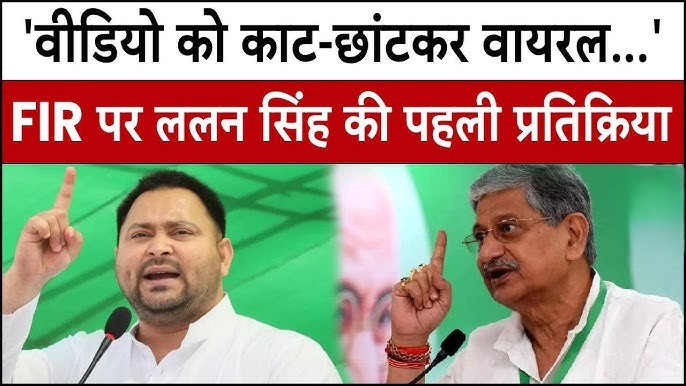
Lallan Singh’s Statement: A Call for Context and Patience
Lallan Singh, known for his pragmatic and composed political style, addressed the media soon after the controversy gained traction. Without directly naming the person in the viral clip, he said,
“In this era of social media, anyone can take a small part of a video and make it viral with false claims. I urge everyone to watch the full video. The truth will come out once you see it completely. People should not fall for such tricks, especially before the elections.”
His words were measured yet firm — signaling the NDA’s confidence that context and truth would eventually outweigh misinformation and manipulation.
Singh’s approach contrasts sharply with the reactive tone adopted by other leaders on both sides of the aisle. By appealing to logic and evidence rather than emotion, he sought to neutralize what the NDA perceives as an orchestrated attempt to mislead voters during the 48-hour silent period before polling.
The Viral Video: What Is Known So Far
While neither Lallan Singh nor the Election Commission has disclosed details of the viral clip, political observers suggest it features a selectively edited interaction or statement that may have been designed to embarrass a particular party or leader.
In today’s digital politics, such incidents are not rare. Over the last few election cycles, social media platforms like X (formerly Twitter), Facebook, and WhatsApp have become key battlegrounds for shaping public opinion. A small, clipped video—often taken out of context—can trend within minutes, influencing undecided voters or reinforcing partisan beliefs.
In Bihar’s high-stakes election, where narratives are everything, this particular clip seems to have been weaponized to target the NDA, especially in districts where the margins are expected to be thin.
The Election Commission has reportedly sought a report from its cyber monitoring teams, who have been keeping an eye on digital content since the model code of conduct came into effect.
Election Commission’s Role: A Tightrope Walk
The Election Commission (EC) has a tough job during elections—ensuring free and fair polls while also addressing the unprecedented challenge of viral misinformation. In this case, since the campaign period has officially ended, political parties are barred from making new appeals or holding rallies.
However, social media remains a gray zone.
The EC’s spokesperson confirmed that they are aware of the video’s circulation and that a fact-check team is verifying its authenticity.
Such incidents underline a growing issue in Indian democracy: the intersection of technology, propaganda, and electoral ethics. Political analysts say that the viral video controversy highlights the fragility of truth in digital campaigning.
As one senior observer put it, “What used to be fake pamphlets in the 1990s are now fake videos in the 2020s.”

Lallan Singh’s Political Persona: A Voice of Stability
To fully understand why Lallan Singh’s words carry weight, one must consider his political journey. A seasoned leader from Bihar and one of Nitish Kumar’s closest confidants, Singh represents a brand of sober, development-oriented politics in a state often driven by emotion and caste equations.
Known for his administrative clarity and command over grassroots politics, Singh has built a reputation for fact-based communication. As a Union Minister and JD(U) stalwart, he often plays the role of the government’s defender in tricky situations — whether on issues of coalition management, opposition attacks, or controversies like the present one.
By saying, “Watch the full video, the truth will come out,” he was not merely dismissing the controversy — he was reaffirming his party’s commitment to transparency and indirectly accusing the opposition of spreading misinformation.
Digital Warfare in Modern Elections
The Bihar elections, like several other recent polls in India, are being fought on the ground and online simultaneously. Political parties now invest heavily in social media teams, WhatsApp groups, and micro-influencers.
Every speech, gaffe, or rally can become viral content within seconds. This environment has both democratized and destabilized electoral communication.
Fake news detection agencies have reported that dozens of edited videos have circulated in the last two weeks alone, many of them designed to create confusion among voters.
Lallan Singh’s warning against such viral content therefore resonates with a larger concern — how misinformation is eroding the trust of the electorate.
“Our democracy is strong, but it depends on informed citizens. People must not believe everything they see online,” Singh emphasized during his press interaction.
NDA’s Strategic Communication Ahead of Polls
The NDA, led by Nitish Kumar’s JD(U) and the BJP, has been campaigning aggressively on the themes of law and order, infrastructure, women’s safety, and welfare schemes. The alliance has sought to project Bihar as a state that has moved past the “jungle raj” era and entered a new phase of development-driven governance.
Yogi Adityanath, Amit Shah, and several other top BJP leaders have joined Nitish Kumar in campaigning across the state. Their narrative has centered around stability, safety, and continuity.
In contrast, the RJD-led opposition has accused the NDA of failing to generate jobs and neglecting rural Bihar.
In such a tightly contested environment, a viral video controversy has the potential to swing votes in a few key constituencies. Hence, Lallan Singh’s prompt response is seen as a damage-control move that seeks to prevent last-minute misinformation from shaping voter sentiment.
Voters React: Confusion, Curiosity, and Concern
On the ground, the reaction to the viral video has been mixed. While some voters expressed confusion and skepticism, many said they were tired of such distractions.
In Nalanda, Gaya, and Patna, local reports suggest that several voters viewed Lallan Singh’s statement as credible, believing that “something was definitely edited” in the video. Others, however, felt that both sides were using social media propaganda as a political weapon.
A voter in Gaya told a local news channel,
“Elections have become like a TV serial — one twist after another. We just want good governance, not drama.”
This sentiment reflects a growing maturity among Bihar’s electorate, who are increasingly aware of the difference between digital sensationalism and real governance issues.
The Bigger Picture: Truth in the Age of Disinformation
Lallan Singh’s statement also opens up a broader debate — how should Indian politics handle the avalanche of manipulated digital content that floods the internet during elections?
While the Election Commission has tried to regulate campaign speech and expenditure, digital content remains largely unmonitored, especially on private messaging platforms.
Analysts argue that media literacy among voters and responsible journalism are essential to safeguard democracy in this era of viral misinformation.
By emphasizing the importance of watching the full video, Lallan Singh essentially made a plea for context over virality, facts over emotion. His statement could serve as a reminder of responsible citizenship in a democracy increasingly driven by short clips and clickbait narratives.
What Lies Ahead: Bihar Votes on November 6
As Bihar prepares for the first phase of voting, the atmosphere remains intense but hopeful. The Election Commission has finalized all arrangements, with additional security forces deployed across sensitive constituencies.
According to the schedule, voting for the remaining phases will follow later in November, culminating in results expected by early December.
The 121 seats in the first phase could well set the tone for the rest of the election, especially if voter turnout remains high. The NDA’s strategy appears focused on defending its developmental record, while the opposition banks on anti-incumbency and youth dissatisfaction.
The viral video controversy, though momentarily disruptive, may fade as the focus shifts back to real issues like employment, education, healthcare, and rural welfare.
Conclusion: Lallan Singh’s Statement as a Lesson in Political Communication
Union Minister Lallan Singh’s calm, logical, and measured response to the viral video controversy stands out as a model of responsible political communication. In an age when outrage often dominates discourse, his advice — “Watch the full video, the truth will come out” — embodies a much-needed call for critical thinking and digital responsibility.
As Bihar heads into a crucial election, Singh’s statement is more than a rebuttal; it is a reminder that democracy functions best when truth is sought, not assumed.
The coming days will reveal whether the controversy impacts voting behavior, but one thing is certain — Bihar’s election is a reflection of India’s evolving political consciousness, where voters, leaders, and institutions must navigate the challenges of misinformation with patience and wisdom.
In the end, truth — like democracy — takes time, but it always prevails.
Read More latest news

