
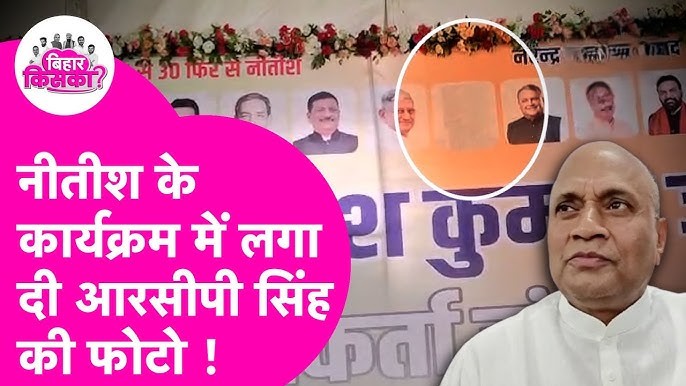
A Major Mistake Found in the Poster Displayed on CM Nitish’s Stage in Sasaram, Including the Photo of Jansuraj Leader RP Singh
Introduction
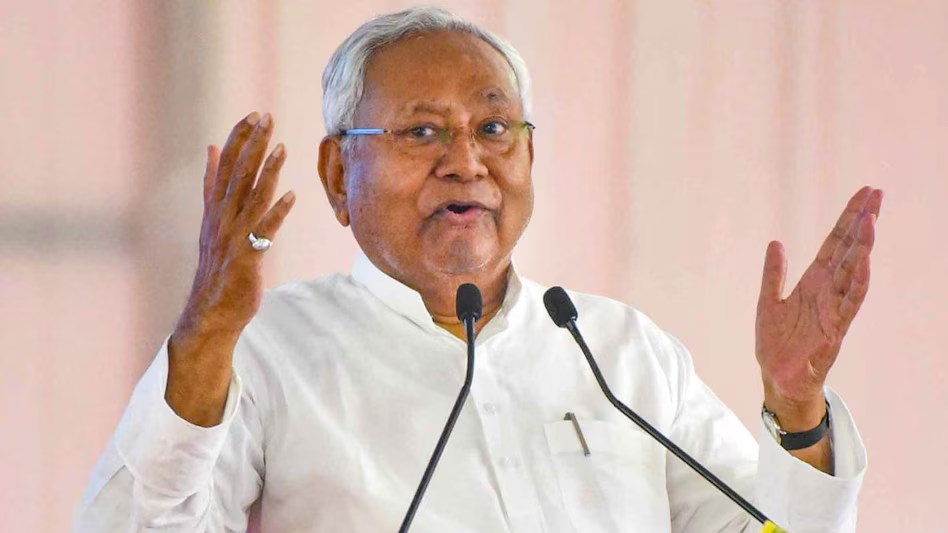
Politics in Bihar is never short of drama, surprises, and controversies. Chief Minister Nitish Kumar, a seasoned politician with decades of experience, is well-known for his carefully managed public image and stage appearances. However, a major blunder recently stole the spotlight during his rally in Sasaram.
On the grand stage, where Nitish Kumar addressed thousands of people, a poster displayed behind him included the photo of Jansuraj leader RP Singh — a political rival. The mistake, though apparently a simple error in poster design and verification, has triggered a storm in Bihar’s political circles.
The incident raises questions about event management, political symbolism, and the battle of narratives in Bihar’s ever-shifting political landscape. Was it merely a designer’s mistake, a lapse in the local administration, or something more — perhaps even an intentional act by rival camps to embarrass Nitish Kumar?
This blog takes a deep dive into the Sasaram stage controversy, exploring the background of Nitish Kumar’s rally, the role of RP Singh in Bihar politics, reactions from different camps, and the larger implications for Bihar’s coalition politics.
The Sasaram Rally: A Quick Recap
The rally in Sasaram was meant to be one of Nitish Kumar’s carefully crafted outreach events.
- The CM was scheduled to address developmental issues, welfare schemes, and governance achievements of his government.
- The stage was decorated with banners and posters showcasing leaders of the Janata Dal (United), prominent local figures, and government slogans.
- Media cameras were rolling, capturing every detail of the event for regional and national coverage.
But amid all this grandeur, a glaring mistake stood out: the photo of Jansuraj leader RP Singh, prominently displayed on the main backdrop alongside Nitish Kumar and his party leaders.
Who is RP Singh?
To understand why this mistake caused such a stir, one must know who RP Singh is.
- RP Singh is a leader associated with the Jansuraj movement, which positions itself as an alternative to traditional parties in Bihar.
- Known for his fiery speeches and criticisms of the Nitish government, he has been vocal about issues like unemployment, corruption, and lack of development in rural Bihar.
- His political journey has been marked by grassroots activism and mobilizing youth in regions like Bhojpur and Rohtas.
For Nitish Kumar, a seasoned player navigating between JD(U), BJP, and INDIA alliance politics, having RP Singh’s photo on his stage was nothing less than a political embarrassment.
The Poster Mistake: What Actually Happened?
Reports suggest the poster design was handled by local organizers and printed in bulk. The inclusion of RP Singh’s photo happened due to:
- Confusion in Names/Images: RP Singh’s name or photograph might have been confused with another local leader of similar appearance or name.
- Deliberate Mischief: Some allege this could have been sabotage, with rivals planting the wrong photo to create embarrassment.
- Lack of Verification: Event managers and JD(U) workers failed to thoroughly verify the posters before they were displayed on stage.
Whatever the reason, the outcome was clear: Nitish Kumar stood in front of a backdrop carrying the image of a leader who openly challenges his authority.
Opposition’s Reaction: Seizing the Opportunity
The opposition wasted no time in capitalizing on this blunder.
- RJD leaders mocked Nitish Kumar, saying that even his organizers no longer recognize who belongs to his party and who doesn’t.
- BJP leaders, who once shared power with Nitish, sarcastically remarked that this was a sign of Nitish’s declining grip over Bihar’s politics.
- Jansuraj activists themselves celebrated, sharing the photos widely on social media with captions like:
“Even Nitish Kumar knows RP Singh is the real face of Bihar’s future.”
This incident became meme material overnight, with #RPSingh trending among Bihar’s political circles on X (formerly Twitter).
JD(U)’s Defense: Damage Control Mode
Caught off guard, JD(U) leaders went into immediate damage control.
- They issued statements clarifying that the inclusion of RP Singh’s photo was a “printing error.”
- Some local JD(U) workers claimed it was an act of conspiracy by rival groups.
- Others tried to downplay the issue, saying the focus should remain on Nitish Kumar’s governance and not on posters.
Yet, the visuals were too powerful to be ignored. In politics, optics often outweigh explanations.
Political Symbolism: Why This Mistake Matters
At first glance, one might dismiss the poster controversy as a minor slip-up. But in Indian politics, symbols and visuals matter as much as speeches and manifestos.
- Image Projection: A stage backdrop represents the ideology and leadership of a political party. Including an opposition face sends mixed signals.
- Narrative Control: Rivals can spin the incident into a story of Nitish’s fading relevance or weakening control.
- Psychological Impact: For Nitish Kumar’s supporters, seeing RP Singh’s face beside their leader can subconsciously create doubts about political loyalty and clarity.
In a state like Bihar, where politics is deeply intertwined with identity and loyalty, such mistakes are far from trivial.
Nitish Kumar’s Position: Between Alliances and Aspirations
This incident also comes at a time when Nitish Kumar is trying to reassert his relevance at the national level:
- Having been a key architect of the INDIA alliance, Nitish’s frequent shifts between alliances (JD(U)-BJP, JD(U)-RJD, JD(U)-Congress) have left voters confused about his ideological stance.
- The poster controversy only fuels narratives that Nitish is losing his grip.
- Meanwhile, emerging leaders like RP Singh are gaining traction among the youth, challenging Nitish’s long-standing dominance.
Similar Political Blunders in India
This is not the first time a political event has been marred by poster controversies:
- In Uttar Pradesh, posters of rival leaders have occasionally appeared at party events due to local factionalism.
- In Madhya Pradesh, BJP rallies once mistakenly displayed Congress leader photos, leading to embarrassment.
- Even at the national level, the wrong use of symbols or faces has often sparked debates about organizational discipline.
The Sasaram incident, therefore, fits into a larger pattern where oversights turn into political ammunition.

Media Coverage: From Local to National Headlines
What amplified the controversy was media coverage.
- Local newspapers in Bihar carried front-page photos of Nitish Kumar addressing the rally with RP Singh’s face visible behind him.
- National TV channels picked up the story, framing it as a symbol of Nitish’s declining control.
- Social media platforms flooded with memes, sarcastic hashtags, and video clips mocking the CM.
The sheer visibility of the error made it impossible for JD(U) to brush it under the carpet.
Public Perception: What Do the People Think?
For the common people of Bihar, the incident triggered mixed reactions:
- Critics of Nitish Kumar saw it as proof that his political time is nearing an end.
- Neutral voters treated it as comic relief in the midst of serious political battles.
- JD(U) loyalists expressed disappointment at the organizers for allowing such a blunder to happen.
More importantly, it has made RP Singh a household name beyond his traditional stronghold.
RP Singh’s Response: From Rival to Victim of Circumstance?
Interestingly, RP Singh responded with both humor and political sharpness.
- He thanked Nitish Kumar sarcastically for giving him a place on his stage.
- He claimed the incident showed that even rivals acknowledged his relevance.
- At the same time, he questioned JD(U)’s organizational discipline, suggesting that a party unable to control its posters cannot control the future of Bihar.
His response turned the mistake into a political opportunity, strengthening his image as a challenger.
The Bigger Picture: Bihar’s Political Flux
The poster blunder is symbolic of a larger truth: Bihar’s politics is in a state of flux.
- Nitish Kumar, once the unchallenged “Sushasan Babu,” is struggling to hold ground amidst emerging leaders.
- The youth are increasingly drawn to alternative voices like RP Singh.
- Coalition dynamics are shaky, with Nitish caught between old loyalties and new compulsions.
The Sasaram incident, therefore, is more than just a mistake — it reflects the transitional phase of Bihar’s politics.
Lessons from the Controversy
This controversy highlights several lessons:
- Event Management Discipline: Political parties must thoroughly vet every aspect of stage management, especially posters and visuals.
- Symbolic Sensitivity: In politics, even minor visual mistakes can alter public perception.
- Opposition’s Readiness: Rivals will seize any opportunity, no matter how small, to create narratives.
- Changing Dynamics: Emerging leaders can gain visibility through even unintentional events.
Conclusion
The poster blunder in Sasaram, where CM Nitish Kumar’s stage carried the photo of Jansuraj leader RP Singh, may have started as a simple error but has snowballed into a political talking point.
In a state where symbols carry immense weight, this mistake has:
- Embarrassed Nitish Kumar.
- Empowered RP Singh.
- Given the opposition fresh ammunition.
As Bihar moves closer to future elections, such incidents will continue to shape narratives. Whether it was a genuine mistake or deliberate sabotage, one thing is certain: in Bihar’s politics, even posters can make or break reputations.
Read more latest news

