
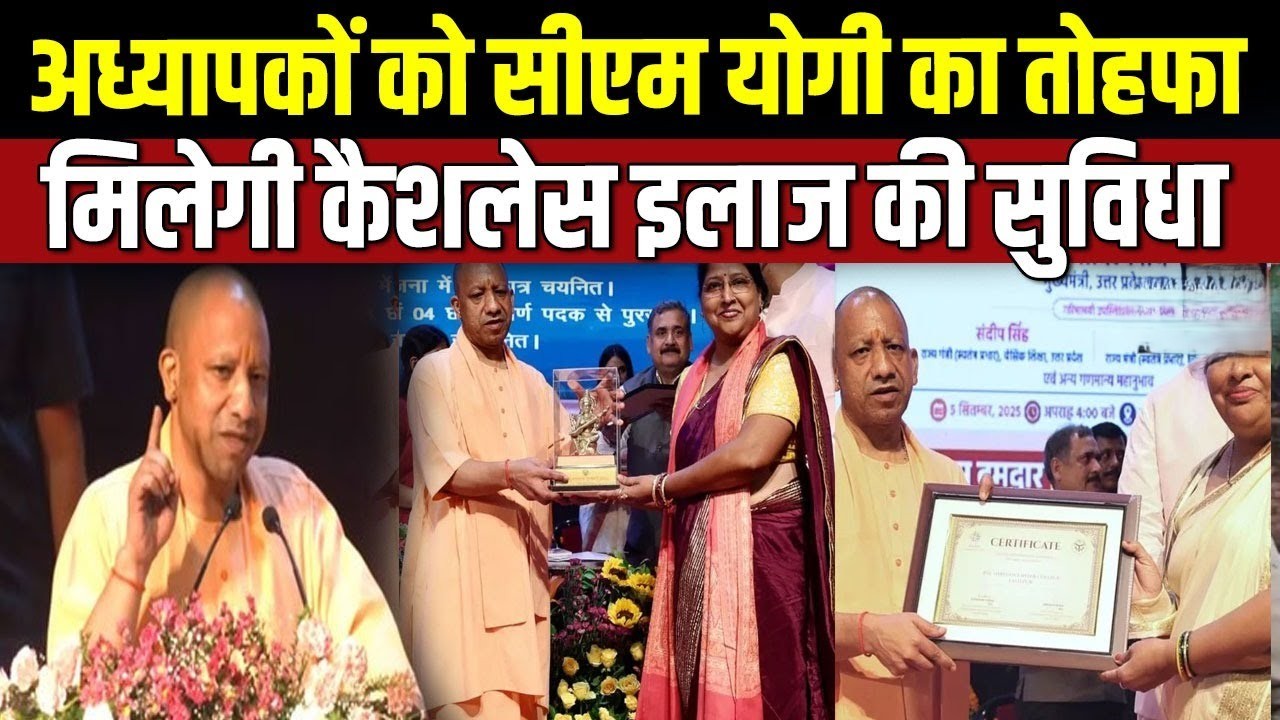
CM Yogi Adityanath Gave a Big Gift to Teachers: Now All Teacher Will Get Cashless Treatment
Introduction
Teachers are often called the backbone of society. They shape young minds, nurture values, and prepare future citizens who will carry the nation forward. In India, teacher have historically been revered as gurus, whose role goes beyond classrooms and textbooks. Yet, despite this cultural reverence, the condition of teachers in many parts of the country has remained neglected. They often face financial insecurities, low healthcare support, and challenges in accessing government benefits.
In this backdrop, Uttar Pradesh Chief Minister Yogi Adityanath’s latest announcement comes as a significant and much-needed reform. By declaring cashless medical treatment for all teacher in the state, CM Yogi has not only acknowledged their contribution but also strengthened his government’s commitment to social welfare.
This move, hailed as a “big gift to teacher”, is expected to have long-term benefits—both for educators and for the education system as a whole. In this detailed blog, we will explore the policy, its background, benefits, political impact, public reaction, and what it means for the future of education in India.
Understanding the Announcement
On Teachers’ Day (or around it), CM Yogi Adityanath announced that every teacher in Uttar Pradesh—whether in government, aided, or recognized institutions—would now be eligible for cashless medical treatment.
This means that teacher will no longer have to worry about arranging money in emergencies or delay treatment due to financial constraints. Instead, hospitals under the government’s empanelled network will directly provide medical services, and the state will bear the cost.
Key highlights of the scheme:
- Coverage: All government, aided, and recognized teacher across Uttar Pradesh.
- Cashless facility: Teachers will not pay upfront at empanelled hospitals.
- Treatment scope: Major illnesses, surgeries, and hospitalization.
- Integration with schemes: Likely linked with Ayushman Bharat & UP government’s health programs.
Why This Policy Matters
1. Healthcare Security for Teacher
Healthcare costs in India have been rising steadily. Even a middle-class family struggles with expenses for major surgeries or prolonged treatments. Teacher, especially in rural and small-town Uttar Pradesh, often earn modest salaries. Cashless treatment ensures that health crises do not push them into debt.
2. Reducing Financial Stress
With the burden of medical expenses removed, teacher can focus better on their profession. Stress-free minds lead to better teaching outcomes, which directly benefits students.
3. Equality Among Teachers
By extending the facility to all teachers—government, aided, and recognized—the scheme ensures inclusivity. It removes the disparity that often exists between teacher of different categories.
4. Political and Social Recognition
Symbolically, this policy elevates teachers’ status. By calling it a gift to teacher, CM Yogi has positioned educators at the center of Uttar Pradesh’s development vision.
Historical Context: Teachers in Uttar Pradesh
Uttar Pradesh, India’s most populous state, has one of the largest teacher populations. From primary schools in villages to universities in cities, lakhs of teacher contribute to educating nearly 25 crore people.
But for decades, teachers have faced several struggles:
- Salary delays in rural and semi-urban institutions.
- Lack of adequate healthcare coverage.
- Bureaucratic hurdles in accessing government schemes.
- Job insecurity among ad-hoc and contract-based teacher.
The announcement of cashless treatment directly addresses one of the most pressing needs—healthcare—while also serving as a morale booster for the teaching community.
Teachers’ Day as a Symbolic Backdrop
The timing of this announcement was deliberate and meaningful. Teacher’ Day, celebrated every year on 5th September, marks the birth anniversary of Dr. Sarvepalli Radhakrishnan, India’s first Vice President and a renowned teacher-philosopher.
By announcing the policy around this day, CM Yogi Adityanath tied the reform to a cultural and emotional sentiment, reinforcing the message that teacher deserve respect not just in words but also in tangible support.
Teachers’ Reactions
The response from the teaching community has been overwhelmingly positive.
- Primary school teachers’ unions welcomed the move, saying it would ease their biggest concern—healthcare costs.
- College professors and lecturers praised the government for recognizing teacher beyond symbolic gestures.
- Retired teachers demanded that the benefit also extend to pensioners, arguing that health issues are even more critical post-retirement.
Many teachers also highlighted how this would help families, since often the teacher is the primary earner and medical costs for spouses and children can be overwhelming.
Public and Social Media Response
The announcement quickly went viral on social media, with hashtags like #CMYogiGiftToTeacher, #CashlessTreatment, and #RespectTeachers trending in Uttar Pradesh.
Parents and students also praised the move, noting that healthier teacher mean better learning environments for children.
Some also compared the policy with other states, asking why such reforms are not nationwide.
Political Impact
Yogi Adityanath’s Image Boost
The move strengthens CM Yogi’s image as a leader who delivers on welfare promises. His government has already rolled out schemes for farmers, women, and youth. By targeting teacher—a respected community—he has broadened his support base.
Electoral Angle
Teachers are an influential voting bloc in Uttar Pradesh. They not only represent numbers but also shape public opinion in rural and urban areas. By gifting them a welfare scheme, Yogi has secured goodwill that may translate into political support.
Comparison with Other States
The move puts pressure on other state governments to introduce similar schemes. In a federal system where states often compete on welfare policies, Uttar Pradesh has taken a lead.
Economic Angle: Cost vs. Benefit
Critics argue that such schemes increase the financial burden on the state. However, when analyzed closely, the benefits outweigh the costs.
- Preventive healthcare reduces long-term expenses.
- A healthy teaching workforce means fewer sick leaves, ensuring uninterrupted education.
- The scheme boosts teachers’ morale, which has intangible but powerful outcomes in productivity.
Moreover, UP’s growing tax base and central assistance make such welfare policies financially feasible.
Teachers as Nation Builders
In speeches around this announcement, CM Yogi emphasized that teachers are nation builders. This phrase is not just rhetoric—it underlines a larger philosophy.
By investing in teachers’ welfare, the government invests indirectly in the future of students, society, and the economy. If teachers feel secure, respected, and cared for, they are more likely to be motivated, innovative, and dedicated.
Challenges Ahead
While the announcement is commendable, its success depends on implementation.
- Hospital Network: The government must ensure enough empanelled hospitals across urban and rural areas.
- Awareness: Teachers should be informed clearly about how to use the scheme.
- Technology Integration: A digital card or app-based system can prevent misuse and delays.
- Coverage for Families: Teachers will expect coverage for spouses and dependents.
- Timely Reimbursements: Hospitals should receive payments on time to keep the system running smoothly.
Broader Implications for Education in India
This policy sets a precedent for how governments should treat teachers. Instead of mere symbolic respect, teachers need concrete benefits. If replicated nationwide, cashless treatment for teachers could become a standard welfare policy, boosting the education system’s health overall.
It also opens the door for discussions on other reforms—housing, retirement benefits, and professional development opportunities.
Conclusion
CM Yogi Adityanath’s announcement of cashless treatment for all teachers in Uttar Pradesh is more than just a welfare scheme—it is a recognition of teachers’ invaluable contribution to society.
By framing it as a “gift to teachers,” he has tapped into both emotion and policy. The move provides healthcare security, reduces stress, and boosts morale. Teachers, parents, and students alike have welcomed it, while political analysts see it as a masterstroke in governance and strategy.
In a country where teachers are called “Guru Devo Bhava”—the embodiment of divinity—the least society can do is ensure their dignity, health, and security. Uttar Pradesh has taken a big step in that direction. Now, the rest of India must follow.
Read more Latest news

