
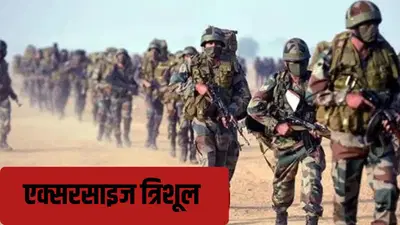
The Indian Army’s ‘Trishul Maneuvers’: Exercise Maru Jwala Showcases India’s Modern Military Might in Rajasthan’s Desert
Trishul maneuvers, In the blazing sands of Rajasthan, where the desert winds carry echoes of valor and endurance, the Indian Army’s Southern Command recently achieved yet another milestone. The grand military display titled “Exercise Maru Jwala”, conducted as part of the “Trishul maneuvers”, has captured national attention and sent a powerful message across borders — that India’s defense preparedness, innovation, and strategic strength continue to rise to new heights.
The Trishul maneuvers are among the most comprehensive training and testing programs conducted by the Indian Army. This year’s edition, featuring Exercise Maru Jwala, demonstrated not only the Army’s advanced technological capabilities but also its readiness to respond to multi-dimensional threats in varied terrains.
The Significance of the Trishul Maneuvers
The Trishul maneuvers are designed to test and refine the Indian Army’s combat capabilities in the western and southern theaters. These large-scale exercises involve coordination between ground forces, mechanized units, artillery, engineers, aviation assets, and now — the new frontier — drone warfare.
The event where the Trishul maneuvers showcased Exercise Maru Jwala holds special significance, as it represents India’s evolving defense doctrine. The focus was on integrating real-time battlefield intelligence, artificial intelligence-driven systems, and modern communication tools to enhance operational efficiency.
The Southern Command, responsible for the country’s southwestern frontiers, played a pivotal role in executing this exercise. Conducted in the vast deserts of Rajasthan, Exercise Maru Jwala under the Trishul maneuvers simulated realistic war-like conditions, combining firepower, mobility, and coordination between different arms of the defense forces.
Why Exercise Maru Jwala Matters
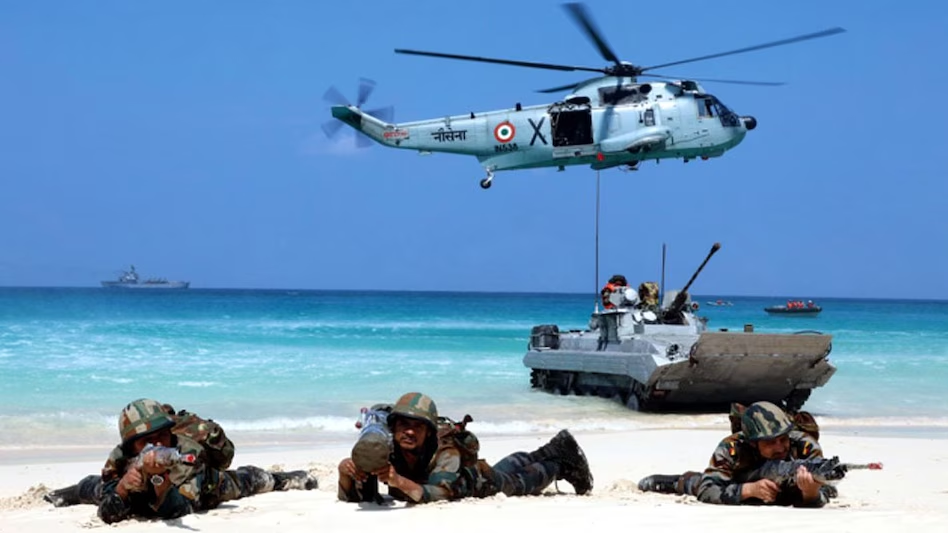
Every edition of the Trishul maneuvers has a specific focus, and Exercise Maru Jwala was no exception. This time, the drill emphasized high-tempo offensive operations under extreme desert conditions. The Army showcased its ability to conduct synchronized operations between mechanized infantry, armored divisions, artillery units, and surveillance systems.
The name Maru Jwala, which translates to “Flame of the Desert,” perfectly symbolizes the Army’s determination and adaptability in harsh terrains. During the Trishul maneuvers, this exercise demonstrated how effectively Indian forces can operate in desert environments similar to potential conflict zones on India’s western borders.
Integration of Modern Technology
One of the most striking aspects of the Trishul maneuvers this year was the use of cutting-edge technology. From the deployment of drone swarms to the real-time transmission of reconnaissance data, the Indian Army showcased a glimpse of what future warfare could look like.
In Exercise Maru Jwala, under the broader Trishul maneuvers, the Army used drones for battlefield surveillance, target acquisition, and logistics support. These drones, equipped with night vision and high-resolution cameras, provided commanders with instant intelligence from the battlefield.
The inclusion of artificial intelligence (AI) algorithms allowed the Army to analyze terrain and enemy movement patterns quickly. This not only enhanced tactical decision-making but also minimized risks to human lives during operations.
The Power of the Mechanized Infantry
The Trishul maneuvers have always been known for highlighting India’s mechanized warfare capabilities, and Exercise Maru Jwala took it a step further. The Indian Army deployed its most powerful tanks, including the Arjun Mk1A and T-90 Bhishma, in coordinated maneuvers to simulate offensive breakthroughs and defensive counterattacks.
These tanks, equipped with thermal imaging and advanced communication systems, moved in synchronization with infantry fighting vehicles (IFVs) like the BMP-2 Sarath. During the Trishul maneuvers, live-fire exercises tested the speed, accuracy, and endurance of these machines in desert warfare scenarios.
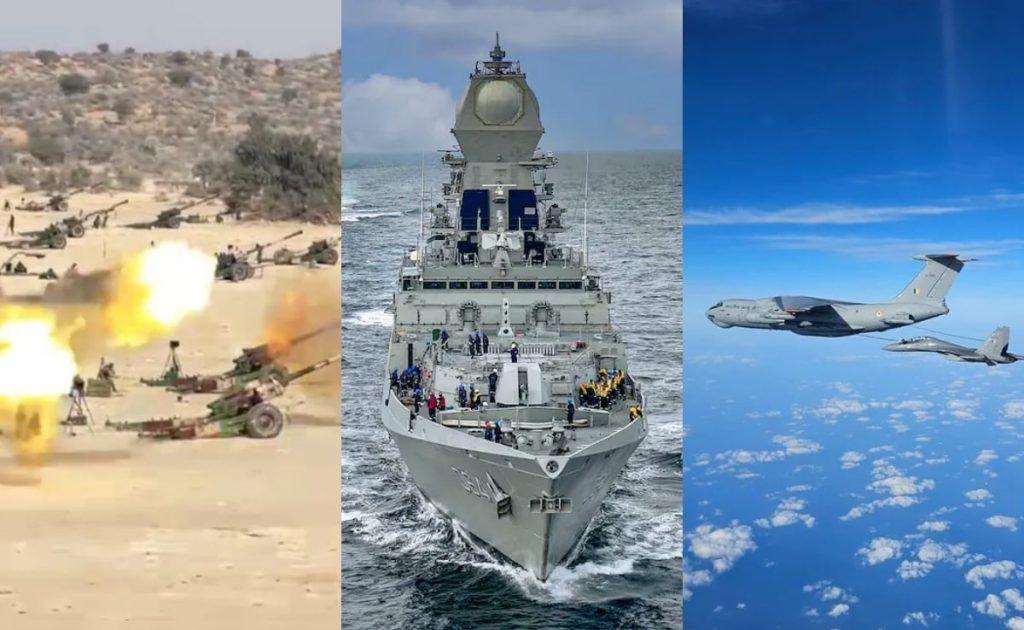
The synergy between ground forces and air assets was another highlight of the Trishul maneuvers, with the Indian Air Force providing close air support and aerial reconnaissance. The seamless integration of all elements of warfare demonstrated India’s preparedness for modern hybrid conflicts.
Drone Warfare: The New Dimension of the Trishul Maneuvers
In today’s battlefield, drones are no longer auxiliary tools — they are essential assets. The Trishul maneuvers placed heavy emphasis on drone-assisted operations, and Exercise Maru Jwala was a perfect demonstration of this evolution.
Drones were used not only for surveillance but also for simulating electronic warfare scenarios. The Army experimented with unmanned aerial systems (UAS) for delivering supplies, monitoring troop movements, and even dropping small payloads in mock combat zones.
The Trishul maneuvers showcased how the Indian Army has adapted to the new age of information warfare, where dominance in the electromagnetic spectrum and data-driven decision-making can determine victory or defeat.
Leadership and Coordination: The Heart of Success
Behind every successful operation lies flawless leadership and coordination. During Exercise Maru Jwala, conducted as part of the Trishul maneuvers, senior officers of the Southern Command supervised complex battle formations involving thousands of troops, vehicles, and heavy weaponry.
Commanders from multiple regiments and brigades coordinated through secure digital communication systems. The Army’s Network for Spectrum (AFNET) was tested for its efficiency, and field commanders operated using real-time situational awareness tools.
Such integration under the Trishul maneuvers reflects India’s shift toward network-centric warfare — a modern military philosophy that ensures all components of the armed forces work in unison through secure communication channels.
Environmental and Terrain Challenges
Conducting large-scale military operations in Rajasthan’s scorching desert is not easy. Temperatures can exceed 45°C, and the loose sand tests both machines and men to their limits. However, this is precisely what makes the Trishul maneuvers unique.
By testing the endurance of tanks, armored vehicles, and soldiers in desert conditions, the Army ensures that its forces remain battle-ready for any eventuality. During Exercise Maru Jwala, part of the Trishul maneuvers, units were required to operate with limited water, harsh sunlight, and simulated disruptions to communication and supply lines.
This kind of realistic training helps the Army refine its logistics planning, vehicle maintenance routines, and combat readiness for potential scenarios along India’s western borders.
A Showcase of Indigenous Defense Production
The Trishul maneuvers also highlighted India’s growing self-reliance in defense manufacturing under the ‘Atmanirbhar Bharat’ initiative. Most of the tanks, artillery guns, and drones used during Exercise Maru Jwala were indigenously produced by Indian companies such as DRDO, BEL, and HAL.
Indigenous equipment like the K9 Vajra self-propelled howitzer and the Pinaka multi-barrel rocket launcher were deployed during the Trishul maneuvers, showcasing India’s capability to produce world-class military hardware.
This demonstration sends a strong message — that India is steadily reducing its dependency on foreign defense imports and moving toward becoming a global defense exporter.
Joint Operations with Air Force Units
The success of Exercise Maru Jwala within the Trishul maneuvers also depended on the close coordination between the Indian Army and the Indian Air Force. Airborne surveillance and airlift capabilities were tested alongside rapid troop mobilization.
Fighter aircraft conducted mock bombing runs, while helicopters like the Advanced Light Helicopter (ALH) Dhruv and Apache attack helicopters provided close air support to advancing ground forces.
Such joint operations are vital for achieving multi-domain superiority, and the Trishul maneuvers serve as an ideal testing ground for improving inter-service communication and strategic alignment.
Night Warfare and Realistic Battle Scenarios
Modern wars are not fought only during the day. Hence, during the Trishul maneuvers, the Indian Army conducted extensive night operations using infrared, laser, and thermal imaging technologies.
In Exercise Maru Jwala, soldiers practiced stealth infiltration, tank movements under low visibility, and drone-guided artillery strikes. The purpose was to enhance night-fighting capabilities and ensure round-the-clock operational readiness.
These realistic simulations under the Trishul maneuvers proved that the Indian Army can maintain its efficiency and dominance, regardless of the time or terrain.
Women in Combat Roles: A Step Forward
Another progressive highlight of the Trishul maneuvers was the participation of women officers in leadership and technical roles during Exercise Maru Jwala. From drone control stations to tank command, women officers showcased their expertise and determination.
Their involvement symbolizes the Indian Army’s evolving structure and its commitment to gender inclusivity in combat support and frontline roles. The Trishul maneuvers thus become not just a display of power but also of progressive values.
Public and International Impact
The Indian Army’s display of precision and coordination during the Trishul maneuvers did not go unnoticed. Defense experts and analysts from around the world praised Exercise Maru Jwala for demonstrating how India is effectively blending traditional warfare with modern technologies.
The success of the Trishul maneuvers has also boosted public confidence in India’s military readiness. The people of Rajasthan, who witnessed the spectacle, expressed pride and admiration for the soldiers’ discipline and courage.
Message to the World: India Is Ready
The underlying message of the Trishul maneuvers is clear — India is prepared to defend its sovereignty and respond swiftly to any external threat. The Army’s ability to execute Exercise Maru Jwala with such precision highlights its high level of professionalism and adaptability.
The Trishul maneuvers also serve as a deterrent, signaling to adversaries that India’s defense capabilities are not limited to traditional combat but extend to electronic, drone, and cyber warfare domains as well.
Leadership Comments and Strategic Insights
Senior defense officials lauded the Trishul maneuvers for being a model of integrated warfare readiness. They highlighted that Exercise Maru Jwala successfully tested new doctrines involving rapid deployment, real-time intelligence sharing, and advanced weaponry integration.
Army Chief General Manoj Pande and Southern Command leaders commended the troops for their performance, discipline, and ability to execute complex maneuvers under extreme conditions. Their remarks underline how the Trishul maneuvers are shaping the Indian Army’s modernization strategy for 2030 and beyond.
Future of the Trishul Maneuvers
Looking ahead, the Trishul maneuvers will continue to evolve as India integrates more technologies like AI-based predictive analytics, autonomous vehicles, and enhanced drone capabilities. The lessons learned from Exercise Maru Jwala will feed into future exercises to improve the Army’s tactical and strategic depth.
With defense modernization gaining momentum and indigenous technology playing a greater role, future Trishul maneuvers could involve cross-domain collaboration with the Navy, Space Command, and cyber defense units.
Conclusion: Trishul Maneuvers Strengthen India’s Defense Backbone
The success of Exercise Maru Jwala, conducted as part of the Trishul maneuvers, is a proud moment for India. It demonstrates not only the Army’s operational excellence but also the nation’s technological progress and strategic foresight.
The Indian Army’s Southern Command, through the Trishul maneuvers, has reaffirmed its commitment to national security, modernization, and self-reliance. From tanks to drones, from desert combat to digital warfare, India is ready for the future.
As the sun set over the golden sands of Rajasthan, the thundering sounds of artillery and the precision of coordination underlined one truth — when it comes to protecting India’s sovereignty, the spirit of the Trishul maneuvers will continue to burn as bright as the “Maru Jwala,” the flame of the desert.
Read more latest news

