
DIG Bhullar’s Bribery Scandal: The Shocking Story of a Police Officer Who Wanted ‘Service and Water’ Every Month!
Introduction: When the Protector Turns Predator
DIG Bhullar The Indian Police Service (IPS) is often seen as the backbone of the country’s law and order machinery — a symbol of integrity, authority, and justice. But what happens when the very officers sworn to uphold the law begin to manipulate it for personal gain?
This disturbing question resurfaced after the shocking revelations in the DIG Bhullar bribery scandal, where a high-ranking police officer allegedly demanded “service and water” — a euphemism for monthly bribes and personal luxuries — from his subordinates and businessmen in exchange for “smooth functioning.”
The scandal has not only rocked the Punjab Police department but also exposed the deep-rooted nexus of corruption that exists within sections of the law enforcement machinery. The tale of DIG (Deputy Inspector General) DIG Bhullar is not merely a case of greed — it is a mirror to how power, when unchecked, can corrupt absolutely.
Who Is DIG Bhullar? The Officer Who Rose Fast and Fell Faster
DIG Bhullar, a senior police officer with an impressive service record on paper, was known among his colleagues for being sharp, disciplined, and politically well-connected. Hailing from Punjab, DIG Bhullar had served in several key law enforcement positions, earning a reputation for being efficient — but also arrogant and entitled.
In official circles, DIG Bhullar was seen as a man who “knew how to get things done.” But behind the façade of an efficient officer lay a darker truth — one that eventually led to his downfall.
His name first surfaced in internal complaints and anonymous letters sent to the Vigilance Bureau months before his arrest. Officers and civilians alike accused him of running an unofficial “system” of monthly collections — cleverly disguised as “service and water” — to ensure that those under his jurisdiction enjoyed “administrative peace.”
The Beginning of the End: How the Scandal Broke Out
The scandal broke wide open when an honest officer, tired of DIG Bhullar demands, decided to record conversations and gather proof of the illegal activities. According to the vigilance sources, the evidence included audio clips, chat records, and financial trails that showed DIG Bhullar or his aides demanding regular monthly payments from subordinate officers and local business entities.
The Vigilance Bureau, which was already keeping an eye on DIG Bhullar due to multiple informal complaints, set up a trap operation. What followed shocked even the investigators — not only was DIG Bhullar accepting bribes, but he had also created an organized structure where lower-ranked officers collected and forwarded money to him under the coded term “paani aur seva” (water and service).
In plain words, these were monthly bribes — protection money in exchange for silence, transfers, or favorable reports.
‘Service and Water’: The Code for Corruption
In the local police slang that has now become infamous, “service and water” were code words used by DIG Bhullar to refer to monthly bribe payments.
Whenever DIG Bhullar subordinates called to discuss any departmental matter, he allegedly reminded them to “take care of the service and water.” This vague but well-understood phrase soon became a symbol of systematic corruption in his department.
In one of the recorded phone conversations leaked to the media, DIG Bhullar reportedly told a subordinate:
“Paanee regular aana chahiye… bina paanee ke system nahi chalta.”
(Water should come regularly… the system can’t run without water.)
This chilling statement, once decoded, revealed how casually and confidently corruption was normalized at the top levels of administration.
The Trap Operation: Caught in the Act
After weeks of surveillance, the Punjab Vigilance Bureau conducted a trap operation at DIG Bhullar office. According to officials, the operation was executed under complete secrecy. A decoy officer, posing as a subordinate, delivered the agreed bribe amount, while surveillance cameras and audio devices recorded the exchange.
The DIG was caught red-handed.
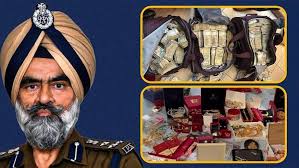
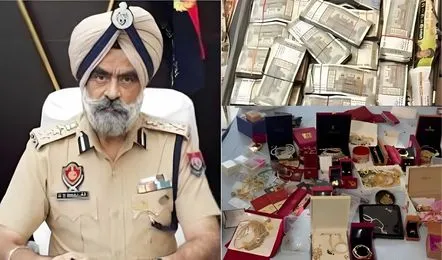
The vigilance team immediately took him into custody, recovering cash and incriminating evidence from his possession. Subsequent raids on his residence and office unearthed large sums of unaccounted money, luxury items, and documents pointing to multiple illegal financial transactions.
As per preliminary estimates, DIG Bhullar had amassed crores of rupees in assets disproportionate to his income.
Shockwaves Across the Police Force
The arrest of a DIG — one of the top-ranking officers in the police hierarchy — sent shockwaves across Punjab’s law enforcement community.
Police personnel who had long whispered about Bhullar’s “monthly demands” suddenly found themselves vindicated. The case sparked intense discussions about corruption within the police, especially among higher ranks.
One officer, speaking anonymously, said:
“Everyone knew he was collecting money, but no one dared to speak up. The system protects its own — until one day it doesn’t.”
This statement encapsulates the fear and frustration within the police ranks. Many officers, especially those of lower ranks, face immense pressure to comply with unethical orders to retain their postings or avoid harassment.
Public Reaction: Outrage and Disbelief
As the story of DIG Bhullar’s arrest hit the media, public outrage exploded across Punjab and beyond. Citizens expressed anger over how a senior police officer — entrusted with protecting the law — could be so deeply involved in illegal practices.
Social media platforms were flooded with comments like:
“If DIGs are taking bribes, what hope do common people have for justice?”
“This is why honest officers are afraid to speak — corruption runs too deep.”
Civil society groups demanded swift prosecution and systemic reforms, calling the incident “a symptom of a much larger disease.”
Political Reactions: Accountability or Damage Control?
The Punjab government, under immense public pressure, assured strict action and promised to let the law take its course.
A senior minister said in a press statement:
“No one, regardless of rank, will be spared. The Vigilance Bureau has our full support in bringing the guilty to justice.”
However, opposition parties accused the government of political hypocrisy, claiming that corruption within the police was an open secret and that Bhullar was being made a scapegoat to divert attention from higher-level complicity.
Political analysts noted that the case could have major implications for upcoming elections, as it exposes administrative failures and a lack of oversight.
Inside the Corruption Network: How the System Worked
Investigators have revealed that Bhullar’s bribery scheme was not an isolated incident but part of an organized network involving multiple officers and middlemen.
The typical flow of money worked like this:
- Local police stations or circles under Bhullar’s jurisdiction collected money monthly from certain businessmen, transporters, and other stakeholders.
- These funds were euphemistically labeled as “service and water.”
- A portion of the money was kept by the collecting officers, and the rest was forwarded to Bhullar’s office.
- In return, Bhullar ensured “no interference” — meaning fewer inspections, favorable postings, and protection from transfers or disciplinary actions.
It was essentially a parallel economy of corruption, deeply embedded in the functioning of the department.
The Legal Case: What Lies Ahead for DIG Bhullar
Following his arrest, Bhullar was charged under multiple sections of the Prevention of Corruption Act and the Indian Penal Code.
The Vigilance Bureau filed an FIR citing charges of:
- Demanding and accepting bribes
- Abuse of official position
- Criminal misconduct
- Possession of disproportionate assets
He has been suspended from service, pending inquiry, and the case has now been transferred to a Special Vigilance Court for trial.
If convicted, Bhullar could face up to 10 years of imprisonment, along with the confiscation of his properties.
A Look at the Bigger Picture: Is Bhullar Alone?
While Bhullar’s arrest is a major development, it raises an uncomfortable question — is he the only one?
Former police officials and anti-corruption experts say such networks cannot operate without institutional complicity. Often, senior officers protect one another in exchange for political favors or loyalty.
A retired DGP (Director General of Police) commented anonymously:
“Bhullar’s case is not an exception. It’s just that his luck ran out. The structure allows such practices to thrive quietly.”
This statement highlights the need for systemic reforms — not just arrests.
The Impact on the Force: Demoralization and Distrust
For honest officers in the Punjab Police, this case has been deeply demoralizing. It has further eroded the public’s trust in the institution.
A senior officer, speaking to local media, said:
“We risk our lives every day for the safety of citizens. When incidents like this happen, the entire department’s image suffers. It hurts the morale of honest officers.”
The case has also sparked internal debates about the need for stronger transparency mechanisms, independent vigilance cells, and digital monitoring of financial activities within police departments.
The Symbolism of ‘Service and Water’: A Metaphor for Systemic Decay
The phrase “service and water” — once used casually by Bhullar — has now become a metaphor for corruption in uniform. It represents how language is twisted to hide criminal behavior behind seemingly harmless words.
This linguistic disguise reflects a larger cultural problem — where corruption becomes normalized, coded, and routine. In such environments, words like “setting,” “adjustment,” or “seva” mask a morally decayed reality.
For India’s fight against corruption to succeed, such linguistic normalization must be broken.
Vigilance Bureau’s Role: A Ray of Hope
The Punjab Vigilance Bureau deserves credit for pursuing the case fearlessly despite Bhullar’s influence. Their operation shows that accountability is still possible when investigative agencies act independently and transparently.
Experts have called this case a landmark in police accountability, potentially setting a precedent for similar crackdowns across India.
However, for real change, vigilance agencies must be given complete autonomy, free from political interference, and equipped with modern tools to track corruption.
Public Demands: Calls for Reform and Transparency
Following the scandal, several civic organizations and activists have demanded structural reforms, including:
- Transparent Transfer Policy – to stop the use of postings as leverage for bribery.
- Regular Audits of Officers’ Assets – to detect disproportionate wealth early.
- Anonymous Whistleblower Mechanisms – to protect honest officers who expose corruption.
- Digital Recordkeeping – for all financial transactions within the department.
- Public Accountability Boards – allowing citizens to report misconduct safely.
If these reforms are implemented sincerely, the Bhullar case could become a turning point for India’s internal policing system.
Social and Psychological Angle: The Corruption Mindset
Psychologists studying corruption argue that power, isolation, and lack of accountability often breed unethical behavior among officials.
In Bhullar’s case, years of unchecked authority, combined with an environment where minor corruption was tolerated, may have emboldened him to scale up his demands.
Corruption, they say, rarely starts big — it begins small, often justified as “a part of the system.” Over time, these small compromises snowball into full-fledged networks of deceit.
Thus, addressing corruption requires not only legal action but also a change in institutional culture and ethics training.
Media’s Role: Bringing the Truth to Light
The exposure of the Bhullar bribery scandal once again underscores the importance of free and responsible journalism.
Local media outlets and investigative journalists played a key role in keeping public pressure alive, ensuring that the case did not get buried under bureaucratic silence.
Their relentless coverage forced higher authorities to act and made it impossible to shield the guilty officer. This shows that an informed and vigilant media remains a crucial pillar in the fight against corruption.
Conclusion: The Fall of Bhullar and the Rise of a Question
The story of DIG Bhullar’s bribery scandal is a grim reminder that corruption, when allowed to grow unchecked, can rot even the strongest institutions from within.
Bhullar’s fall from grace — from a respected officer to a symbol of greed — shows how power without integrity becomes a danger to the very people it’s meant to protect.
His case must not end with one arrest or a sensational headline. It must serve as a wake-up call for comprehensive police reforms, greater transparency, and stricter accountability mechanisms.
As the investigation continues, the people of Punjab — and indeed, all of India — are asking one question:
“If those meant to serve demand service for themselves, who will serve justice?”
Until that question is answered with action and reform, stories like Bhullar’s will continue to haunt India’s corridors of power.
Read More latest news

