

Rahul Gandhi’s Emotional Meeting with Hariom Valmiki’s Family: A Conversation That Echoed Beyond Politics.
Introduction: A Meeting That Stirred the Nation
Hariom Valmiki In Indian politics, few moments transcend electoral boundaries and touch the moral conscience of the nation. Rahul Gandhi’s recent visit to meet the family of Hariom Valmiki was one such moment. It wasn’t just a political act—it was an emotional, symbolic gesture that spoke volumes about empathy, social justice, and the deep-rooted inequalities that continue to plague Indian society.
After meeting the bereaved family, Rahul Gandhi addressed the media, his tone somber yet firm. He said:
“Hariom Valmiki was not just a victim of violence; he was a victim of a system that still refuses to treat everyone equally. His death should awaken our collective conscience.”
This statement, coming from the Leader of the Opposition in the Lok Sabha, reignited a national debate on caste-based injustice, police apathy, and the politicization of human pain.
This 3000-word exploration delves into the story of the incident, Rahul Gandhi’s visit, the political implications of his words, and how this meeting reflects a broader ideological struggle in India’s social fabric.
The Tragic Story of Hariom Valmiki
Hariom Valmiki, a young Dalit man from Uttar Pradesh, became a symbol of India’s unfinished fight against caste discrimination and violence. His story, like that of countless others across rural India, is one of ambition crushed by prejudice.
According to reports, Hariom Valmiki was assaulted following a local dispute that escalated due to caste tensions. What shocked many was the alleged indifference of local authorities, who reportedly failed to act promptly. The family accused certain influential local figures of using power and intimidation to suppress the case.
For days, the family lived in fear and grief, waiting for justice that never seemed to arrive. Social activists and Dalit rights organizations soon took up the cause, bringing it into the national spotlight.
It was against this backdrop that Rahul Gandhi decided to visit the Valmiki family—not merely as a politician, but as someone who, in his own words, wanted to “share their pain and listen to their truth.”
Rahul Gandhi’s Arrival: Symbolism and Sincerity
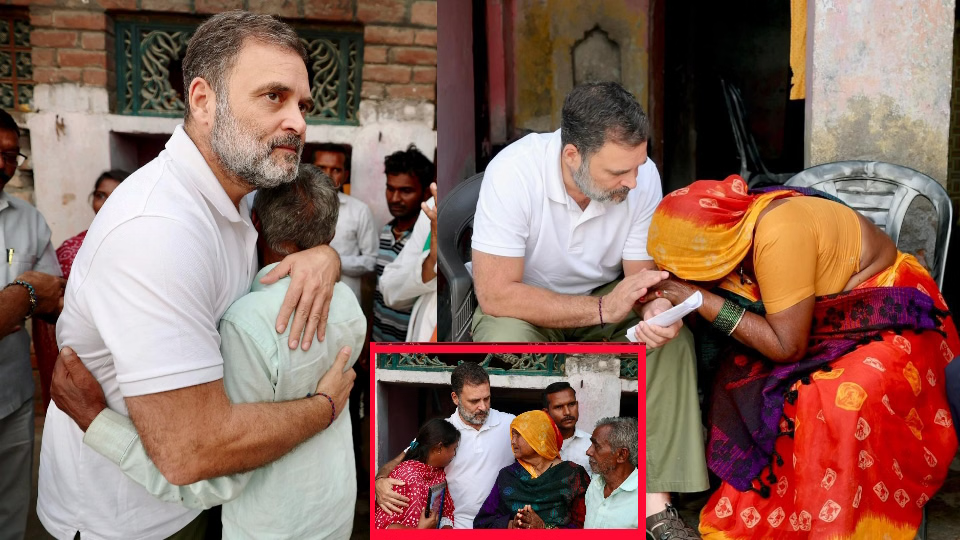
When Rahul Gandhi arrived at the Valmiki family’s modest home, the scene was both emotional and politically charged. Local Congress leaders, Dalit activists, and villagers had gathered to witness the visit.
Rahul entered the house quietly, greeted the grieving mother with folded hands, and sat down on the floor beside her. He listened intently as family members recounted the events leading to Hariom Valmiki death—how he had been beaten, how the police delayed action, and how the system seemed stacked against them.
Eyewitnesses described the moment as deeply moving. Rahul Gandhi’s face reflected genuine anguish as he listened to the story of neglect and discrimination. He assured the family that he would take their fight for justice to the national level.
Later, speaking to the media, Rahul said:
“I am not here as a politician, but as a human being. What happened to Hariom Valmiki is unacceptable in any society that calls itself democratic. We must ask ourselves—what kind of nation are we building if such things continue to happen?”
His words struck a chord with many, especially among marginalized communities who have long felt invisible in the corridors of power.
“I Will Raise This in Parliament”: Rahul’s Promise of Justice
During his media interaction, Rahul Gandhi made a strong commitment:
“I will raise this matter in Parliament. I will not let Hariom Valmiki death be forgotten.”
He accused the ruling government of remaining silent on issues of caste atrocities, claiming that “those who talk about nationalism must first ensure justice for their citizens.”
Rahul framed Hariom Valmiki case as not just a Dalit issue but a national issue, linking it to the broader theme of justice and equality. He reiterated that the Congress Party’s duty is to stand with the weak, the marginalized, and the voiceless.
This approach aligned with his ongoing ‘Bharat Jodo Nyay Yatra’, which focuses on uniting people through justice, fairness, and inclusion.
Political Reactions: The Battle of Narratives
As expected, Rahul Gandhi’s visit triggered a flurry of political reactions.
- BJP leaders accused him of politicizing a tragedy, arguing that law enforcement should be allowed to investigate without “political interference.” Some leaders claimed that Rahul’s visit was “a photo opportunity.”
- Congress leaders, on the other hand, defended the move, calling it an act of compassion, not politics.
- Dalit organizations welcomed Rahul’s stance, saying that at least one national leader had shown the courage to visit and listen.
Political analysts noted that Rahul’s visit had rekindled the Congress Party’s traditional pro-Dalit positioning, which had weakened over the years due to the rise of regional forces like the Bahujan Samaj Party (BSP).

The Emotional Undercurrent: More Than Politics
While critics debated the political motivations, those who witnessed the interaction between Rahul and the Valmiki family saw something genuinely human.
Rahul’s quiet demeanor, his decision to sit on the floor, and his refusal to deliver a grand political speech were gestures that resonated deeply. The family later said:
“He came like a son, not like a politician. He didn’t make promises for votes—he listened.”
This sentiment highlights an important shift in Rahul Gandhi’s public persona. Over the years, he has moved from being perceived as a dynastic leader to a symbol of empathy and moral politics. His recent focus on issues like unemployment, farmer distress, and caste violence reflects this evolution.
The Historical Context: Congress and the Dalit Question
To understand the significance of Rahul’s visit, one must look at the historical relationship between the Congress and Dalit politics.
In the early years of independent India, the Congress, under leaders like Mahatma Gandhi and Jawaharlal Nehru, positioned itself as a party of social harmony and inclusion. However, over the decades, Dalit representation within the party declined, and regional parties like Samajwadi Party filled the void.
Rahul Gandhi’s recent outreach efforts—from visiting Dalit villages to speaking about caste-based economic inequalities—are attempts to rebuild that lost connection. His meeting with Hariom Valmiki’s family is part of this broader strategy of reviving Congress’s social justice legacy.
A Voice Against Systemic Injustice
In his post-meeting statement, Rahul Gandhi emphasized the need to reform India’s justice system, which he said continues to fail the poor and marginalized. He said:
“There are two Indias—one where justice is quick and certain, and another where even filing an FIR becomes a struggle. Hariom Valmiki death is the outcome of this systemic inequality.”
He urged for institutional accountability, demanding that officers who neglect their duties in cases involving marginalized communities face strict punishment.
Rahul’s message was not just about one incident—it was a call for systemic change, appealing to citizens to question everyday injustices around them.
Social Media and Public Response
Rahul Gandhi’s visit became one of the most discussed topics on Twitter, Facebook, and YouTube. Hashtags like #JusticeForHariom Hariom Valmiki and #RahulWithValmikiFamily began trending soon after his interaction with the media.
While supporters praised his courage and compassion, critics accused him of performative politics. Nonetheless, the overwhelming online narrative reflected sympathy for the family and admiration for Rahul’s direct engagement.
Many civil rights activists also shared videos from the visit, calling it a wake-up call for India’s conscience.
Humanizing Politics: Rahul Gandhi’s Distinct Approach
In recent years, Rahul Gandhi’s political style has undergone a noticeable transformation. Instead of focusing solely on rallies or speeches, he has prioritized direct interaction with citizens—farmers, workers, students, and victims of injustice.
His visit to Hariom Valmiki family fits this pattern of empathetic politics. It is part of his broader campaign to build a politics rooted in human connection rather than power.
Observers note that this approach is resonating especially among young voters, who value authenticity over traditional political rhetoric.
Rahul’s Broader Message: The Fight for Equality Is Moral, Not Political
During his press briefing, Rahul made a striking statement that captured the essence of his visit:
“When a young man like Hariom Valmiki loses his life because of his caste, it is not a political issue—it is a moral issue. If we ignore it, we lose our humanity.”
This line sums up his ideological position—that politics must not merely manage power but also protect moral order.
By reframing caste violence as a moral and human crisis, Rahul seeks to push the national conversation beyond party politics.
Opposition Reactions and Counterpoints
The BJP, Samajwadi Party, and Samajwadi Party all reacted differently:
- The BJP maintained that the government is committed to justice and accused Rahul of spreading negativity.
- The Samajwadi Party acknowledged Rahul’s concern but argued that “the Congress had its own failures in uplifting Dalits when it was in power.”
- The Samajwadi Party took a neutral stance but noted that “it is good to see national leaders visiting ground zero.”
These responses reveal the complex electoral dynamics around Dalit issues, which continue to influence political narratives in Uttar Pradesh and across India.
The Symbolism of Rahul’s Silence
One of the most powerful moments during the visit was Rahul Gandhi’s silence. After speaking with Hariom Valmiki mother, he sat quietly for a few minutes, his head bowed.
For many observers, this silence spoke louder than any speech. It represented respect, mourning, and solidarity—a moment of shared humanity in a deeply divided society.
It reminded people that leadership is not only about speaking but also about listening and feeling.
Media Analysis: The Making of a New Rahul Gandhi
Major media outlets interpreted Rahul’s visit as part of his evolving political identity.
Editorials in national dailies noted that Rahul’s focus on ground-level issues, injustice, and empathy represents a “new kind of opposition politics.”
Political commentator Harish Khare wrote:
“Rahul Gandhi is slowly transforming from a politician of privilege into a messenger of conscience.”
This evolving image could significantly impact how the public perceives him and the Congress Party’s ideological direction ahead of upcoming elections.
The Larger Implication: Can Compassion Revive Congress?
Beyond the emotional resonance, Rahul’s visit has strategic importance. The Congress has been striving to reclaim moral credibility in Indian politics. By standing with marginalized communities, the party hopes to rebuild its image as the voice of justice and equality.
However, experts warn that symbolism must translate into sustained action. The Congress will have to follow up with legal, social, and political measures to ensure Hariom Valmiki case doesn’t fade from public memory.
If Rahul’s emotional appeal leads to policy advocacy and systemic reform, it could mark a turning point for both his leadership and India’s political culture.
Conclusion: A Visit That Became a Statement
Rahul Gandhi’s meeting with Hariom Valmiki’s family was more than a condolence visit—it was a moral intervention in a nation grappling with inequality. His words, “I am here not as a politician, but as a human being,” captured the essence of his message.
In a time when politics often thrives on division, Rahul’s empathy brought a rare moment of unity and reflection. Whether it leads to tangible justice for Hariom Valmiki family remains to be seen, but the symbolic weight of the gesture has already left its mark.
The story of this meeting reminds us that politics, at its best, is not about power—it’s about people, compassion, and moral courage.
As Rahul Gandhi walked away from the Valmiki home, the nation was left with a lingering thought:
If more leaders listened before they spoke, perhaps justice would not be such a distant dream.
Read more latest News

