

Tejashwi Yadav’s Scathing Attack on Modi Government: “Modi Sent 30 Helicopters to Stop a 37-Year-Old Man!” – A Bold Promise to Provide Jobs to Every Family Without Government Employment
Introduction: A Storm in Bihar’s Political Arena
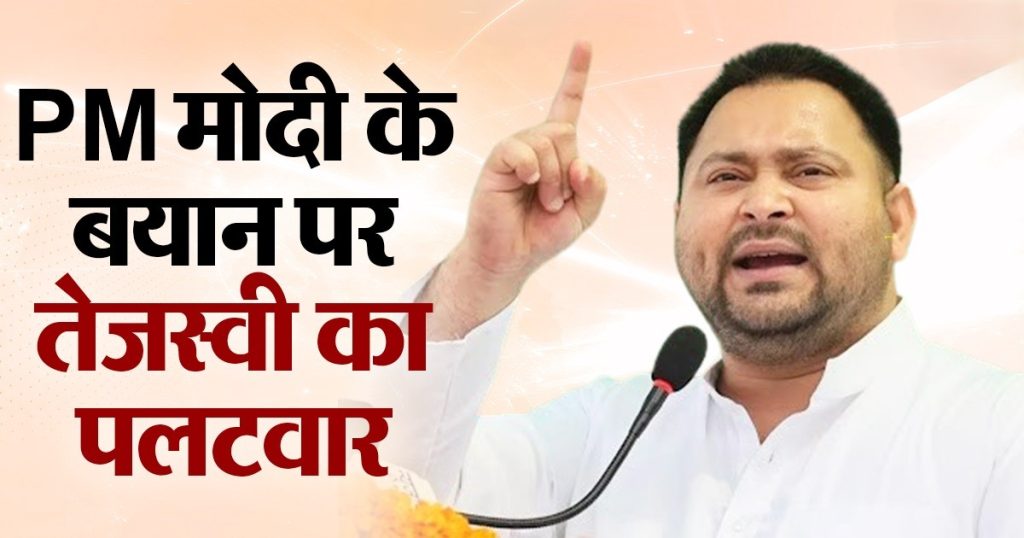
Tejashwi Yadav As Bihar gears up for one of its most fiercely contested elections in recent years, political rhetoric has reached its peak. Amidst the noise and fervor, one statement has captured the attention of both supporters and critics alike — Tejashwi Yadav’s powerful attack on Prime Minister Narendra Modi. In a fiery rally, the Rashtriya Janata Dal (RJD) leader declared, “Modi sent 30 helicopters to stop a 37-year-old man!”
With this remark, Tejashwi Yadav not only took a jibe at the massive campaign machinery of the BJP but also projected himself as a symbol of youthful defiance and people’s resistance. What followed was an even bolder promise — that if the RJD forms the government, “every family without a government job will get one.”
This statement has set the tone for Bihar’s political discourse, reviving memories of his 2020 election promise of 10 lakh jobs and rekindling debates about employment, governance, and the politics of opportunity in one of India’s most economically challenged states.
The Context: Bihar’s Political Battle of Narratives
Bihar’s political landscape has always been dominated by charismatic leaders and deeply rooted caste equations. Yet, in recent years, a new narrative has begun to take shape — one centered around youth aspirations, employment, and development.
Tejashwi Yadav, son of former Chief Minister Lalu Prasad Yadav, represents this generational shift. At 37, he has emerged as the face of a young and impatient Bihar that seeks not just social justice but also economic empowerment.
On the other hand, Prime Minister Narendra Modi, known for his nationwide influence and powerful oratory, remains a formidable force. Backed by the BJP’s strong organizational machinery, Modi continues to dominate the national stage. But Tejashwi Yadav remark — “Modi sent 30 helicopters to stop a 37-year-old man” — underscores the growing confidence of the Opposition that seeks to challenge this dominance, particularly in the Hindi heartland.
The Rally That Shook the Political Spectrum
At the heart of this storm lies a massive public rally organized by the RJD in Bihar. The atmosphere was electric — red flags fluttered in the air, slogans of “Tejashwi Bhaiya Zindabad” echoed across the ground, and thousands gathered to hear the young leader speak.
Taking the stage with characteristic energy, Tejashwi Yadav addressed the crowd with a mix of humor, sarcasm, and political sharpness. His remark about Modi deploying “30 helicopters” was not just a jab but a symbolic portrayal of how the central government, with its vast resources, was allegedly trying to suppress the voice of Bihar’s youth-led movement.
“When I see 30 helicopters hovering over Bihar just to stop me, I realize one thing — this government fears the voice of the people. Modi ji has all the power, all the machinery, and yet he’s worried about a 37-year-old man who’s just raising questions about jobs and inflation!”
This line drew massive applause. It resonated deeply with a generation frustrated with joblessness, inflation, and perceived neglect of Bihar’s development needs.
Employment: The Central Theme of Tejashwi Yadav Campaign
Tejashwi Yadav’s political strategy has always revolved around the promise of jobs. His 2020 campaign slogan — “Naukri Do, Vote Lo” (Give jobs, take votes) — became a viral chant across Bihar. Although his party couldn’t form the government then, his focus on unemployment struck a chord, especially with Bihar’s young population, which makes up more than 60% of the electorate.
This time, he has doubled down on that message.
“If our government is formed, every family in Bihar that doesn’t have a government job will get one. This is my promise,” Tejashwi Yadav declared amidst thunderous cheers.
He further explained that his government would prioritize families struggling with poverty and unemployment, ensuring that no household remains without a source of stable income. His message was clear — he wants to be remembered as the leader who turned Bihar from a state of migration to a state of employment.
A Promise That Connects with the Ground Reality
To understand the impact of Tejashwi Yadav statement, one must grasp the economic and social fabric of Bihar. The state continues to face chronic unemployment and underdevelopment, despite several decades of reforms and government schemes.
According to recent data from the Centre for Monitoring Indian Economy (CMIE), Bihar’s unemployment rate hovers around 13%, significantly higher than the national average. Millions of youth migrate every year to states like Delhi, Maharashtra, Gujarat, and Punjab in search of work.
In rural Bihar, families often depend on a single breadwinner employed as a migrant laborer. Government jobs are seen as the ultimate aspiration — not just for stability but for dignity. In such a context, Tejashwi Yadav promise of “one government job per family” directly addresses the emotional and economic core of Bihar’s masses.

The Political Messaging: Tejashwi Yadav vs. Modi
Tejashwi Yadav rhetoric is a calculated move in a high-stakes political battle. By invoking the image of Modi using “30 helicopters,” he presents himself as a David challenging the Goliath of Indian politics. The remark carries layers of political symbolism:
- Power vs. People: Modi’s large-scale campaign represents the establishment, while Tejashwi Yadav positions himself as the voice of the common youth.
- Central vs. State Politics: The statement subtly reminds voters of the growing centralization of power under the Modi government and how regional voices are being overshadowed.
- Youth vs. Experience: It sets up a generational contest — between an experienced, 74-year-old leader and a 37-year-old challenger representing India’s new political consciousness.
Through such contrasts, Tejashwi crafts an image of himself as the people’s fighter — young, dynamic, and fearless.
Critics Question the Feasibility of the Promise
However, not everyone is convinced. Political analysts and BJP leaders have questioned the practicality of Tejashwi’s promise. Critics argue that providing a government job to every family without one would impose an enormous financial burden on the state exchequer, which already struggles with limited resources.
A BJP spokesperson quipped,
“Tejashwi Yadav should first explain how he plans to create lakhs of government jobs when the state can barely pay salaries on time. These are hollow promises meant to mislead the people before elections.”
Economists also point out that Bihar’s revenue base is weak, with heavy dependence on central grants and minimal industrial output. Without structural reforms, such large-scale employment generation may remain a dream.
Supporters See It as a Vision, Not Just a Promise
Yet, among Tejashwi’s supporters, this promise is seen less as an immediate policy and more as a vision — a roadmap for prioritizing employment over rhetoric.
RJD’s manifesto team has reportedly been working on a model that would combine:
- Skill development programs,
- Expansion of public infrastructure projects,
- New recruitment in education, healthcare, and police sectors,
- And revival of local industries and cooperatives.
Tejashwi has hinted that his goal is to create an employment ecosystem where every family gets an opportunity for stable livelihood — even if it’s not purely a government job in the conventional sense.
A Message to the Migrant Workforce
One of the most powerful emotional appeals in Tejashwi’s campaign is directed at Bihar’s migrant workers. During the COVID-19 lockdown, thousands of migrants returned to Bihar, exposing the state’s dependence on outside employment.
Tejashwi reminded the crowd:
“During COVID, you saw how our brothers and sisters walked thousands of kilometers to return home. Did the government think of them? Did Modi ji send 30 helicopters to bring them back? No. But today, he sends 30 helicopters to stop Tejashwi Yadav from speaking about jobs!”
This line drew an overwhelming emotional response. For many in Bihar, migration is not a choice but a compulsion — and Tejashwi’s words reflect their pain and frustration.
The Battle for Perception: Social Media and Youth Mobilization
In today’s digital age, Tejashwi’s team has also mastered the art of social media messaging. The “30 helicopters” remark went viral within hours, with hashtags like #TejashwiVsModi, #BiharSpeaks, and #NaukriDoVoteLo trending across platforms.
Youth volunteers of RJD flooded Twitter and Instagram with memes, short videos, and clips from the rally, portraying Tejashwi as a giant-slayer. The imagery of helicopters became symbolic — representing not just the BJP’s might but also the fear of an emerging challenger.
The BJP, too, responded strongly online, accusing the RJD of misleading voters with false hopes. Yet, in terms of narrative momentum, Tejashwi seemed to have captured the public imagination — at least for the moment.
Echoes of 2020: Learning from the Past
In 2020, Tejashwi Yadav led one of the most vibrant campaigns in Bihar’s political history. Despite being heavily outspent and facing the BJP-JDU alliance, he managed to secure 75 seats, turning the RJD into the single largest party in the Assembly. His promise of 10 lakh jobs was mocked then — but it later became a reference point for all political discussions on Bihar’s economy.
Now, five years later, his upgraded promise — “one government job per family” — shows his confidence and evolution as a leader. It signals that he’s not retreating from bold commitments but doubling down on them.
Tejashwi’s Broader Political Strategy
Beyond the slogans and attacks, Tejashwi’s campaign strategy appears to be threefold:
- Reframe Bihar’s Politics: Move the conversation from caste-based identity politics to issue-based politics — especially employment and inflation.
- Unite the Youth: Mobilize Bihar’s massive youth population as a political force that demands accountability and reform.
- Challenge the Narrative of Fear: Portray himself as fearless in the face of Modi’s political might, turning every attack into proof of his growing strength.
By declaring himself as the “37-year-old man” whom Modi fears, Tejashwi taps into a deep psychological chord — that of a small voice challenging a mighty system.
The Road Ahead: Challenges and Opportunities
While Tejashwi’s speech has energized his base, turning promises into policy will be the real challenge. Bihar’s bureaucracy, financial constraints, and dependence on central funds will test any future government’s ability to deliver on large-scale employment guarantees.
Yet, politically, Tejashwi’s narrative gives him a clear edge among the youth. His promise, even if ambitious, sets him apart as the only major leader openly addressing Bihar’s unemployment crisis.
If he can sustain this momentum, expand alliances, and translate enthusiasm into votes, the 2025 elections could see a serious challenge to the BJP-JDU combine.
Conclusion: The Rise of a 37-Year-Old Challenger
Tejashwi Yadav’s remark — “Modi sent 30 helicopters to stop a 37-year-old man” — will be remembered as one of the defining quotes of Bihar’s election season. It symbolizes the confidence of a new generation of leaders willing to take on the political giants of Delhi.
His promise of “one job per family” may be ambitious, even utopian, but in the world of politics, such bold commitments often become rallying cries for change. For Bihar’s unemployed youth, Tejashwi’s words are not just a promise — they are a reflection of their own aspirations, anger, and hope for dignity.
In a state where dreams have too often been deferred, a young leader’s challenge to the establishment rekindles belief that change — real, tangible change — may finally be on the horizon.
Whether Tejashwi can transform rhetoric into reality remains to be seen. But one thing is certain: the 37-year-old man has already succeeded in shaking the political landscape — and reminding India that Bihar’s voice cannot be silenced, even by thirty helicopters.
Read more latest news

