
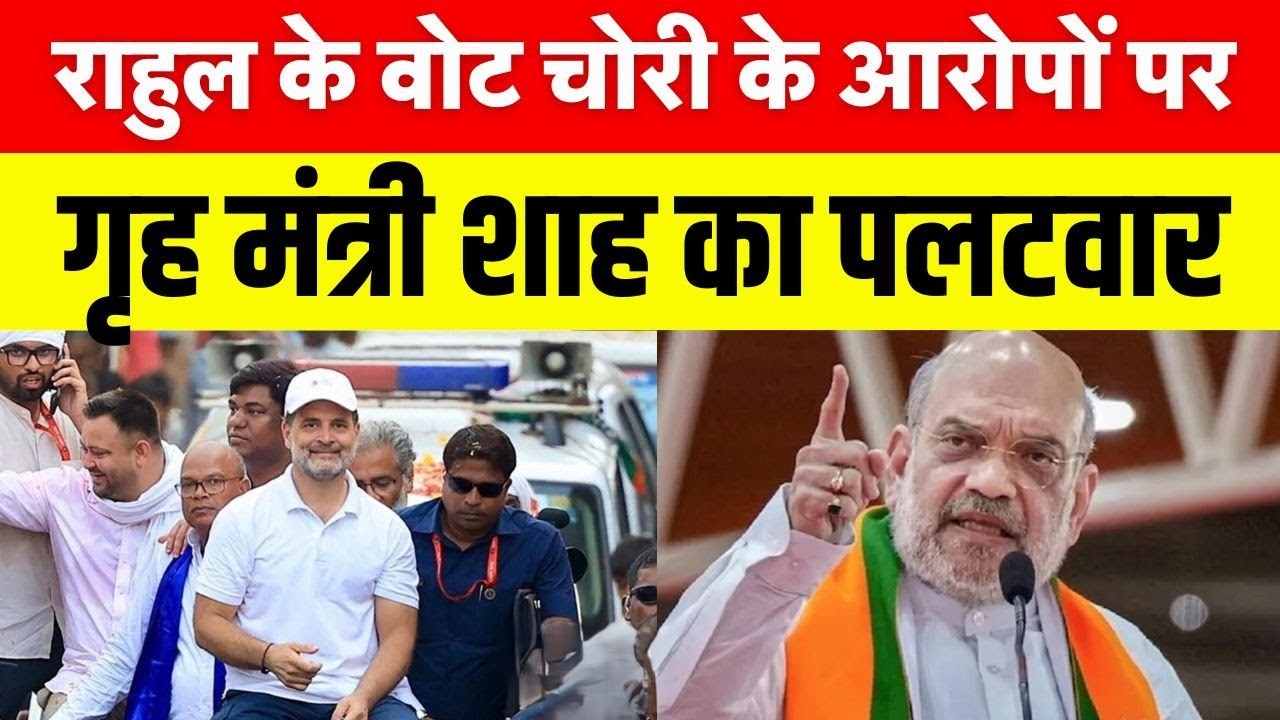
Amit Shah’s Counterattack on Rahul Gandhi: “Rahul Is Talking About the Votes of Infiltrators…” — The Political War Over ‘Vote Theft’ Intensifies
Introduction: A War of Words at the Heart of Indian Democracy
Home Minister Amit Shah has launched a scathing attack on Rahul Gandhi! Countering Rahul Gandhi’s “vote theft” statement, Amit Shah said, “Rahul is talking about the votes of infiltrators…” India’s political climate has once again heated up with a fierce verbal duel between two of the nation’s most powerful political figures — Union Home Minister Amit Shah and Congress leader Rahul Gandhi. The latest flashpoint arose when Rahul Gandhi accused the government and the Election Commission of engaging in what he termed “vote theft,” a phrase that sent shockwaves through the political spectrum.
But Amit Shah, never one to back down from confrontation, hit back sharply. Addressing a massive rally, he declared, “Rahul Gandhi is talking about the votes of infiltrators, not Indians.”
This one statement has not only ignited a political firestorm but has also reframed the ongoing debate around electoral integrity, infiltration, and the politics of nationalism. As the 2025 election season approaches, the war of narratives between the BJP and the Congress seems to be reaching its most intense phase yet.
Rahul Gandhi’s ‘Vote Theft’ Statement: The Spark That Lit the Fire
It all began with Rahul Gandhi’s fiery press conference earlier this week. In a charged tone, the Congress leader accused the BJP and the Election Commission of engaging in massive irregularities in voter lists across several constituencies.
Rahul claimed:
“What we are witnessing is not an election — it’s a theft of democracy. Votes are being stolen. Fake names are being added, and genuine voters are being deleted.”
He went further to allege that the BJP was systematically targeting Dalit, backward, and minority communities through manipulative deletions in voter lists, calling it “a criminal conspiracy to destroy India’s democracy.”
The statement immediately drew widespread attention and sparked fierce reactions from the ruling party. Within hours, BJP leaders accused Rahul Gandhi of undermining democratic institutions and questioning the credibility of India’s Election Commission — one of the most powerful autonomous bodies in the democratic world.
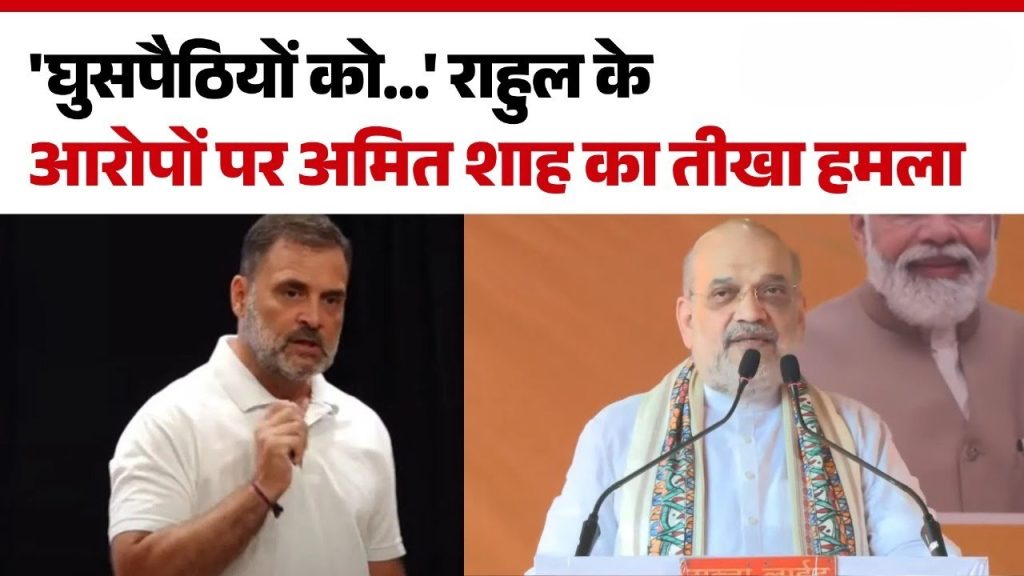
Amit Shah Strikes Back: “Rahul Is Talking About Votes of Infiltrators”
Never known for mincing words, Home Minister Amit Shah fired back in characteristic fashion. Speaking at a rally in Assam, Amit Shah launched a direct counterattack on Rahul Gandhi’s claims, turning the entire narrative on its head.
“Rahul Gandhi says votes are being stolen. But I want to ask him — whose votes are you talking about? These are not Indian citizens’ votes; these are the votes of infiltrators that the Congress has always protected for its politics of appeasement.”
The crowd erupted in applause. Amit Shah’s statement struck a chord in regions like Assam and Bengal, where the issue of illegal immigration and infiltration has long dominated political discourse.
He added further:
“Under Prime Minister Modi’s leadership, we are cleaning the electoral rolls. We are ensuring that only Indian citizens — not infiltrators or illegal migrants — vote in Indian elections. But Rahul Gandhi wants to keep these infiltrators on the list because that’s how Congress survives politically.”
With that, Amit Shah transformed what was initially a debate about voter fraud into a larger ideological confrontation — between national security and minority appeasement, citizenship and vote bank politics, integrity and infiltration.
The BJP’s Counter-Narrative: From ‘Vote Theft’ to ‘Vote Purification’
Amit Shah’s counterattack effectively shifted the political battlefield. Instead of defending against Rahul’s allegations, the BJP turned the conversation toward national identity and citizenship integrity. The party’s narrative is clear: the Congress is not protecting democracy — it’s protecting infiltrators.
This transformation in rhetoric aligns perfectly with the BJP’s long-standing ideological positions. Ever since 2014, the party has emphasized the need to identify and remove illegal immigrants, especially in border states like Assam, Bengal, and Tripura. The National Register of Citizens (NRC) and the Citizenship Amendment Act (CAA) were both part of this broader vision.
Now, by linking Rahul Gandhi’s “vote theft” comments with infiltration, Amit Shah is not just responding politically — he’s reinforcing the BJP’s nationalist identity and consolidating its core voter base.
The Historical Context: The Long Shadow of Illegal Immigration
The issue of illegal immigration has been a sensitive and deeply polarizing topic in Indian politics for decades. It traces back to the Bangladesh Liberation War of 1971, which led to millions crossing the border into India — particularly into Assam and West Bengal.
Over the years, this influx has transformed local demographics and triggered numerous agitations, including the historic Assam Movement of the 1980s, which culminated in the Assam Accord of 1985.
For the BJP, infiltration represents not just a legal issue but a cultural and security threat. Shah’s remark that Rahul Gandhi is defending “the votes of infiltrators” is rooted in this historical grievance — one that continues to evoke strong emotions among large sections of the population.

Rahul Gandhi’s Defense: “BJP Is Destroying Democracy”
In response to Shah’s comments, Rahul Gandhi stood his ground. Addressing the media the next day, he accused the Home Minister of twisting the issue to hide the BJP’s alleged manipulation of the electoral process.
Rahul retorted:
“When we talk about fake names and missing voters, the BJP calls it infiltration. This is their standard playbook — distract, divide, and defame. The truth is, they are terrified of losing. That’s why they are deleting the names of poor and backward voters.”
He added that the Congress is not defending infiltrators but demanding a fair and transparent election.
“Our fight is to protect the democratic rights of every Indian, irrespective of religion or caste. If Amit Shah wants to call that ‘infiltration,’ it shows how disconnected they are from reality.”
The Congress party later released a detailed report claiming discrepancies in voter rolls across several states, demanding a judicial probe and more transparency from the Election Commission.
The Political Stakes: 2025 and the Battle for Narrative Control
Both statements — Rahul Gandhi’s “vote theft” and Amit Shah’s “infiltrators” counter — are not isolated exchanges. They form part of a larger narrative battle as India heads toward the 2025 state elections and gears up for the 2026 general elections.
For Rahul Gandhi, the “vote theft” accusation fits into his broader narrative of “BJP undermining institutions.” Over the past few years, he has repeatedly accused the Modi government of destroying democratic checks and balances — from the judiciary to the media.
For Amit Shah and the BJP, the infiltration angle reinforces their nationalist narrative — portraying themselves as protectors of India’s borders and identity, while painting the Congress as a party willing to compromise national security for political gain.
Thus, what began as an argument over voter rolls has now evolved into a full-fledged ideological confrontation:
- Congress framing it as a battle for democracy and transparency.
- BJP framing it as a fight for national integrity and citizenship purity.
Decoding Amit Shah’s Strategy: The Master of Political Framing
Amit Shah’s ability to turn defensive issues into offensive narratives has been a defining feature of his political career. Whether it was the CAA-NRC debate, Article 370, or now the “vote theft” controversy, Shah consistently flips the frame to focus on nationalism and identity — themes that resonate deeply with the BJP’s core voter base.
In this case, he’s not just rebutting Rahul Gandhi — he’s reframing the entire issue. By connecting voter list cleansing with national security, Shah transforms a bureaucratic issue into an emotional, patriotic cause.
His rhetorical question — “Whose votes are you defending, Rahul? Infiltrators or Indians?” — is designed to corner the Congress in a moral and political dilemma.
If Congress defends its position, it risks being portrayed as pro-infiltrator; if it backtracks, it loses the moral high ground. Either way, Shah ensures that the BJP controls the narrative.
Reactions Across the Political Spectrum
The fallout from Shah’s remarks has been swift and widespread.
- BJP leaders rallied behind Shah, amplifying his message across social media and campaign events. Hashtags like #RahulForInfiltrators and #ShahExposesCongress began trending within hours.
- Congress allies defended Rahul Gandhi, accusing Shah of deliberate communal polarization and hate politics.
- Regional parties such as the Trinamool Congress (TMC) and the DMK offered mixed responses — supporting Rahul’s call for electoral fairness while distancing themselves from his more confrontational tone.
- Political analysts noted that Shah’s counterattack is strategically aimed at galvanizing the BJP’s base in border states and Hindi heartland regions ahead of key elections.
The Larger Issue: Trust in Electoral Institutions
Beyond the political rhetoric, this debate touches on a far deeper concern — the public’s trust in India’s democratic institutions.
Rahul Gandhi’s accusations, if left unproven, risk eroding faith in the Election Commission, an institution that has long been seen as impartial and robust. On the other hand, Amit Shah’s claim about “infiltrators’ votes” raises questions about the accuracy of voter lists and the process of identification.
This dual challenge — defending the integrity of elections while addressing genuine concerns about illegal voting — lies at the heart of India’s democratic debate. It’s a delicate balance, and both sides risk alienating voters if they appear to be exploiting the issue for political gain rather than finding solutions.
Public Perception: A Divided Audience
Public opinion on this controversy appears sharply divided along political lines.
In BJP strongholds, Shah’s narrative of protecting the electoral system from “infiltrators” resonates strongly. For many, his tough stance symbolizes nationalism and security.
Meanwhile, among Congress supporters and liberal sections, Rahul Gandhi’s “vote theft” charge is seen as a courageous stand against what they perceive as creeping authoritarianism and manipulation of democratic institutions.
On social media, this polarization is even more evident — with both sides sharing videos, memes, and soundbites reinforcing their version of the truth.
In essence, this controversy isn’t just about votes — it’s about which story the public chooses to believe.
Regional Impact: Assam, Bengal, and the Hindi Heartland
Amit Shah’s remarks carry particular weight in the eastern and northeastern regions, where the issue of illegal immigration has deep historical roots.
- In Assam, where the NRC (National Register of Citizens) has already excluded around 19 lakh people for lack of documents, Shah’s remarks are seen as reaffirmation of the BJP’s commitment to protecting local interests.
- In West Bengal, where the BJP is trying to expand its base, the infiltration narrative continues to be a potent weapon against Mamata Banerjee’s TMC, which the BJP accuses of “vote bank politics.”
- In the Hindi belt, the issue plays into broader themes of nationalism and security — reinforcing the BJP’s image as the protector of India’s sovereignty.
For Rahul Gandhi, this means his message of “vote theft” must find resonance beyond his traditional support base if it is to counter the BJP’s nationalist framing.
Media and Public Discourse: A War of Soundbites
Television debates, editorials, and social media feeds have all been flooded with discussions on the Shah-Rahul face-off. News channels have repeatedly aired clips of both leaders, dissecting their words and speculating on their political intentions.
Analysts note that both leaders are skilled communicators, albeit with contrasting styles.
- Rahul Gandhi speaks from a moral standpoint, invoking the language of democracy, rights, and justice.
- Amit Shah speaks from a strategic and ideological standpoint, emphasizing security, identity, and discipline.
This contrast makes their exchanges not just political battles but also ideological showdowns — each representing a fundamentally different vision of India’s democracy.
The Symbolism: ‘Infiltrators’ vs. ‘Voters’
At the core of this debate lies a symbolic clash. Rahul Gandhi speaks of citizens whose rights are being stolen. Amit Shah speaks of infiltrators whose illegal votes must be stopped.
This duality reflects two competing imaginations of India:
- Rahul’s India — a plural, inclusive democracy where every vote counts equally.
- Shah’s India — a secure, disciplined nation where citizenship is sacred and non-negotiable.
Both narratives appeal deeply to their respective constituencies, making this not just a political fight, but a cultural and ideological one.
Looking Ahead: What This Clash Reveals About India’s Political Future
As India moves closer to another election cycle, this episode underscores several key trends in its political discourse:
- Polarization as Strategy: Both parties are mobilizing their bases by appealing to emotionally charged issues — democracy for Congress, nationalism for BJP.
- Narrative Dominance: The real contest is not over facts but over who controls the story.
- Rise of Personal Politics: Both Amit Shah and Rahul Gandhi represent the personalization of political conflict — where individual clashes define party fortunes.
- Democracy in Transition: These battles, though heated, reflect the vibrancy of India’s democracy — where every institution and every leader is subject to public scrutiny and debate.
Conclusion: Two Visions, One Democracy
In the end, Amit Shah’s remark — “Rahul is talking about the votes of infiltrators” — and Rahul Gandhi’s counterclaim of “vote theft” are more than just political soundbites. They represent the ideological fault lines shaping India’s future.
For Shah, the fight is about securing the nation — cleansing the voter rolls of infiltrators and protecting the purity of citizenship.
For Rahul, the fight is about saving democracy — ensuring that every genuine citizen has the right to vote without fear or manipulation.
Between these two visions lies the pulse of Indian democracy — noisy, passionate, contested, yet resilient.
As the political temperature rises and both leaders sharpen their attacks, one thing is clear: India’s democratic journey will continue to be shaped not just by policies and programs, but by powerful words, clashing ideologies, and the people’s unending desire to be heard.
Read More latest news

