
Tej Pratap Yadav Said Nitish Kumar Should Vacate Residence: Political Row Over Government Bungalows Intensifies in Bihar
Introduction
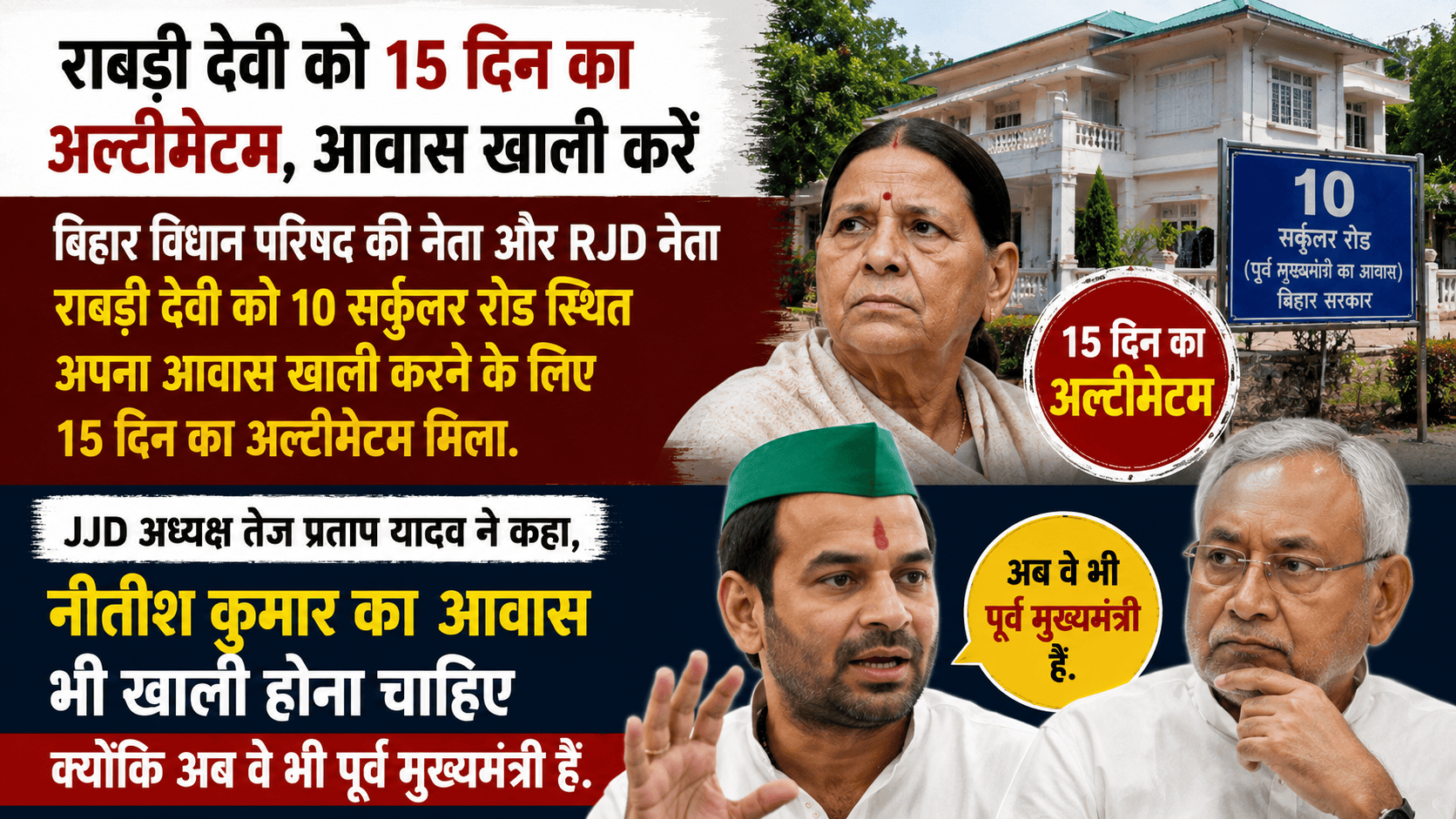
During his response to the notice served to Rabri Devi, Tej Pratap Yadav said Nitish Kumar should also vacate his government residence because he is now a former chief minister.
Bihar politics has once again become the center of attention after a fresh controversy emerged over government residences allotted to former chief ministers and senior political leaders. The issue gained momentum after Bihar Legislative Council leader and RJD leader Rabri Devi reportedly received a 15-day ultimatum to vacate her residence at 10 Circular Road in Patna.
The development triggered strong reactions from various political leaders, especially from Jan Janata Dal (JJD) President Tej Pratap Yadav.
The statement immediately sparked a political debate in Bihar, with leaders from both the ruling alliance and the opposition expressing their views on the issue. As the controversy deepened, questions arose regarding government housing rules, political privilege, and equal treatment for all former office holders.
Rabri Devi Receives Notice to Vacate Residence
The controversy began when reports surfaced that Rabri Devi had been given a 15-day deadline to vacate her official residence located at 10 Circular Road in Patna.
The residence has long been associated with the family of former Bihar Chief Minister Lalu Prasad Yadav. Over the years, the bungalow has become one of the most recognizable political addresses in the state.
Following the notice, Tej Pratap Yadav said Nitish Kumar should face similar action if authorities are applying housing regulations uniformly.
According to political observers, the issue quickly evolved from a housing matter into a larger political confrontation between rival parties in Bihar.

Why the Residence Matters
The bungalow at 10 Circular Road is not just an ordinary government residence. It carries immense political significance due to its association with the RJD leadership.
Many major political decisions, party meetings, and election strategies have reportedly been discussed at this address over the years. Therefore, any move related to the property naturally attracts public and media attention.
After the ultimatum became public, Tej Pratap Yadav said Nitish Kumar should not receive any special treatment if government rules require former office holders to vacate official residences.
His remarks quickly became one of the most discussed topics in Bihar politics.
Tej Pratap Yadav’s Strong Response
Tej Pratap Yadav did not hold back while responding to the notice.
Addressing journalists, Tej Pratap Yadav said Nitish Kumar is also a former chief minister and therefore should be required to vacate any government accommodation allotted under that capacity.
He argued that rules should apply equally to all political leaders regardless of party affiliation or political influence.
The statement received widespread coverage in regional and national media, further intensifying the debate.
Political analysts noted that the comments reflected the opposition’s attempt to portray the issue as one of fairness and equal treatment.
Political Reactions Across Bihar
Following the remarks, leaders from various political parties entered the debate.
Supporters of the RJD backed Tej Pratap Yadav’s position, arguing that government regulations should be enforced consistently. They claimed that if Rabri Devi is being asked to vacate her residence, similar standards should apply to all former chief ministers.
During multiple public interactions, Tej Pratap Yadav said Nitish Kumar should set an example by complying with the same expectations imposed on other leaders.
Meanwhile, leaders from the ruling alliance defended the government’s actions and insisted that all decisions were being taken according to established legal procedures.
The Historical Importance of Circular Road Residences
Patna’s Circular Road has long been associated with Bihar’s political elite.
Several chief ministers, ministers, and influential politicians have resided in government bungalows located in this area. As a result, these residences often become symbols of political power and influence.
When Tej Pratap Yadav said Nitish Kumar should vacate his residence, the debate expanded beyond one specific bungalow and began focusing on the broader issue of government housing policy.
Experts pointed out that official residences frequently become politically sensitive because they represent status and authority.
Government Housing Rules in Focus
The controversy has also drawn attention to government regulations governing official residences.
Typically, government accommodation is allotted based on a leader’s current constitutional or administrative position. Once a leader leaves office, rules often specify timelines for vacating the premises.
Because Tej Pratap Yadav said Nitish Kumar should also vacate his residence, many citizens began questioning how these regulations are implemented in practice.
The debate has encouraged greater public scrutiny of government housing policies and their enforcement.

Nitish Kumar’s Political Legacy
Nitish Kumar remains one of Bihar’s most influential political figures.
Having served multiple terms as chief minister, he has played a significant role in shaping the state’s political landscape. His supporters credit him with improving infrastructure, governance, and public services.
However, after Tej Pratap Yadav said Nitish Kumar should vacate his residence, the focus shifted from governance issues to questions about official privileges and post-office entitlements.
The controversy highlights how even administrative matters can quickly become political flashpoints.
Opposition’s Strategy
Political observers believe the issue provides the opposition with an opportunity to challenge the ruling establishment.
By emphasizing equal treatment under the law, opposition leaders hope to connect with voters who are concerned about fairness and transparency in governance.
Repeatedly, Tej Pratap Yadav said Nitish Kumar should be treated in the same manner as Rabri Devi if housing rules are being enforced.
This argument has become a central theme in opposition messaging surrounding the controversy.
Public Opinion and Social Media Reactions
The issue has generated significant discussion on social media platforms.
Many users have expressed support for the idea that government rules should apply equally to everyone. Others argue that the matter should be resolved through legal and administrative channels rather than political statements.
After Tej Pratap Yadav said Nitish Kumar should vacate his residence, hashtags related to the controversy began trending across Bihar.
Public reactions have reflected broader concerns about political accountability and the use of government resources.
Legal and Administrative Questions
The controversy also raises important legal questions.
Housing allocations for former chief ministers often involve specific regulations and special provisions. Determining eligibility can require detailed examination of existing laws and administrative policies.
Because Tej Pratap Yadav said Nitish Kumar should vacate his residence, legal experts have started discussing whether all former chief ministers are subject to identical housing requirements.
Such discussions may influence future policy decisions regarding official residences.
Bihar’s Changing Political Environment
Bihar’s political environment has become increasingly competitive in recent years.
Parties are continuously looking for issues that resonate with voters and help shape public perception. The residence controversy has provided another opportunity for political positioning.
When Tej Pratap Yadav said Nitish Kumar should vacate his bungalow, many analysts interpreted the statement as part of a broader political strategy aimed at highlighting perceived inconsistencies in governance.
Whether the issue remains in the headlines will depend on future developments and official responses.
The Symbolism of Government Residences
Government residences often hold symbolic value beyond their practical function.
They can represent political legacy, public service, and institutional authority. Consequently, disputes over such properties frequently attract attention disproportionate to their administrative significance.
After Tej Pratap Yadav said Nitish Kumar should vacate his residence, the discussion evolved into a debate about political privilege and public accountability.
The symbolism attached to these residences explains why the controversy has generated widespread interest.

Impact on Upcoming Political Narratives
Political controversies often shape future campaign narratives.
The residence dispute may become a talking point in upcoming political debates, public meetings, and election campaigns. Parties are likely to use the issue to reinforce their broader arguments about governance and fairness.
Because Tej Pratap Yadav said Nitish Kumar should face the same rules as Rabri Devi, the opposition may continue emphasizing equal treatment and transparency.
Such themes frequently resonate with voters who expect accountability from public officials.
Media Coverage and Public Debate
The media has played a significant role in keeping the issue in the spotlight.
Television channels, newspapers, and online platforms have extensively covered statements from political leaders and developments related to the residence notice.
Each time Tej Pratap Yadav said Nitish Kumar should vacate his residence, the remarks generated fresh headlines and renewed discussion.
This demonstrates how political narratives can gain momentum through sustained media attention.
What Happens Next?
Several possible scenarios could emerge in the coming weeks.
Authorities may proceed with the notice issued to Rabri Devi. Alternatively, legal challenges or political negotiations could influence the outcome.
Meanwhile, the demand that Tej Pratap Yadav said Nitish Kumar should also vacate his residence is likely to remain part of the political discourse.
Observers will be closely watching whether government agencies respond to the arguments raised by the opposition.
Conclusion
The controversy surrounding Rabri Devi’s residence at 10 Circular Road has become one of the most talked-about political issues in Bihar. What began as an administrative notice has evolved into a larger debate about government housing, political privilege, and equal treatment under the law.
Throughout the controversy, Tej Pratap Yadav said Nitish Kumar should also vacate his residence because he is now a former chief minister. His remarks have sparked discussions across political circles, legal forums, and social media platforms.
As Bihar continues to witness intense political competition, issues such as government housing often become symbols of broader debates about accountability and fairness. Whether the matter is resolved through administrative action, legal intervention, or political dialogue, it has already succeeded in capturing public attention.
The coming days will reveal how authorities, political leaders, and the public respond to the evolving situation. Until then, the statement that Tej Pratap Yadav said Nitish Kumar should vacate his residence remains at the center of Bihar’s latest political controversy.
Read More latest news

