
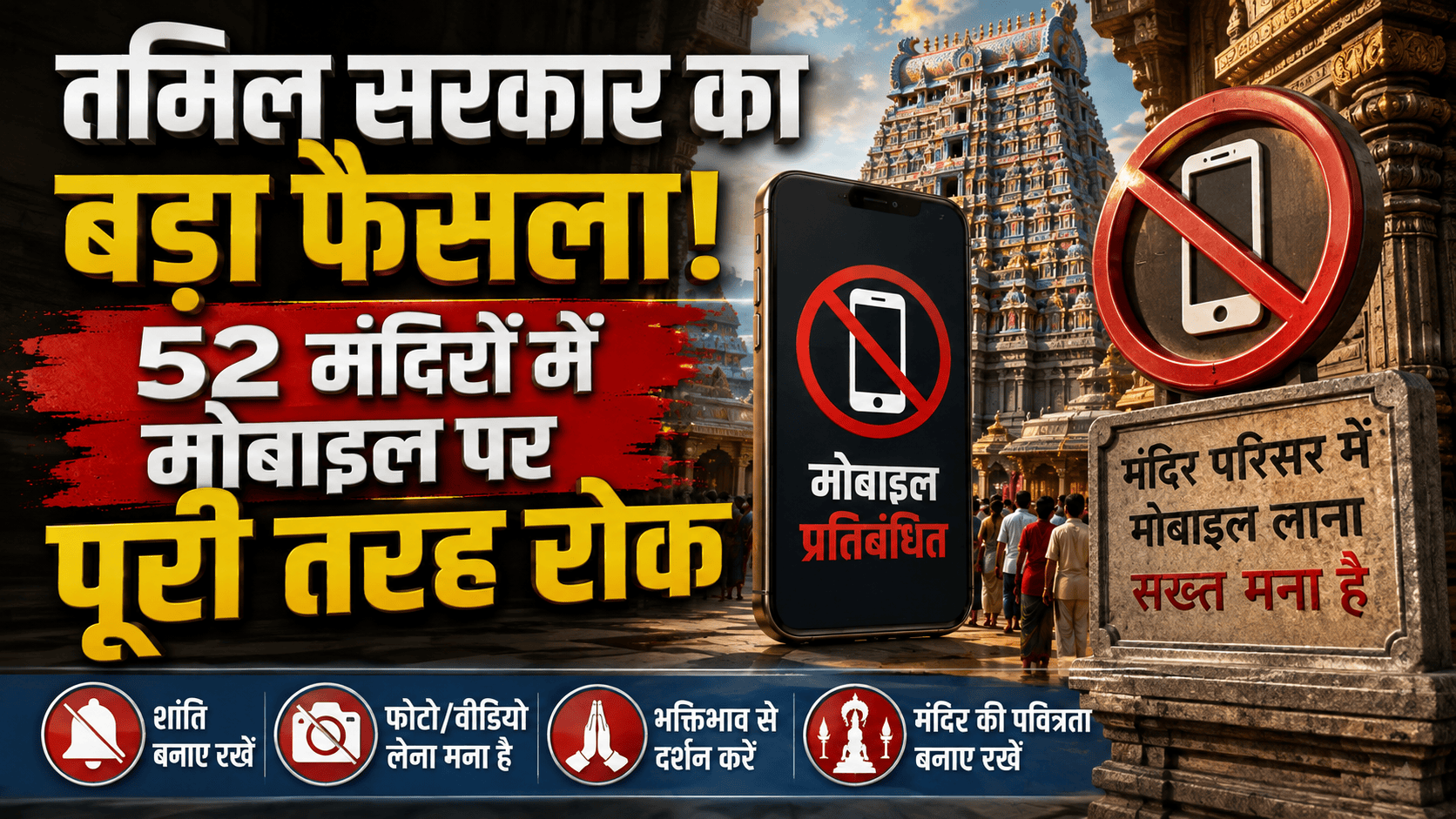
Tamil Government Has Banned Mobile Phones in 52 Temples: A New Step to Preserve Temple Sanctity
Now, the Tamil government has banned mobile phone use inside the premises of 52 temples, bringing renewed attention to the relationship between technology and religious spaces.
For thousands of years, temples in Tamil Nadu have remained places of prayer, devotion, meditation, and spiritual reflection. Devotees traditionally entered temple premises carrying flowers, coconuts, camphor, and offerings for the deity. They also brought their personal worries and prayers, hoping to find peace and strength. But in the 21st century, another item has become almost inseparable from the modern devotee: a fully charged smartphone.
The decision reflects growing concerns about maintaining discipline, silence, privacy, and the traditional atmosphere inside temples. Smartphones have become an essential part of daily life, but their constant presence can sometimes interfere with the spiritual environment that temples are intended to provide. With the Tamil government has banned mobile policy being discussed widely, questions are being raised about whether devotees should temporarily disconnect from technology while connecting with their faith.
Why Are Mobile Phones Becoming a Concern in Temples?
Mobile phones have changed the way people communicate, work, shop, travel, and even worship. A devotee can now take photographs, record videos, make phone calls, check social media, or livestream an event from inside a temple. While some visitors may consider this harmless, temple authorities often face a different challenge.
The Tamil government has banned mobile use in the premises of 52 temples in an effort to create an environment where devotees can concentrate on prayer without digital distractions. Ringing phones, conversations, camera flashes, video recordings, and social media activities can disturb other worshippers.
Temples are not simply tourist attractions. For millions of people, they are sacred spaces where rituals and traditions have been preserved for generations. The restriction is therefore being viewed as an attempt to protect the sanctity and atmosphere of these important religious institutions.
From Offerings to Smartphones
There is an interesting contrast between the traditional devotee and the modern devotee. In earlier generations, people entered temples with flowers, coconuts, fruits, lamps, and camphor. They would stand before the deity, close their eyes, and spend a few moments in prayer.
Today, a smartphone often accompanies the same journey. People may want to photograph the temple architecture, record a special ritual, communicate with family members, or immediately share their experience online.
The Tamil government has banned mobile policy highlights how deeply smartphones have entered religious life. The issue is not necessarily about technology itself. Rather, it is about determining when and where technology should be used.
A temple visit is often meant to provide a break from the pressures of everyday life. If a devotee continues checking notifications, answering calls, or recording videos, the opportunity for quiet reflection can easily be lost.


Protecting the Spiritual Atmosphere
One of the strongest arguments supporting the restriction is the preservation of peace inside temple premises. Religious ceremonies often involve chanting, bells, music, prayers, and rituals. These experiences can be disrupted when visitors use mobile phones.
The Tamil government has banned mobile phones in 52 temples as part of an effort to encourage devotees to focus on worship. A phone-free environment could help reduce unnecessary conversations and distractions, allowing people to participate more mindfully in religious activities.
There is also a privacy concern. Not everyone visiting a temple wants to appear in a photograph or video uploaded to social media. Restricting mobile phone use can reduce the possibility of visitors being unintentionally recorded during moments of prayer.
A Question of Balance
However, any restriction involving smartphones naturally raises questions. Mobile phones are also useful for emergencies, communication, digital payments, navigation, and accessing important information. Elderly devotees or people accompanying children may sometimes need access to their phones.
The Tamil government has banned mobile use within selected temple premises, but the broader discussion is about finding the right balance between modern convenience and traditional values.
Rather than treating smartphones as inherently negative, the policy can be understood as encouraging people to use them responsibly. There are many places where smartphones are extremely useful. But there are also locations where putting the device away for a while can improve the experience.
Temples as Technology-Free Spaces
The idea of temporarily disconnecting from technology is becoming increasingly relevant in modern society. People spend significant portions of their day looking at screens. Smartphones provide entertainment and convenience, but they can also make it difficult to remain fully present.
The Tamil government has banned mobile phones in these temples, creating an opportunity for devotees to experience worship without digital interruptions. A short period without notifications, calls, cameras, and social media may allow visitors to focus more deeply on prayer.
For some devotees, the restriction may even make the temple visit more meaningful. Instead of thinking about capturing the perfect photograph, they can concentrate on the atmosphere, rituals, architecture, and their personal connection with the deity.
Impact on Younger Generations
The policy could also have an educational impact on younger devotees. Children and young adults have grown up in a world where smartphones are almost always within reach. Asking them to keep their phones away inside a temple could teach them that certain places require special forms of respect and behavior.
The Tamil government has banned mobile use in 52 temples, and the decision may encourage families to discuss the importance of religious etiquette with younger generations.
A temple visit can then become more than a quick stop for prayers. It can become an opportunity for families to spend time together without digital distractions and introduce children to cultural traditions.
Will the Restriction Change Temple Visits?
Whether the measure significantly changes visitor behavior will depend on how it is implemented. Clear communication, proper storage facilities where necessary, and reasonable exceptions for genuine emergencies could make the policy easier for devotees to follow.
The Tamil government has banned mobile phone usage in selected temples, but successful implementation will require cooperation between temple authorities and visitors. Devotees also have a responsibility to respect the rules of sacred places.
The restriction should not necessarily be viewed as an attack on modern technology. Instead, it can be seen as creating boundaries for technology use. Smartphones can remain an important part of everyday life while being temporarily set aside during worship.
A Return to Mindful Worship
The Tamil government has banned mobile phones in 52 temples at a time when digital distractions are becoming increasingly common. The decision has therefore sparked an important conversation about how people experience religion in the smartphone era.
The Tamil government has banned mobile use, but the larger message may be about mindfulness. When devotees enter a temple, they can leave behind not only their phones but also, for a short while, the pressures of work, social media, messages, and everyday responsibilities.
The Tamil government has banned mobile phones within the selected temple premises, reminding visitors that sacred spaces have their own traditions and expectations.


For generations, devotees have entered temples carrying flowers, coconuts, and camphor. Today, they may still carry those offerings—but they may also be carrying a smartphone. The new restrictions ask them to make a simple choice: for the duration of their temple visit, can they put the phone aside and give their complete attention to prayer?
The Tamil government has banned mobile use to reinforce that idea of undistracted worship. The Tamil government has banned mobile phones in 52 temples, making this an important development in the management of religious spaces.
Ultimately, the Tamil government has banned mobile policy represents a broader debate between convenience and tradition. Technology will continue to evolve, and smartphones will remain part of modern life. Yet temples can continue to serve as places where people pause, reflect, pray, and reconnect with themselves.
The Tamil government has banned mobile use in these selected temples, but the real objective is perhaps not simply to remove a device from a person’s hand. It is to restore attention to the spiritual experience.
As the Tamil government has banned mobile phone use in these sacred premises, devotees may discover that sometimes the most valuable connection is not a connection to the internet, but a connection to faith, tradition, and inner peace.
The Tamil government has banned mobile phones in these temples, and the decision is likely to remain part of the wider discussion about how religious institutions should adapt to the digital age while preserving their timeless character.
Read more latest news

