
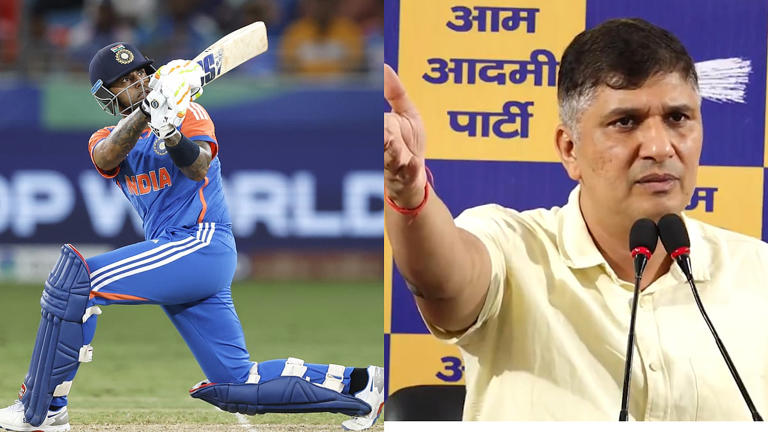
AAP Leader Saurabh Bhardwaj Challenges Cricketer Suryakumar Yadav and BCCI – A War of Words Between Politics and Cricket
Introduction
AAP leader Saurabh Bhardwaj challenges Indian politics and cricket have often crossed paths, sometimes in symbolic ways and other times through direct confrontations. In the latest development, Aam Aadmi Party (AAP) leader and Delhi minister Saurabh Bhardwaj has taken aim at Indian cricketer Suryakumar Yadav and even the Board of Control for Cricket in India (BCCI). His remarks have created a stir, sparking a debate on the relationship between politics, sports, and the role of players in shaping public discourse.
Known for his outspoken nature, Bhardwaj did not mince words in his recent statement. He issued what he described as a “challenge” to Suryakumar Yadav and BCCI, questioning not only the conduct of players but also the way cricket is being run in India. The statement quickly went viral, igniting conversations among cricket fans, political observers, and the media alike.
In this blog, we’ll explore the details of Bhardwaj’s challenge, the context behind his remarks, the role of cricket in Indian society, reactions from different stakeholders, and what this controversy signifies for the intersection of politics and sports in India.
Who is Saurabh Bhardwaj?
Before diving into the controversy, it is important to understand the figure at the center of it — Saurabh Bhardwaj. A senior leader of the Aam Aadmi Party, Bhardwaj serves as a minister in the Delhi government. He has been a vocal critic of the BJP and other political adversaries, and is known for making sharp, attention-grabbing statements.
Bhardwaj has often raised issues related to governance, transparency, and accountability. In this case, his decision to target the cricket establishment and a star player like Suryakumar Yadav reflects his broader political strategy: speaking directly to issues that resonate with the masses.
Who is Suryakumar Yadav?
On the other hand, Suryakumar Yadav, popularly known as “SKY”, is one of India’s most celebrated cricketers in recent years. With his flamboyant batting style, especially in T20 cricket, he has earned global recognition. His consistent performances in international matches and the Indian Premier League (IPL) have made him a household name.
Cricketers like SKY enjoy immense popularity, often being treated as youth icons and role models. Their influence extends beyond the cricket field, shaping conversations around culture, lifestyle, and sometimes even politics. This makes any criticism of them by political leaders highly significant.
The Core of the Controversy: Bhardwaj’s Challenge
Saurabh Bhardwaj’s challenge to Suryakumar Yadav and the BCCI revolves around accountability, transparency, and social responsibility. According to Bhardwaj, cricketers cannot remain silent on issues affecting ordinary citizens while enjoying the perks of being national icons.
He argued that:
- Players like Suryakumar Yadav, who are adored by millions, should not restrict themselves to cricket alone.
- The BCCI, as one of the richest cricket boards in the world, should be more transparent in its functioning.
- The influence of corporate sponsors and political figures in cricket raises questions about fairness.
Bhardwaj’s words struck a chord with those who believe that sports and public accountability go hand in hand. At the same time, his remarks drew criticism from fans who felt that dragging cricketers into politics was unnecessary.

Cricket and Politics: A Deep Connection
The tension between cricket and politics is nothing new in India. From the time of Maharaja Ranjitsinhji to modern-day stars like Virat Kohli and Rohit Sharma, cricketers have always had a special place in Indian society.
Key points about the cricket-politics connection:
- Cricket as a Unifier: Cricket often brings the nation together, transcending caste, religion, and regional differences.
- Political Symbolism: Politicians have historically used cricket events to showcase nationalism.
- BCCI’s Power: The BCCI is one of the most influential sports bodies in the world, and its decisions are often influenced by politics and business.
- Cricketers as Icons: Players often remain apolitical, but their silence on social issues sometimes draws criticism.
Bhardwaj’s challenge highlights this very tension: should cricketers remain neutral, or should they use their platform to address social concerns?
Why Suryakumar Yadav?
It’s important to ask why Bhardwaj specifically targeted Suryakumar Yadav. There could be several reasons:
- Popularity Factor: SKY is one of the most talked-about cricketers today, making him an ideal target if the aim is to grab public attention.
- Youth Icon: Bhardwaj may be appealing to the youth by positioning himself as someone who dares to speak against powerful figures.
- Symbolism: By challenging a beloved cricketer, Bhardwaj is indirectly questioning the culture of hero worship in India.
This move ensures that his remarks get maximum traction in the media and among the public.
The BCCI Angle
Bhardwaj didn’t stop at Suryakumar Yadav — he also took on the BCCI, which he accused of being non-transparent and politically influenced.
His main points included:
- Lack of clarity in selection processes.
- Over-commercialization of cricket through IPL and sponsorship deals.
- Political leaders allegedly holding indirect influence over BCCI decisions.
These criticisms are not new, but coming from a political leader, they carry weight. Many critics have long argued that the BCCI needs greater accountability, especially since it manages the nation’s favorite sport.

Public and Media Reactions
Unsurprisingly, Bhardwaj’s comments sparked a storm on social media and in news debates.
- Supporters’ View:
- Many agreed with him, saying that cricketers should not shy away from speaking about issues like unemployment, corruption, or inequality.
- Some also applauded him for taking on the BCCI, which they believe functions like an “untouchable empire.”
- Critics’ View:
- Fans of Suryakumar Yadav accused Bhardwaj of politicizing cricket.
- They argued that cricketers are professionals, not politicians, and should not be forced into political debates.
- Some felt Bhardwaj was only trying to gain publicity by dragging SKY into controversy.
- Media:
- Television debates focused on whether Bhardwaj’s statement was fair or opportunistic.
- News portals carried headlines highlighting the “challenge” to SKY, ensuring the controversy remained in public discussion.
Cricket Fans’ Emotional Bond
Cricket in India is more than just a sport — it’s an emotion. Fans form deep connections with players, often defending them passionately. This explains why Bhardwaj’s comments drew strong backlash from SKY’s supporters.
For many, Suryakumar Yadav represents hard work, perseverance, and the dreams of millions of youth. They believe he should be respected for his contributions to cricket, not pulled into political controversies.
Sports and Social Responsibility
At the heart of this debate lies an important question: Do sports personalities have a responsibility to speak on social issues?
- For: Celebrities, including cricketers, enjoy fame and influence. Many believe they should use their platforms to highlight pressing concerns like poverty, discrimination, or environmental issues.
- Against: Critics argue that athletes should focus on their sport and not risk alienating fans with political statements.
Globally, athletes like Muhammad Ali, Colin Kaepernick, and Naomi Osaka have used their platforms for activism. In India, however, most cricketers remain silent, which is why Bhardwaj’s comments resonate with some sections of society.
Political Strategy Behind Bhardwaj’s Remarks
From a political perspective, Bhardwaj’s remarks can be seen as a strategic move. By challenging SKY and BCCI, he achieves multiple goals:
- Media Attention: His comments dominate headlines and social media, boosting his visibility.
- Youth Outreach: By targeting a youth icon, Bhardwaj positions himself as someone who speaks the language of young people.
- Challenging Status Quo: He questions institutions (like BCCI) that often escape scrutiny.
- Polarization: His comments create a debate that forces people to take sides — either with cricketers or with calls for accountability.
Long-Term Impact of the Controversy
Whether this controversy fades away or leads to lasting discussions depends on how both sides respond.
- If Suryakumar Yadav chooses to respond, the issue could escalate further.
- If BCCI addresses the criticisms, it may open the door for more transparency.
- Politically, Bhardwaj may continue using sports as a metaphor for accountability, strengthening his brand as an outspoken leader.
For fans, the controversy may serve as a reminder that cricketers are not just entertainers but public figures whose influence extends beyond the stadium.
Conclusion
Saurabh Bhardwaj’s challenge to Suryakumar Yadav and the BCCI highlights the uneasy intersection between politics, sports, and society in India. While his comments have sparked outrage among cricket fans, they have also reignited important questions about the role of athletes in public life and the accountability of powerful institutions like the BCCI.
Whether one agrees with Bhardwaj or not, the controversy underlines a larger truth: in a country like India, where cricket is a religion, even the smallest political remark about the game can create nationwide ripples.
As the debate continues, one thing is certain — the relationship between politics and cricket will remain as complex and intertwined as ever. And for now, Saurabh Bhardwaj has ensured that his voice, like his challenge, will not go unnoticed.
Read more latest news

