
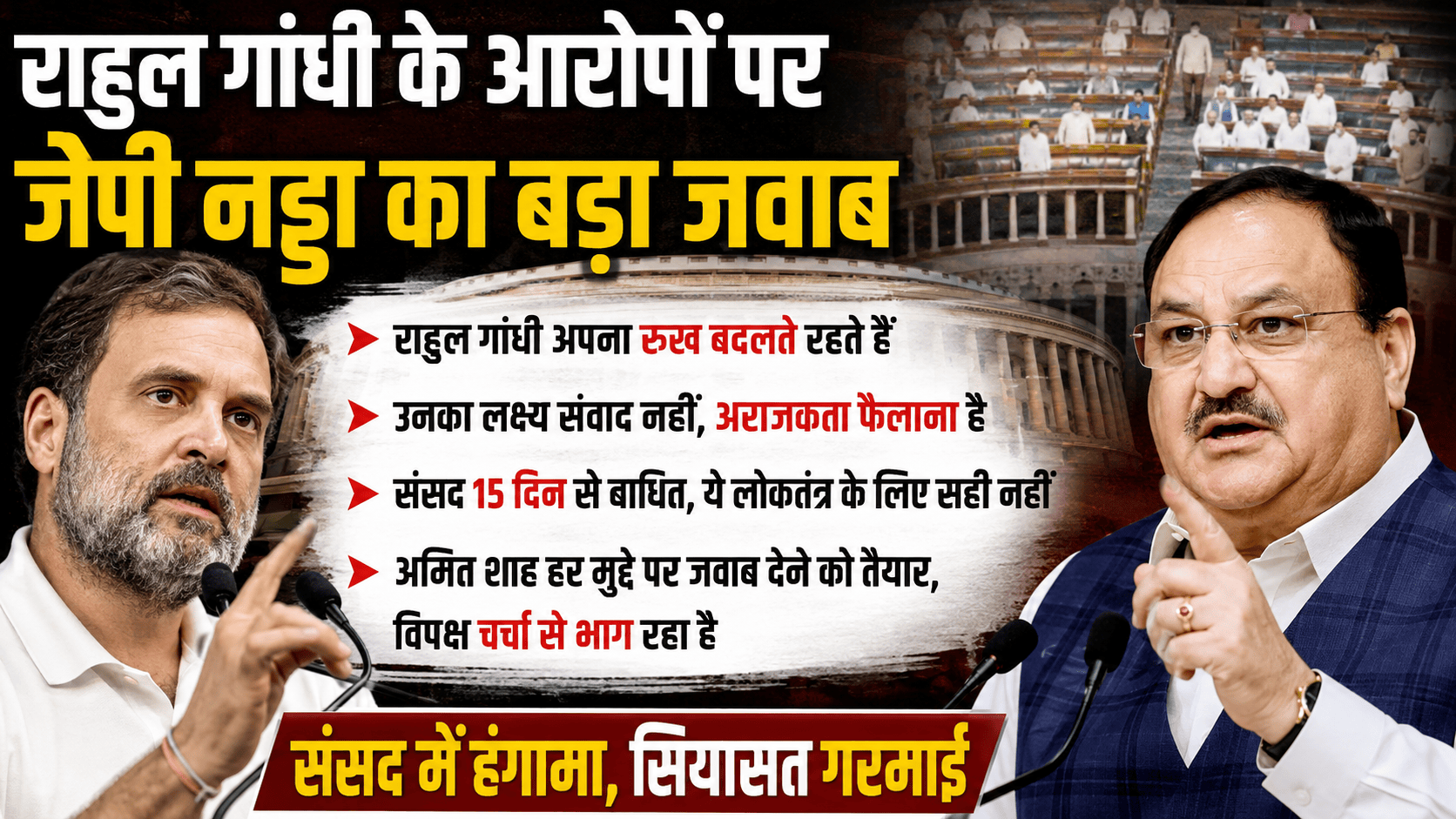
Responding Rahul Gandhi Allegations: JP Nadda Says Opposition Is Avoiding Debate, Aims to Create Chaos
Responding Rahul Gandhi allegations, Union Health Minister and senior BJP leader JP Nadda accused Congress leader Rahul Gandhi of repeatedly changing his position on parliamentary issues. Nadda claimed that the opposition’s objective was not meaningful dialogue but creating disruption and political chaos.
According to Nadda, Parliament has been disrupted for 15 days, preventing important matters from being discussed in a constructive manner. He further stated that Union Home Minister Amit Shah is prepared to answer questions raised by the opposition, but opposition leaders are allegedly avoiding a proper discussion.
Responding Rahul Gandhi Allegations, JP Nadda Targets Opposition Strategy
Responding Rahul Gandhi allegations, JP Nadda argued that Rahul Gandhi’s position on various issues keeps changing. According to the BJP leader, the Congress leader raises allegations and political questions but does not remain consistent when the government offers an opportunity for discussion.
Nadda’s remarks have added another layer to the ongoing political dispute between the government and opposition. The BJP has maintained that Parliament should function normally so that issues of national importance can be debated and the government can provide answers on the floor of the House.
The Congress and other opposition parties, however, have continued to raise their concerns and demand answers from the government on issues they consider important. This has resulted in repeated political clashes between the treasury benches and opposition members.
Parliament Disruption Becomes a Major Political Issue
Responding Rahul Gandhi allegations, Nadda highlighted the alleged disruption of Parliament for 15 days. He questioned whether repeatedly interrupting proceedings could help resolve the issues being raised by opposition parties.
Parliamentary disruption has become a recurring point of confrontation between governments and opposition parties in India. While opposition parties often argue that protests and disruptions are necessary to force the government to address important concerns, the government generally maintains that elected representatives should use parliamentary mechanisms for debate.
The latest controversy reflects this continuing disagreement. The BJP argues that the opposition should allow Parliament to function and participate in discussions, while opposition leaders have sought to highlight their political and policy concerns through protests and demands for debate.
Amit Shah Ready to Respond Says Nadda
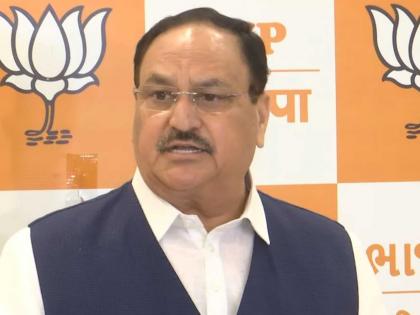
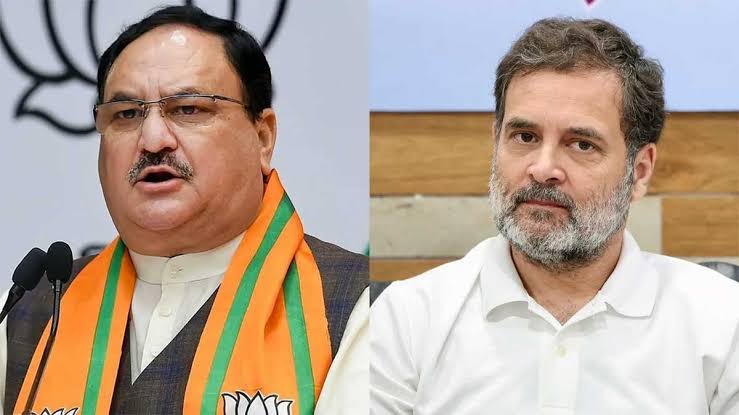
Responding Rahul Gandhi allegations, JP Nadda also referred to Union Home Minister Amit Shah. Nadda stated that Shah is ready to respond to every issue raised by the opposition.
This claim is central to the BJP’s argument that the opposition should participate in parliamentary debate rather than disrupting proceedings. According to Nadda, if opposition leaders have questions or allegations, they can raise them in Parliament and seek direct responses from the government.
The BJP’s position is that parliamentary debate provides an institutional platform for accountability. Ministers can respond to allegations, explain government policies and clarify their positions before elected representatives.
Nadda therefore questioned why the opposition would allegedly avoid discussion when the government is prepared to respond.
Rahul Gandhi and Congress Continue to Challenge Government
Responding Rahul Gandhi allegations, the BJP’s criticism comes amid continued political attacks by Rahul Gandhi and the Congress against the government. Gandhi has frequently used Parliament and public platforms to raise questions about government policies and decisions.
The Congress has positioned itself as an opposition force responsible for questioning the government and highlighting issues affecting citizens. From the BJP’s perspective, however, allegations need to be accompanied by parliamentary discussion and evidence-based debate.
This difference in approach has contributed to an increasingly confrontational political atmosphere. Both sides have attempted to present themselves as defenders of democratic accountability, while accusing the other side of weakening parliamentary functioning.
Debate or Disruption?
Responding Rahul Gandhi allegations, Nadda’s remarks raise a broader question about the role of protest and disruption in parliamentary democracy. Opposition parties have traditionally used protests to draw attention to issues when they believe their concerns are not receiving adequate attention.
At the same time, Parliament is designed to provide an institutional space where elected representatives can debate legislation, question ministers and scrutinize government decisions.
The challenge lies in maintaining a balance between protest and parliamentary functioning. Opposition parties need mechanisms to express disagreement, while the government also needs sufficient opportunity to present its explanations and defend its policies.
The BJP’s criticism suggests that the government believes the current level of disruption has crossed that balance.
Political Battle Intensifies
Responding Rahul Gandhi allegations, JP Nadda accused the opposition of seeking chaos rather than dialogue. Such allegations are likely to further intensify the political battle between the BJP and Congress.
For the ruling party, the issue provides an opportunity to argue that the government is willing to answer questions but is being prevented from doing so because of disruptions. For the opposition, continued pressure on the government remains a key part of its political strategy.
The disagreement is therefore not simply about individual statements. It reflects a larger contest over how political accountability should operate inside Parliament.
Why Parliamentary Discussion Matters
Responding Rahul Gandhi allegations, Nadda’s comments also bring attention to the importance of parliamentary debate. Parliament allows representatives from different political parties to present competing viewpoints on issues affecting the country.
A functioning parliamentary system depends on both government and opposition participating in this process. The government is expected to answer questions and explain its decisions, while the opposition is expected to scrutinize those decisions and offer alternatives.
When proceedings are repeatedly disrupted, opportunities for such exchanges can be reduced. This is why parliamentary functioning has become an important part of the latest BJP-Congress confrontation.
BJP’s Message to the Opposition
Responding Rahul Gandhi allegations, the BJP’s message is that opposition parties should use parliamentary debate rather than repeatedly disrupting proceedings. Nadda’s statement that Amit Shah is ready to answer questions is intended to reinforce the government’s claim that it is open to discussion.
The BJP is effectively challenging the opposition to bring its allegations to the floor of Parliament and participate in a formal debate. This approach allows ministers to respond on record and gives lawmakers an opportunity to challenge those responses.
Whether the opposition accepts this approach will remain an important political question as the parliamentary confrontation continues.

Opposition’s Political Challenge
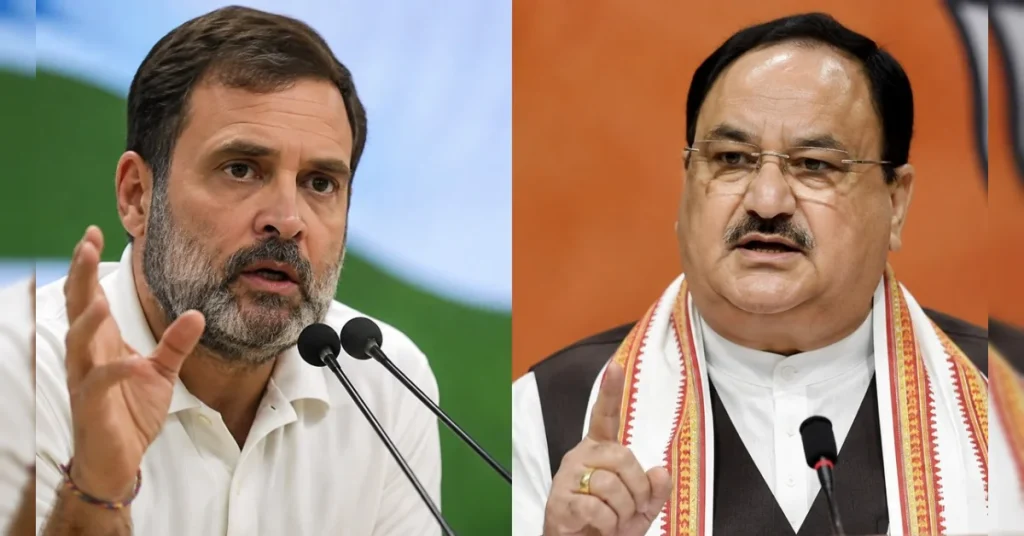
Responding Rahul Gandhi allegations, the Congress and other opposition parties face the challenge of maintaining pressure on the government while ensuring that their concerns receive substantive parliamentary attention.
Political protests can generate public attention, but parliamentary debate can provide a more detailed platform for questioning government decisions. The effectiveness of either strategy depends on how political parties use the available democratic institutions.
The current dispute demonstrates how disagreements over parliamentary procedure can quickly become part of a larger political battle.
Conclusion
Responding Rahul Gandhi allegations, JP Nadda has accused Rahul Gandhi of changing his stance and claimed that the opposition’s objective is to create chaos rather than engage in dialogue. He also alleged that Parliament has faced disruption for 15 days and emphasized that Home Minister Amit Shah is ready to answer questions raised by the opposition.
The latest confrontation highlights the continuing political divide between the BJP and Congress. At the heart of the dispute is a fundamental question: should political differences be resolved primarily through protest and disruption, or through structured parliamentary debate?
Responding Rahul Gandhi allegations has therefore become part of a larger debate over parliamentary accountability, opposition strategy and the functioning of India’s democratic institutions. As the political confrontation continues, the ability of both sides to move from accusations toward substantive discussion will be closely watched.
Read more latest news

