
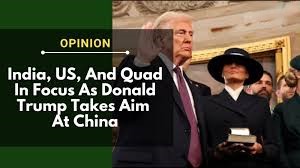
Straight Talk | India, US, And Quad in Focus as Donald Trump Takes Aim at China
Quad The international order stands at a crucial crossroads as Donald Trump embarks on his second term as President of the United States. With a staunch focus on countering China’s growing influence, Trump is set to reshape alliances and redefine America’s foreign policy objectives. Central to this strategy is the Quadrilateral Security Dialogue (Quad), a coalition of the US, India, Japan, and Australia, which has emerged as a key pillar in the Indo-Pacific geopolitical framework.
This article delves into the dynamics of the Quad, the evolving India-US partnership, and Trump’s broader approach to countering China’s influence.
The Quad: A Strategic Coalition
What is the Quad?
often described as a “mini-NATO” for the Indo-Pacific, is a strategic dialogue aimed at promoting a free, open, and inclusive Indo-Pacific region. Initially conceptualized in 2007, the coalition gained momentum in recent years as member nations sought to address shared concerns over China’s assertiveness in the region.
The Quad’s focus areas include:
- Maritime Security: Ensuring freedom of navigation and preventing militarization of key waterways like the South China Sea.
- Infrastructure Development: Offering alternatives to China’s Belt and Road Initiative (BRI).
- Economic Cooperation: Building resilient supply chains to reduce dependence on China.
- Technological Collaboration: Developing standards for emerging technologies such as 5G and AI.
The Quad’s Role in Countering China
The Quad countries share common grievances over China’s actions, from territorial disputes in the South and East China Seas to its economic coercion tactics. In this context, the Quad serves as a platform to collectively address these challenges. Key initiatives include:
- Conducting joint military exercises, such as the Malabar naval drills.
- Strengthening regional partnerships with countries like Vietnam, Indonesia, and the Philippines.
- Enhancing cooperation in areas like cyber security and space.
India-US Relations: A Strategic Partnership
Deepening Defense Ties
India has emerged as a critical player in the Indo-Pacific, and its partnership with the US has reached unprecedented levels. Under Trump’s leadership, the India-US defense relationship has flourished, marked by key agreements such as:
- BECA (Basic Exchange and Cooperation Agreement): Facilitates sharing of geospatial intelligence.
- COMCASA (Communications Compatibility and Security Agreement): Enables secure communications between armed forces.
- Increasing arms sales, including drones, fighter jets, and missile systems.

Economic Collaboration
While defense ties have strengthened, economic relations between India and the US remain complex. Bilateral trade has grown significantly, but issues such as tariffs, intellectual property rights, and market access continue to pose challenges. The Trump administration’s focus on reducing trade deficits aligns with India’s ambition to boost exports, creating opportunities for mutual benefit.
India’s Role in the Indo-Pacific
India’s geographic location and its status as the world’s largest democracy make it a natural ally for the US in countering China. Key aspects of India’s role include:
- Military Presence: Expanding naval capabilities in the Indian Ocean to counter Chinese influence.
- Connectivity Projects: Partnering with the US to develop infrastructure in South Asia and Africa.
- Tech and Innovation: Collaborating on critical technologies to reduce dependency on China.
Trump’s China Strategy: Confrontation Over Cooperation
Economic Decoupling
During his first term, Trump initiated a trade war with China, imposing tariffs on Chinese goods and pressuring US companies to shift supply chains. In his second term, this strategy is likely to intensify, with a focus on:
- Reshoring Manufacturing: Incentivizing companies to bring production back to the US.
- Strengthening Allies: Encouraging Quad nations to reduce economic dependence on China.
- Sanctions: Expanding restrictions on Chinese companies, particularly in tech.
Technological Rivalry
Trump’s administration has taken a hard stance against Chinese tech giants like Huawei and TikTok, citing security concerns. This rivalry extends to areas such as:
- 5G Development: Collaborating with Quad nations to create alternatives to Huawei’s infrastructure.
- AI and Quantum Computing: Promoting research partnerships within the Quad.
- Cybersecurity: Coordinating efforts to counter cyber threats from China.
Military Posturing
The Trump administration has emphasized military strength as a deterrent to China’s aggression. Key initiatives include:
- Increased Naval Presence: Deploying warships in the South China Sea and Indian Ocean.
- Arms Sales: Providing advanced weaponry to Quad allies.
- Military Alliances: Strengthening partnerships with ASEAN nations to counterbalance China.
Challenges and Criticisms
1. Balancing Multilateralism with Nationalism
While Trump champions the Quad, his “America First” approach has sometimes created tensions with allies. Critics argue that unilateral actions, such as imposing tariffs on allies, undermine the spirit of multilateral cooperation.
2. India’s Balancing Act
India faces the challenge of balancing its growing ties with the US against its historical relationship with Russia and its economic dependency on China. Any overt alignment with the US could invite retaliation from Beijing.
3. Regional Tensions
The Quad’s military activities risk escalating tensions in the Indo-Pacific. China has labeled the coalition as a “Cold War mentality” and warned against its expansion.
4. Economic Dependencies
Despite efforts to decouple, the Quad nations remain economically intertwined with China. Breaking these dependencies will require significant investments and time.
Opportunities for Cooperation
1. Infrastructure Development
The Quad can counter China’s BRI by offering transparent and sustainable infrastructure projects in developing nations. This could include investments in:
- Ports and railways in Africa and South Asia.
- Renewable energy projects in the Pacific Islands.
2. Vaccine Diplomacy
The Quad played a pivotal role in vaccine distribution during the COVID-19 pandemic. Expanding such initiatives can enhance the coalition’s soft power.
3. Climate Change
Addressing climate change through joint research and funding for green technologies can serve as a unifying agenda for the Quad.
4. People-to-People Ties
Strengthening educational and cultural exchanges among Quad nations can foster deeper understanding and trust.
The Road Ahead
As Trump’s administration ramps up its focus on China, the Quad will play a central role in shaping the Indo-Pacific order. India, with its strategic location and growing influence, stands to benefit from this partnership but must navigate its position carefully. For the US, success will depend on maintaining the cohesion of the Quad while addressing its own internal challenges.
The Trump administration’s aggressive stance against China has set the stage for a complex, high-stakes geopolitical game. Whether this strategy succeeds will depend on the ability of Quad nations to work together and present a united front in the face of shared challenges.
In the coming years, the Indo-Pacific will remain the world’s most dynamic and contested region, with the Quad at the heart of this evolving narrative.
Read more latest news

