
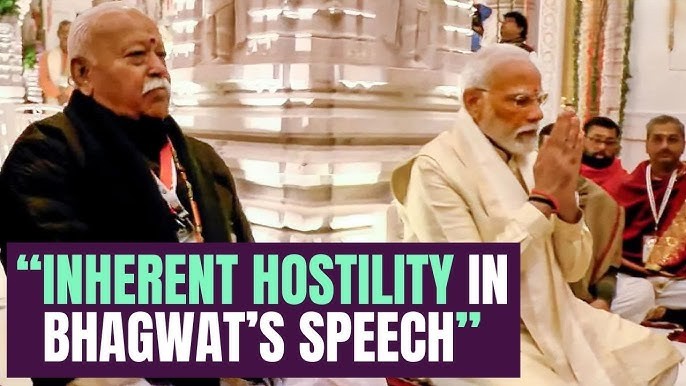
On the 2nd of April 2025, Prime Minister Narendra Modi is scheduled to visit Nagpur Smruti Mandir, Maharashtra, to participate in a significant event that will undoubtedly capture the attention of both political and cultural spheres. During his visit, Modi will pay homage at the ‘Smruti Mandir’ (Memorial Temple), a site associated with the revered RSS (Rashtriya Swayamsevak Sangh) founder Dr. K.B. Hedgewar. Additionally, he will share the stage with the RSS Chief, Mohan Bhagwat, marking a notable moment of political and ideological alignment between the Bharatiya Janata Party (BJP) and the RSS.
Smruti Mandir In a nation as politically charged and ideologically diverse as India, the Prime Minister’s visit to the Smruti Mandir and his public appearance alongside the RSS Chief holds deep symbolic and practical implications. This event is not just another political gathering but also a statement that speaks to the current state of Indian politics, the intricate relationship between the BJP and the RSS, and the broader cultural and ideological currents shaping the nation’s future.
This blog will unpack the significance of Prime Minister Modi’s visit to Smruti Mandir, the historical and ideological importance of the RSS, and what sharing a stage with RSS Chief Mohan Bhagwat signifies for the BJP, India’s political landscape, and the broader discourse on nationalism, religion, and culture.
The RSS and the Smruti Mandir: Historical Context
Before delving into the political significance of Modi’s visit, it is essential to understand the importance of the RSS and the Smruti Mandir itself. Founded in 1925 by Dr. K.B. Hedgewar, the RSS is a Hindu nationalist organization that has played a pivotal role in shaping the ideological framework of contemporary India. While it started as a volunteer-based organization with a focus on physical training and discipline, it quickly expanded its influence to include cultural, educational, and political activities aimed at promoting Hindu unity and cultural pride.
The Smruti Mandir, situated in Nagpur, is a memorial dedicated to the founder of the RSS, Dr. Hedgewar, and serves as a symbol of the RSS’s deep historical roots in Nagpur. It stands as a tribute to the man who laid the foundation for an organization that would go on to become a significant force in Indian politics, especially with the rise of the BJP.
Dr. Hedgewar’s vision was to create a strong Hindu society that would be capable of addressing the challenges posed by colonial rule and later, by various social and political movements. Over time, the RSS has expanded its reach and influence, not just in Maharashtra but across India, shaping the nation’s cultural, educational, and political dynamics. As such, the Smruti Mandir is not merely a religious or cultural site but also a repository of the RSS’s historical legacy.
The RSS and the BJP: A Symbiotic Relationship
The relationship between the RSS and the BJP is crucial to understanding the political dynamics of modern India. The RSS is often considered the ideological parent of the BJP, with many of the latter’s leaders, including Prime Minister Modi, having strong ties to the RSS. While the BJP is a formal political party with an electoral mandate, the RSS serves as a cadre-based organization that influences the party’s ideology, policy-making, and outreach efforts.
For decades, the RSS has shaped the political philosophy of the BJP, particularly in terms of its emphasis on Hindutva (Hindu nationalism), cultural conservatism, and a vision of India as a Hindu-majority nation. While the BJP, especially under Modi’s leadership, has worked to broaden its base and appeal to a wider electorate, the RSS remains a key ideological and organizational force behind its political agenda.
Modi’s connection to the RSS is well-known. He was a full-time pracharak (campaigner) with the RSS before entering formal politics with the BJP. His rise to prominence within the BJP was significantly aided by the RSS’s support, which helped cement his political career. The RSS’s philosophy continues to be a guiding force for the BJP, influencing the party’s policies, campaign strategies, and even its approach to governance.
Therefore, Modi’s visit to Smruti Mandir and his appearance alongside Bhagwat is not merely ceremonial. It is a manifestation of the strong bond between the BJP and the RSS, signifying the political alignment of the two entities. The event underscores the ongoing influence of the RSS in shaping the BJP’s political agenda and highlights the continuity of the ideological vision set forth by Dr. Hedgewar.
The Significance of the Smruti Mandir Visit for Modi
Prime Minister Modi’s visit to Smruti Mandir is laden with political and ideological significance. First and foremost, it symbolizes his unbroken connection to the RSS and the legacy of Dr. Hedgewar. By paying homage at the memorial, Modi not only reaffirms his ideological commitments but also signals his continued support for the RSS’s vision of a Hindu-centric India.
The visit also comes at a time when the BJP is preparing for crucial state elections and gearing up for the 2024 General Elections. By engaging with the RSS and appearing alongside Bhagwat, Modi is sending a clear message to his core supporters within the Hindu nationalist camp that his allegiance to the RSS and its ideals remains steadfast. This is particularly important as Modi continues to consolidate his position as the undisputed leader of the BJP and the face of Hindu nationalism in Indian politics.
Furthermore, the Smruti Mandir visit reflects Modi’s broader strategy of engaging with cultural and religious symbolism to solidify his political base. Since assuming office in 2014, Modi has repeatedly used religious and cultural touchstones to appeal to the masses. From the promotion of yoga and the celebration of Diwali at the national level to the construction of the Ram Mandir in Ayodhya, Modi has utilized Hindu religious symbolism as a tool for political mobilization.
The Smruti Mandir visit is in keeping with this approach. It emphasizes his connection to the RSS and strengthens his association with Hindu cultural pride, which is a cornerstone of the BJP’s ideology. At the same time, it serves as a reminder to Modi’s supporters that he remains deeply connected to the ideological roots of the BJP, despite his position as the leader of the entire nation.
Mohan Bhagwat and the Role of the RSS Chief
Sharing the stage with Mohan Bhagwat, the current chief of the RSS, adds another layer of significance to Modi’s visit. Bhagwat, who has been at the helm of the RSS since 2009, is one of the most influential figures in contemporary Indian politics. Under his leadership, the RSS has further entrenched itself as a dominant ideological force in the country, pushing forward its vision of a Hindu Rashtra (Hindu Nation) and striving to shape India’s political discourse according to its principles.
Bhagwat’s influence extends far beyond the RSS. He is widely regarded as one of the most powerful figures within the Sangh Parivar, the broader network of Hindu nationalist organizations that includes the BJP, the Vishwa Hindu Parishad (VHP), and others. His views on Hindu unity, the promotion of Hindu culture, and the need for a Hindu-first India resonate deeply within the BJP, which has embraced many of these ideas.
Modi’s decision to share the stage with Bhagwat is a powerful political gesture. It signifies not just the political closeness between the BJP and the RSS but also underscores the ideological alignment between Modi and Bhagwat. Despite the fact that Modi is the Prime Minister of India, a position that traditionally requires a degree of political neutrality, his partnership with Bhagwat highlights the BJP’s continuing commitment to the RSS’s vision of India.
The presence of both leaders on the same stage reinforces the idea that the BJP, under Modi’s leadership, remains firmly grounded in the RSS’s ideological framework. It also signals to the party’s base that the BJP’s success is inseparable from the support and influence of the RSS.
The Political Implications for India’s Secularism
The event in Nagpur also raises important questions about the state of secularism in India. India’s Constitution, which was adopted in 1950, enshrines the principle of secularism, asserting that the state shall not favor any religion. However, over the years, the relationship between religion and politics has become increasingly intertwined, especially with the rise of the BJP and its association with the RSS.
Critics of the BJP argue that the party’s alignment with the RSS signals a shift away from India’s secular ideals, favoring instead a vision of India as a Hindu-majority nation. This ideological shift is evident in the BJP’s policies and rhetoric, which often emphasize Hindu culture, values, and religious identity. Modi’s visit to the Smruti Mandir and his public appearance with Bhagwat only serve to reinforce this perception.
For supporters of the BJP, however, the event represents the fulfillment of a long-standing vision of a Hindu-centric India, one where Hindu values are given prominence in public life. Modi and the RSS, they argue, are simply reclaiming India’s cultural and religious heritage, which they believe has been marginalized by colonialism and post-independence secularism.
The visit to Smruti Mandir, therefore, becomes a focal point in the ongoing debate about the role of religion in Indian politics. It raises the question of whether India can continue to uphold its secular principles while simultaneously embracing a vision of Hindu nationalism promoted by the RSS and supported by the BJP.
What This Means for the Future of Indian Politics
The shared stage between Prime Minister Modi and RSS Chief Mohan Bhagwat in Nagpur is a potent symbol of the ongoing influence of the RSS in Indian politics. It reinforces the BJP’s ideological commitment to Hindutva and signals that Modi’s leadership will continue to be shaped by the RSS’s vision for India. This partnership between the BJP and RSS is likely to play a central role in the upcoming state elections and the 2024 General Elections.
At a deeper level, this event serves as a reminder of the political consolidation that has occurred in India under Modi’s leadership. By aligning closely with the RSS, Modi has solidified his position as the leader of the Hindu nationalist movement in India, and his party’s agenda reflects this ideological orientation. The visit to Smruti Mandir and his appearance alongside Bhagwat mark a significant moment in the political journey of both Modi and the RSS, underscoring the ongoing symbiotic relationship between the two.
As India continues to grapple with its identity, secularism, and the role of religion in politics, the events in Nagpur will likely serve as a defining moment in the country’s political history. The visit symbolizes the evolving nature of Indian democracy, where the lines between religion and politics are increasingly blurred, and the vision for the future of the nation is shaped by the ideologies of powerful political and cultural organizations like the RSS.
In conclusion, Prime Minister Modi’s visit to Smruti Mandir and his shared stage with RSS Chief Mohan Bhagwat is a potent political statement with far-reaching implications. It is a reflection of the deepening ties between the BJP and the RSS, the growing influence of Hindu nationalism, and the ongoing debates over secularism and the future direction of India’s democracy.
read more latest news

