PM Modi’s Announcement from Red Fort: The Country Will Get National Security Cover in 10 Years
Introduction
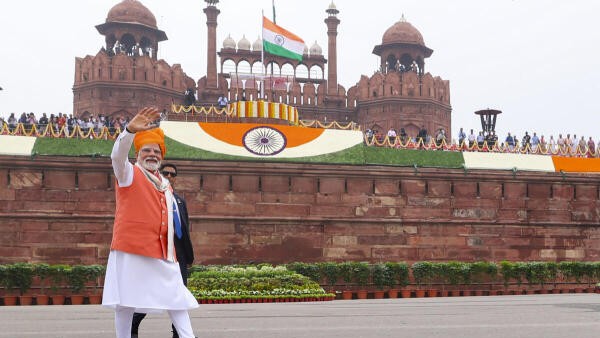
On the occasion of Independence Day 2025, Prime Minister Narendra Modi addressed the nation from the historic Red Fort in Delhi. This annual tradition, which carries immense symbolic and political weight, is not just a commemoration of India’s independence but also a stage to lay out the government’s vision for the future. In his address this year, PM Modi made a historic and bold announcement—that within the next 10 years, India will have a complete national security cover, ensuring the safety of its citizens against all forms of internal and external threats.
This announcement has ignited nationwide discussion. What does a “national security cover” mean in practical terms? How will India achieve it within a decade? What are the implications for defense, technology, intelligence, and international diplomacy? In this blog, we will dive deep into PM Modi’s speech, explore the potential roadmap for this vision, and analyze its impact on India’s future.
PM Modi’s Red Fort Address: Setting the Tone for a Secure India
Every year, the Prime Minister’s Red Fort speech is not just ceremonial but also policy-oriented. It outlines the government’s priorities for the coming years.
This year, PM Modi emphasized three core themes:
- National Security – A 360-degree cover within 10 years.
- Technological Sovereignty – Aatmanirbhar Bharat in defense, cyber, and space.
- Global Leadership – India’s role as a balancing force in geopolitics.
PM Modi’s words reflected both confidence and urgency:
“In the coming 10 years, India will establish a comprehensive national security cover—land, sea, air, space, and cyber. No citizen of this great nation will feel vulnerable, no external force will dare to threaten our sovereignty.”
This was not just a statement but a strategic vision—one that will require reforms, investments, and partnerships across multiple sectors.
What Does “National Security Cover” Mean?
The phrase “national security cover” suggests a holistic approach. It’s not limited to the military alone but encompasses all dimensions of security:
- Military Security – Strengthening the Army, Navy, Air Force with advanced weapons, AI-driven warfare, and modern infrastructure.
- Border Security – Comprehensive surveillance of land and maritime borders with drones, radars, satellites.
- Cyber Security – Protection from hacking, data theft, AI-driven cyber warfare, and digital espionage.
- Internal Security – Eliminating terrorism, extremism, organized crime, and insurgency.
- Economic Security – Safeguarding critical industries, supply chains, and national resources.
- Space Security – Defending satellites and space-based assets from hostile attacks.
- Energy & Resource Security – Ensuring uninterrupted access to energy and food resources.
Thus, the promise of a “10-year national security shield” reflects India’s ambition to become self-reliant, resilient, and globally powerful.
The 10-Year Roadmap: How India Plans to Achieve This Vision
To fulfill PM Modi’s commitment, India will need a clear roadmap spanning the next decade. Based on past policy patterns and current initiatives, the roadmap could include:
1. Defense Modernization
- Expansion of Made-in-India defense projects under Aatmanirbhar Bharat.
- Production of advanced fighter jets, submarines, hypersonic missiles, and drones.
- Modernization of infantry with smart weapons and AI-assisted systems.
2. Cyber & Digital Security
- Establishing a National Cyber Command Center.
- Collaborations with global IT giants for AI-based cyber defense.
- Training a dedicated cyber-security force to counter hacking and data theft.
3. Border & Maritime Protection
- Deployment of drones, satellites, and AI-surveillance on borders with Pakistan and China.
- Strengthening of coastal security after the 26/11 lessons.
- Advanced naval bases in the Indian Ocean to monitor Chinese movements.
4. Intelligence Network Expansion
- Integration of RAW, IB, NIA, and DRDO technologies into a single coordinated security grid.
- Enhanced international intelligence-sharing with the US, Israel, France, and Japan.
5. Space & Satellite Security
- Launch of defense satellites for real-time border monitoring.
- Space warfare readiness programs under ISRO and DRDO.
- Collaboration with NASA, JAXA, and ESA for defense-space technology.
6. Civil Defense & Citizen Security
- Expanding disaster management systems for floods, earthquakes, and pandemics.
- Public participation in homeland security through awareness and training programs.
- Emergency response apps and AI-based citizen alert systems.
India’s Current Security Challenges
PM Modi’s vision becomes even more relevant when we analyze India’s present security environment:
- China: Tensions along the LAC, including Ladakh and Arunachal Pradesh.
- Pakistan: Cross-border terrorism and infiltration attempts.
- Cyber Threats: Rising cases of hacking targeting government and banking systems.
- Terrorism: While largely contained, sleeper cells and radicalization remain risks.
- Energy Dependence: Oil imports make India vulnerable to global shocks.
- Internal Threats: Left-wing extremism, insurgency in some regions, and communal tensions.
Thus, achieving a comprehensive security shield will not only safeguard sovereignty but also stabilize India’s economic and social growth.
Global Reactions to Modi’s Announcement
The announcement was closely watched internationally.
- United States welcomed the vision, offering deeper defense and cyber cooperation.
- Russia expressed interest in joint defense production.
- China remained silent but wary, interpreting it as a strategic challenge.
- European Union highlighted cyber-security cooperation with India.
- Neighbouring countries like Nepal, Bhutan, Sri Lanka, and Bangladesh looked at India’s security vision as a regional stabilizer.
This indicates that India’s national security plan is not just domestic but has geopolitical consequences.
Critics and Opposition Views
While PM Modi’s supporters praised the announcement as visionary and historic, opposition leaders and analysts raised questions:
- Feasibility – Can India realistically achieve a nationwide security shield in 10 years?
- Budget Concerns – Will defense spending reduce allocations for healthcare and education?
- Civil Liberties – Will enhanced surveillance compromise privacy rights?
- Execution Risks – Past projects like Make in India have faced delays; will this face the same fate?
Such critiques underline the importance of transparent execution, balanced budgets, and citizen rights protection while implementing this vision.

Symbolism of Red Fort Announcements
The Red Fort has always been the stage where Indian Prime Ministers make epochal declarations. From Nehru’s “Tryst with Destiny” to Indira Gandhi’s Green Revolution push, and from Atal Bihari Vajpayee’s nuclear strength assertion to Modi’s Digital India and Swachh Bharat, every announcement has carried historical weight.
PM Modi’s “10-year national security cover” promise fits into this legacy, symbolizing a new phase of India’s global rise.
Possible Benefits of a National Security Shield
If successfully implemented, India could witness:
- Stronger Defense – Deterrence against China and Pakistan.
- Economic Stability – Secure borders and cyber safety encourage investment.
- Technological Advancement – Growth in AI, defense manufacturing, and cybersecurity.
- Geopolitical Power – India becomes a global guardian of democracy and peace.
- Citizen Confidence – People feel safer in both physical and digital spaces.
Conclusion: A Vision for a Strong and Secure India
PM Modi’s Independence Day 2025 announcement from the Red Fort marks a turning point in India’s security doctrine. The promise of a comprehensive national security shield within 10 years is ambitious, but it is aligned with India’s aspirations of becoming a global superpower.
The journey will not be easy. It will require policy reforms, technological breakthroughs, global partnerships, and citizen participation. But if India achieves this vision, it will not only secure its own people but also emerge as a pillar of stability in an uncertain world.
As India steps into its century of growth, the commitment to national security could become the foundation upon which its economic, political, and cultural renaissance will be built.
Read more latest news