

Searching for Another Earth: How Scientists Are Unveiling the Secrets of Exoplanets Like Kepler-452b and TRAPPIST-1e
Introduction: Humanity’s Age-Old Question—Are We Alone?
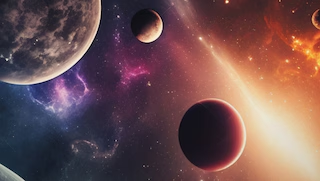
Planets like Kepler-452b and TRAPPIST-1e may have water and habitable conditions. For centuries, humans have gazed at the night sky and wondered if life exists beyond Earth. From early astronomers like Galileo and Kepler to modern scientists at NASA and ESA, the curiosity about other worlds has shaped the course of space exploration. Today, with cutting-edge telescopes and space missions, scientists are getting closer than ever to answering that question. Recent discoveries of several Earth-like exoplanets—planets that orbit stars beyond our Sun—have reignited the hope that somewhere in the vast universe, another “Earth” might exist.
Among these, two names stand out: Kepler-452b and TRAPPIST-1e. Both are located in their stars’ habitable zones—the region where temperatures may allow liquid water to exist, a key ingredient for life as we know it. With the James Webb Space Telescope (JWST) now studying their atmospheres, the dream of finding another habitable world has moved from science fiction to scientific possibility.
The Discovery of Exoplanets: A Brief History
The first confirmed discovery of an exoplanet came in 1992, when astronomers Aleksander Wolszczan and Dale Frail found planets orbiting a pulsar—a rapidly rotating neutron star. But these were not Earth-like worlds; they were harsh and irradiated. It was not until 1995, when Michel Mayor and Didier Queloz discovered 51 Pegasi b, that the hunt for exoplanets truly began.
Since then, astronomers have identified over 5,600 exoplanets, with more being added every month. These planets come in a dazzling variety—gas giants, ice worlds, rocky planets, and even “super-Earths,” which are slightly larger and heavier than our own planet.
The Kepler Space Telescope, launched by NASA in 2009, revolutionized this field. By continuously monitoring the brightness of more than 150,000 stars, Kepler was able to detect tiny dips in light caused by planets passing in front of their host stars—a method known as the transit method. Through Kepler’s eyes, we began to realize that planets are not rare cosmic accidents; they are common companions of stars.
Kepler-452b: The “Older Cousin” of Earth
One of the most celebrated discoveries of the Kepler mission is Kepler-452b, often nicknamed Earth’s older cousin. Announced by NASA in 2015, this planet orbits a star remarkably similar to our Sun, about 1,400 light-years away in the constellation Cygnus.
Kepler-452b is about 60% larger than Earth and lies within the habitable zone of its star, where conditions could allow for liquid water on its surface. The host star, Kepler-452, is about 6 billion years old—roughly 1.5 billion years older than our Sun. This means that if life ever developed on Kepler-452b, it may have had a head start compared to life on Earth.
Scientists believe that Kepler-452b may have a rocky composition, similar to Earth, though this is not yet confirmed. Its orbit of 385 days makes it strikingly Earth-like in terms of duration. However, because its star is older and slightly hotter, the planet may be undergoing a “runaway greenhouse effect,” similar to Venus, where increasing temperatures could be evaporating any surface water.
Still, Kepler-452b remains one of the most promising candidates for a potentially habitable exoplanet discovered so far.

TRAPPIST-1e: A Jewel in a System of Seven Worlds
While Kepler-452b captured the public’s imagination, another discovery truly electrified the scientific community—the TRAPPIST-1 system. Found by astronomers using the Transiting Planets and Planetesimals Small Telescope (TRAPPIST) in Chile and later confirmed by NASA’s Spitzer Space Telescope, TRAPPIST-1 is an ultra-cool dwarf star located about 39 light-years away in the constellation Aquarius.
What makes this system extraordinary is that it hosts seven Earth-sized planets, three of which—TRAPPIST-1d, TRAPPIST-1e, and TRAPPIST-1f—lie within the star’s habitable zone. Among them, TRAPPIST-1e stands out as the most Earth-like.
TRAPPIST-1e is nearly identical to Earth in size and mass. It receives about 60% of the sunlight that Earth gets from the Sun, suggesting a moderate climate that could allow for liquid water if it possesses a suitable atmosphere. Scientists estimate that it could have a rocky surface, and its density suggests that it might even have oceans beneath a thin atmosphere.
The TRAPPIST-1 system also offers a unique advantage: because its planets are close together, their gravitational influence on one another allows scientists to calculate their masses and densities with precision—something not possible for most exoplanets. This makes TRAPPIST-1 a natural laboratory for studying planetary evolution and potential habitability.
Why Liquid Water Matters
In the search for life beyond Earth, one phrase dominates: “Follow the water.” All known life forms depend on liquid water for survival—it’s the medium in which essential biochemical reactions occur.
That’s why astronomers focus on the habitable zone, also called the “Goldilocks zone,” where temperatures are “just right”—not too hot, not too cold—for water to remain liquid.
Kepler-452b and TRAPPIST-1e both fall within this crucial zone around their stars. However, being in the habitable zone doesn’t automatically mean the planet is habitable. Factors such as atmospheric composition, magnetic fields, and geological activity play equally important roles in determining whether a planet can sustain life.
The Role of the James Webb Space Telescope (JWST)
Launched in December 2021, the James Webb Space Telescope (JWST) is humanity’s most powerful space observatory. With its enormous gold-coated mirror and advanced infrared instruments, JWST is designed to peer deeper into space and time than ever before—capturing light from the first galaxies and studying exoplanets in unprecedented detail.
JWST’s ability to analyze atmospheric compositions of exoplanets marks a groundbreaking step in the search for life. By observing how starlight passes through a planet’s atmosphere during transit, scientists can detect specific chemical fingerprints—such as water vapor, carbon dioxide, methane, or oxygen.
Already, JWST has made historic observations of TRAPPIST-1e and its neighboring planets. Early data indicates that TRAPPIST-1e does not have a thick hydrogen atmosphere, making it more Earth-like than gas-dominated planets. Scientists are now searching for traces of carbon dioxide and water vapor—potential indicators of a temperate, habitable world.
In the case of Kepler-452b, JWST’s capabilities are being used to analyze its reflected light spectrum, which may provide insights into cloud patterns or surface compositions, though its great distance makes direct observation challenging.
The Possibility of Life Beyond Earth
Could these planets harbor life? While no direct evidence has been found yet, the possibility cannot be ruled out.
For Kepler-452b, if it still retains a moderate climate and water, microbial or even complex life could exist. However, the age of its star might mean that the planet has become too hot and dry over time.
TRAPPIST-1e, on the other hand, presents a more exciting case. Because it orbits a cooler, smaller star, it might enjoy long-term stability—though the star’s tendency to emit solar flares poses potential risks to any atmosphere or biosphere.
Researchers are also exploring whether life could exist in subsurface oceans, protected from radiation. If planets like TRAPPIST-1e possess thick ice layers with liquid water beneath, microbial ecosystems similar to those hypothesized on Europa or Enceladus (moons of Jupiter and Saturn) could be possible.
Challenges in Detecting Habitable Worlds
While technological advances have brought us closer to identifying potentially habitable planets, enormous challenges remain.
- Distance: Even the nearest exoplanets are light-years away. Kepler-452b is 1,400 light-years distant, far beyond our current reach for exploration.
- Data Limitations: Most discoveries are based on indirect observations, relying on light patterns rather than actual images.
- Atmospheric Interference: Detecting the thin chemical signatures of an exoplanet’s atmosphere requires incredible precision, often hindered by the brightness of the parent star.
- False Positives: Sometimes, natural processes—like volcanic activity or non-biological chemical reactions—can mimic biological signals, complicating interpretation.
Despite these challenges, every new discovery brings us closer to understanding our place in the cosmos.
Future Missions and the Road Ahead
The coming decades promise to be transformative for exoplanet research. Alongside JWST, several new missions are poised to take the search for life to the next level:
- ESA’s PLATO (Planetary Transits and Oscillations of stars) mission, launching later this decade, will focus on discovering Earth-like planets around Sun-like stars.
- NASA’s Nancy Grace Roman Space Telescope, expected to launch in the early 2030s, will use advanced coronagraph technology to directly image exoplanets.
- LUVOIR (Large UV Optical Infrared Surveyor), a proposed mission, aims to study hundreds of exoplanets in detail, potentially even detecting signs of life through biosignature gases.
These projects reflect a growing global effort to answer one of humanity’s greatest questions—are we alone?
Philosophical and Cultural Impact
The discovery of Earth-like exoplanets is not just a scientific breakthrough; it has profound philosophical implications. The idea that there may be billions of potentially habitable worlds forces us to rethink our uniqueness in the universe.
If even one of these worlds harbors life, it would fundamentally alter humanity’s understanding of biology, religion, and existence. As Carl Sagan once said, “Somewhere, something incredible is waiting to be known.”
Moreover, these discoveries inspire future generations to pursue careers in science, astronomy, and space exploration. They remind us that humanity’s destiny may extend far beyond Earth—that we are, in a very real sense, a cosmic species.
Conclusion: The Dawn of a New Cosmic Era
The discoveries of Kepler-452b and TRAPPIST-1e mark only the beginning of our journey into the cosmic unknown. These planets, orbiting distant stars, offer glimpses of what other Earths might look like—places where oceans could glisten under alien suns, where atmospheres breathe life into landscapes unseen by human eyes.
As the James Webb Space Telescope continues to probe their atmospheres, humanity stands on the threshold of one of the most profound discoveries in history: proof that we are not alone.
Each data point, each spectrum, each tiny dip in starlight is a whisper from the cosmos—a reminder that the universe is vast, ancient, and filled with possibilities. Whether or not we ever find another Earth, the search itself unites us in a common quest—to understand the origins of life and our place in the grand cosmic story.
The night sky, once a tapestry of mystery, is slowly revealing its secrets. And as we continue to explore, one thing becomes certain: the journey to find another Earth has just begun.
Read More latest News

