

Congress MP Shashi Tharoor to Skip High Command Meeting: Signals, Strategy, and the Kerala Political Churn
The political atmosphere in Kerala has once again heated up after reports emerged that MP Shashi Tharoor will not attend a crucial meeting called by the Congress high command to discuss preparations for the upcoming Kerala Assembly elections. The development has triggered intense debate within political circles, party workers, and observers who closely track the Congress party’s internal dynamics in the state. The absence of MP Shashi Tharoor from such a significant meeting is being viewed not merely as a scheduling issue, but as a move loaded with political meaning.
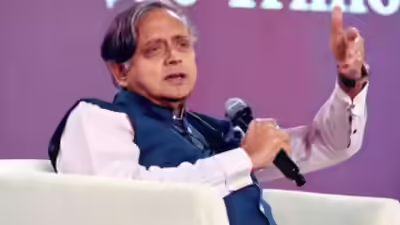
According to sources, the decision by MP Shashi Tharoor came in the aftermath of a recent Mahapanchayat event held in Kochi. This event, which drew wide attention, is now being linked to the broader questions of leadership, strategy, and the future direction of the Congress in Kerala. As speculation grows, many are asking whether MP Shashi Tharoor is signaling dissatisfaction, asserting independence, or positioning himself differently within the party’s internal framework.
The High Command Meeting and Its Importance
The Congress high command’s meeting was intended to streamline preparations for the Kerala Assembly elections, a contest that holds immense importance for the party. Kerala has traditionally been a stronghold where the Congress-led United Democratic Front (UDF) has alternated power with the Left Democratic Front (LDF). In such a context, every strategic meeting matters. The absence of a senior leader like MP Shashi Tharoor naturally stands out.
Party insiders suggest that the meeting was meant to finalize campaign messaging, leadership roles, and constituency-level coordination. For many, the non-attendance of MP Shashi Tharoor raises questions about internal communication and alignment. Is the leadership on the same page, or are there undercurrents that could affect election preparedness?
Mahapanchayat in Kochi A Turning Point?
The Mahapanchayat event in Kochi has emerged as a crucial backdrop to this development. Organized as a platform for dialogue and public engagement, the event saw participation from various intellectuals, youth leaders, and civil society voices. MP Shashi Tharoor’s presence and remarks at the Mahapanchayat reportedly struck a chord with many attendees, especially the younger demographic.
Sources claim that after the Mahapanchayat, MP Shashi Tharoor reflected deeply on his role and the direction of politics in Kerala. Some interpret his decision to skip the high command meeting as an extension of that reflection. Rather than routine party deliberations, MP Shashi Tharoor may be prioritizing broader engagement and ideological conversations.
Who Is MP Shashi Tharoor in Kerala Politics
To understand the impact of this decision, one must appreciate the stature of MP Shashi Tharoor. A four-time Member of Parliament from Thiruvananthapuram, he is known for his intellectual depth, international exposure, and articulate advocacy. MP Shashi Tharoor has often been seen as a bridge between traditional Congress politics and a more modern, global outlook.
Over the years, MP Shashi Tharoor has built a strong personal brand that sometimes transcends party lines. This has earned him admiration as well as criticism within the Congress. His supporters view him as a leader who can rejuvenate the party’s image, while critics argue that his style does not always align with grassroots organizational politics.
Internal Party Dynamics and Silent Messages
Political analysts believe that when a leader of the stature of Shashi Tharoor skips a high command meeting, it sends a message—whether intended or not. Within the Congress, where discipline and collective decision-making are emphasized, such moves are closely scrutinized.
Some leaders have downplayed the issue, stating that MP Shashi Tharoor may have had prior commitments. Others, however, see it as a subtle assertion of autonomy. In Kerala, where factionalism has historically affected the Congress, the actions of MP Shashi Tharoor are being read through multiple lenses.
Public Perception and Media Narrative
The media narrative around MP Shashi Tharoor’s decision has been intense. Television debates, newspaper columns, and social media discussions have all weighed in. For the general public, especially in Kerala, MP Shashi Tharoor is more than just a politician—he is a public intellectual whose actions are often interpreted symbolically.
Supporters argue that MP Shashi Tharoor is focusing on constructive engagement rather than closed-door meetings. Critics counter that at a crucial electoral juncture, unity and participation are paramount. This divergence of views reflects the broader debate about leadership styles within the Congress.
Impact on Kerala Assembly Election Strategy
From an electoral standpoint, the key question is whether the absence of MP Shashi Tharoor from the meeting will have any tangible impact on Congress preparations. Strategists point out that the Kerala Assembly elections will be fought on issues such as governance, employment, social welfare, and federal relations.
MP Shashi Tharoor’s voice on national and international issues has often complemented the party’s narrative. If his engagement with the party machinery becomes selective, it could influence how campaign messages are shaped and delivered, particularly in urban and semi-urban constituencies.
Supporters See Principle, Not Protest
Many supporters of MP Shashi Tharoor insist that his decision should not be misread as rebellion. They argue that MP Shashi Tharoor has always operated with a degree of intellectual independence and that this has ultimately benefited the Congress by broadening its appeal.
According to this view, MP Shashi Tharoor skipping one meeting does not equate to distancing himself from the party. Instead, it reflects a belief that political engagement must go beyond formal structures and connect meaningfully with people.
Critics Worry About Mixed Signals
On the other hand, critics within the party worry that such decisions by MP Shashi Tharoor could send mixed signals to party workers. At the grassroots level, discipline and coordination are vital during elections. When senior leaders like MP Shashi Tharoor appear disengaged from official processes, it may affect morale or create confusion.
This concern is particularly relevant in Kerala, where the Congress faces stiff competition from a well-organized Left front and an increasingly assertive BJP.
Historical Context: Tharoor and the Congress
This is not the first time Shashi Tharoor has found himself at the center of internal party discussions. In the past, he has contested for the Congress presidential post and openly spoken about internal reforms. These episodes have reinforced the perception of Shashi Tharoor as a leader unafraid to express his views, even if they challenge the status quo.
His current decision, therefore, fits into a broader pattern of independent thinking. Whether the party chooses to view this as an asset or a complication remains to be seen.
What Lies Ahead?
As the Kerala Assembly elections draw closer, the Congress will need to balance unity with diversity of thought. Leaders like Shashi Tharoor bring visibility and credibility, but their relationship with the organizational structure must be carefully managed.
If MP Shashi Tharoor continues to engage with the electorate through platforms like Mahapanchayats and public dialogues, it could complement the party’s campaign. However, sustained absence from key strategic meetings could also deepen internal debates.
Conclusion: A Moment of Reflection for the Congress
The decision of MP Shashi Tharoor to not attend the high command meeting has opened up important conversations about leadership, participation, and strategy within the Congress. Rooted in the context of the Kochi Mahapanchayat, the move underscores the evolving nature of political engagement in Kerala.
Ultimately, whether this episode becomes a footnote or a turning point will depend on how both Shashi Tharoor and the Congress leadership navigate the road ahead. For now, it serves as a reminder that in politics, actions—especially by prominent figures—often speak louder than words.
Read more latest news

