

Mohan Bhagwat’s Swadeshi Mantra on Trump Tariff: “Dependence Should Not Turn Into Compulsion”
Introduction
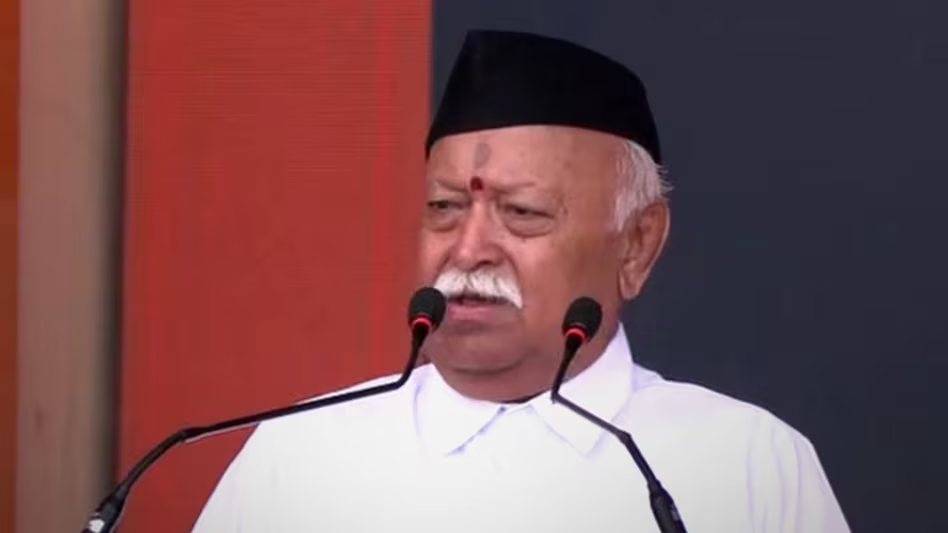
Mohan Bhagwat gave the mantra, The global economy is in the middle of a turbulent phase. With shifting alliances, protectionist policies, and fierce competition over resources, trade wars are becoming more frequent. Recently, former U.S. President Donald Trump shocked the world by announcing hefty tariffs on imports, directly impacting major economies, including India. While policymakers, industrialists, and economists scrambled to assess the impact, a powerful message came from Rashtriya Swayamsevak Sangh (RSS) chief Mohan Bhagwat.
In his typically simple yet impactful style, Bhagwat delivered a mantra of Swadeshi—a principle deeply rooted in India’s history and philosophy. He cautioned that while trade and international cooperation are essential, “dependence should not turn into compulsion.” His words sparked a debate across political, economic, and social circles.
In this blog, we explore the deeper meaning of Bhagwat’s statement, its connection to India’s economic traditions, the Trump tariff challenge, and the path forward for India in building a resilient, self-reliant economy.
Mohan Bhagwat and the Swadeshi Philosophy
Mohan Bhagwat, as the Sarsanghchalak of the RSS, has consistently emphasized the importance of Swadeshi—a concept that goes beyond just buying local goods. For him, Swadeshi is about:
- Building economic self-reliance,
- Preserving cultural identity,
- Ensuring sustainability, and
- Reducing excessive dependence on foreign powers.
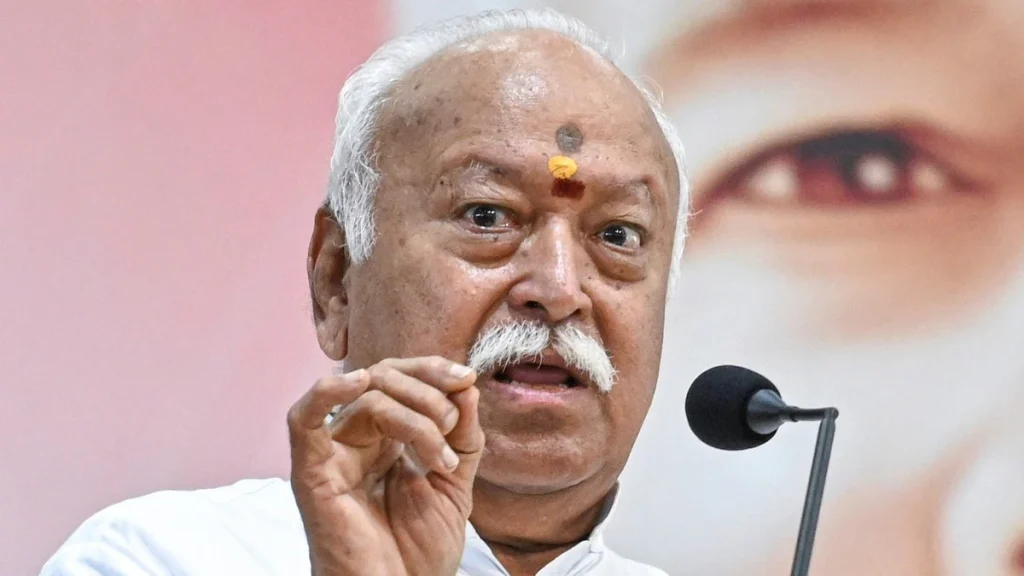
His message after Trump’s tariff decision highlighted a long-standing concern: India should engage globally, but it must always maintain enough strength to stand on its own. If a country becomes overly dependent on another for essential goods, technology, or security, it risks being manipulated. This is what Bhagwat meant when he said: “Dependence should not turn into compulsion.”
The Trump Tariff Shock
Donald Trump’s decision to impose steep tariffs—first 25% and later increased to 50% on several imports—was aimed at reviving U.S. manufacturing and reducing dependence on foreign goods. However, the ripple effects were felt worldwide. For India, the tariffs were particularly significant in sectors like:
- Steel and Aluminum Exports
- Textiles and Apparel
- Automobile Parts
- Pharmaceutical Raw Materials
Indian exporters suddenly faced higher costs to sell in the U.S., one of India’s largest trade partners. This not only threatened profits but also forced India to rethink its trade strategy.
Bhagwat’s intervention in this debate was timely. He used the moment to remind India that external shocks—like tariffs—can destabilize an economy only if it is overdependent on foreign markets.
Dependence vs. Compulsion: The Core Message
Let’s break down Bhagwat’s warning:
- Dependence is natural in a globalized economy. Every nation imports and exports. No country can produce everything. India imports oil, technology, and defense equipment; the U.S. imports software, textiles, and pharmaceuticals. This is healthy interdependence.
- Compulsion arises when a nation cannot survive without another’s products or markets. For example, if India cannot produce critical medicines without raw materials from one country, it risks being blackmailed.
Bhagwat’s message was that India must ensure its economic policies never create such compulsions. Swadeshi, therefore, is not about isolation but about balance—engage with the world, but never be at its mercy.
Historical Roots of Swadeshi
To understand the power of Bhagwat’s words, we must revisit history.
- The Freedom Movement
- The Swadeshi movement of 1905, during Bengal’s partition, saw Indians boycotting British goods and promoting local industry.
- Leaders like Bal Gangadhar Tilak and Mahatma Gandhi championed Khadi and village industries as symbols of self-reliance.
- Gandhian Economics
- Gandhi’s vision of Swadeshi was holistic. He believed villages should be self-sufficient, producing their own food, clothing, and goods.
- This was not just economics but also a form of political independence.
- Post-Independence India
- Leaders like Jawaharlal Nehru emphasized industrialization, while others like Deendayal Upadhyaya advocated Integral Humanism, which also prioritized local self-reliance.
Bhagwat’s statement is in line with this historical continuity. By invoking Swadeshi in the age of Trump tariffs, he connected India’s present economic dilemmas to its civilizational wisdom.
The Present Economic Reality
India today is one of the fastest-growing economies in the world. Yet, it remains vulnerable in several sectors:
- Oil Imports: India imports over 80% of its crude oil. Price fluctuations or sanctions can destabilize the economy.
- Electronics: Mobile phones, chips, and components are largely imported, especially from China.
- Defense: Despite progress, India still buys a majority of its weapons from abroad.
- Agriculture: Farmers depend on imported fertilizers and sometimes foreign technology.
Trump’s tariffs highlighted these weaknesses. If the U.S. can disrupt Indian exports overnight, imagine what would happen if India were similarly dependent on imports from one country. This is exactly the compulsion Bhagwat warned against.
Political and Public Reactions
Bhagwat’s remarks sparked diverse reactions:
- Supporters praised his foresight, saying India must learn to protect itself in a volatile world.
- Critics argued that his call for Swadeshi was impractical in the modern globalized economy.
- Economists pointed out that India needs a balanced approach—neither blind globalization nor complete isolation.
Interestingly, even opposition leaders acknowledged that Trump’s tariffs were a wake-up call. The debate has shifted from “Should we adopt Swadeshi?” to “How much Swadeshi is enough?”
Swadeshi in Practice: What India Can Do
To translate Bhagwat’s words into policy, India needs to take several steps:
1. Strengthening Domestic Manufacturing
- Incentivize local production under schemes like Make in India.
- Encourage MSMEs (Micro, Small, and Medium Enterprises), which are the backbone of local economies.
2. Diversifying Trade Partners
- Reduce reliance on any single country.
- Strengthen trade with Africa, Southeast Asia, and Latin America.
3. Boosting Research and Development
- Invest in indigenous technology for defense, pharmaceuticals, and electronics.
- Reduce dependency on foreign patents.
4. Promoting Agricultural Self-Reliance
- Develop organic and local farming models.
- Reduce dependence on imported fertilizers and GM seeds.
5. Cultural Swadeshi
- Encourage consumers to prefer local brands over imported ones.
- Launch awareness campaigns similar to Gandhi’s Khadi movement.
The Global Context: Are Other Nations Doing the Same?
Interestingly, India is not alone in this shift. Across the world, nations are rediscovering the value of self-reliance:
- United States: Trump’s tariffs were themselves an expression of economic nationalism.
- China: Promotes “dual circulation” to depend less on exports and more on domestic demand.
- Japan: Encourages companies to shift supply chains out of China and back home.
- Europe: Talks of “strategic autonomy” in technology and defense.
Bhagwat’s Swadeshi mantra, therefore, aligns with a global trend.
Swadeshi vs. Atmanirbhar Bharat
Prime Minister Narendra Modi has championed the idea of Atmanirbhar Bharat (Self-Reliant India), especially after the COVID-19 pandemic. The philosophy overlaps with Swadeshi but with a modern twist:
- Use global supply chains but strengthen domestic capacity.
- Encourage Indian startups, digital platforms, and innovation.
- Position India as both a self-reliant and globally competitive economy.
Bhagwat’s remarks, therefore, strengthen Modi’s vision, providing it with cultural and ideological depth.
Challenges to Implementing Swadeshi
While the philosophy is powerful, the road is not easy. Some challenges include:
- Global Supply Chains: Many Indian industries are deeply integrated with global suppliers. Breaking away suddenly can hurt growth.
- Consumer Behavior: Indians often prefer foreign brands, seeing them as symbols of quality. Changing mindsets takes time.
- Cost Factor: Imported goods are sometimes cheaper than locally made ones. Domestic producers must be made competitive.
- Policy Consistency: Governments must ensure long-term policies. Sudden changes can discourage investors.
Conclusion: Turning a Challenge into an Opportunity
The empty stands in Ahmedabad during the India-West Indies Test exposed one kind of weakness in Indian cricket administration. Similarly, Trump’s tariffs exposed vulnerabilities in India’s economy. But Bhagwat’s mantra of Swadeshi turns these challenges into opportunities.
By reminding the nation that dependence should never turn into compulsion, he has provided a timeless guideline for economic and political strategy. India need not isolate itself but must ensure its foundations are strong enough to withstand external shocks.
As the global order becomes more uncertain, Bhagwat’s words echo louder: True freedom lies not just in political sovereignty but also in economic self-reliance.
Read More latest news

