
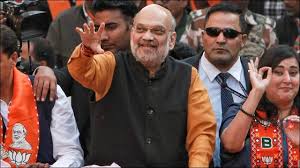
Amit Shah: “Indian History Will Be Decided in Three Phases—One Would Be Before & After Modi Era”
Introduction
Modi Era In a significant remark, Union Home Minister Amit Shah stated that Indian history will be defined in three phases, with a major division occurring before and after the Modi era. This statement highlights the transformative impact of Prime Minister Narendra Modi’s leadership on India’s political, economic, and social landscape.
Shah’s remark underscores that Modi’s governance marks a watershed moment in Indian history, shaping policies, ideologies, and governance models that will influence generations to come.
In this article, we will analyze:
✔ The three historical phases Amit Shah referred to
✔ The impact of the Modi era on India
✔ The before and after Modi governance model
✔ The future trajectory of India under Modi’s vision
1. The Three Phases of Indian History
Amit Shah, in his speech, broadly categorized Indian history into three phases:
🔹 Phase 1: Pre-Independence Era (Before 1947)
- Colonial Rule & Struggles: British rule, economic exploitation, and the long freedom struggle.
- Key Figures: Mahatma Gandhi, Netaji Subhas Chandra Bose, Sardar Patel, Bhagat Singh, and Dr. B.R. Ambedkar.
- Partition & Challenges: India’s partition in 1947 led to mass displacement, communal violence, and economic struggles.
🔹 Phase 2: Post-Independence Era (1947–2014)
- Congress Dominance: The Congress-led era with Jawaharlal Nehru, Indira Gandhi, Rajiv Gandhi, and later the UPA rule.
- Economic Reforms: The liberalization of 1991, initiated under P.V. Narasimha Rao and Manmohan Singh, opened India’s economy.
- Political Instability & Corruption: Coalition governments, policy paralysis, and corruption scandals like 2G Scam, Commonwealth Scam.
🔹 Phase 3: The Modi Era (2014–Present & Beyond)
- Strong Leadership: A decisive leadership model under Narendra Modi.
- Major Reforms: GST, Digital India, Startup India, Make in India, Atmanirbhar Bharat.
- Rise of Nationalism: A focus on India-first policies, military strength, and foreign diplomacy.
- Transformation in Politics: The decline of dynastic politics, emergence of New India Vision.
Amit Shah’s statement suggests that Modi’s leadership has ushered India into a new historical phase, fundamentally different from the previous ones.

2. The Modi Era: Defining Characteristics & Impact
Amit Shah’s assertion that history will be divided into “before and after Modi” highlights the monumental changes brought by PM Modi’s governance.
Here’s a look at the key transformations:
✅ Political Transformation: The End of Dynastic Politics
- The decline of the Nehru-Gandhi family’s political dominance.
- Rise of merit-based leadership over family-driven politics.
- Shift from vote-bank politics to performance-driven governance.
✅ Economic Reforms & Global Leadership
- GST & Economic Reforms: Implementing GST, Direct Benefit Transfers, and Startup India.
- Atmanirbhar Bharat: Focus on self-reliance, manufacturing, and Make in India.
- Global Recognition: India’s position as the fastest-growing economy and G20 Presidency.
✅ Social & Cultural Revivalism
- Restoration of Ram Mandir in Ayodhya after decades of legal battles.
- Promotion of Hindu heritage, Vedic education, and Indic culture.
- Rise in nationalism and cultural pride across the country.
✅ National Security & Foreign Policy Strengthening
- Surgical Strikes & Balakot Airstrikes against Pakistan.
- Revocation of Article 370, fully integrating Jammu & Kashmir into India.
- Strengthened relations with USA, Israel, Middle East, Russia, and Africa.
These changes indicate that the Modi era represents a fundamental shift in India’s governance and global positioning.
3. Before & After Modi: A Comparative Analysis
Amit Shah’s statement suggests a clear demarcation in India’s history, splitting governance styles into Before Modi (Pre-2014) and After Modi (Post-2014).
🟢 Before Modi (1947–2014): The Congress Era
✔ Dominance of Congress & Nehruvian Socialism.
✔ Focus on centralized planning and bureaucratic control.
✔ High levels of corruption & policy paralysis.
✔ Weak foreign policy & frequent border intrusions.
🟢 After Modi (2014–Present): The New India Era
✔ Decisive & strong governance with faster policy execution.
✔ Focus on economic growth, self-reliance, and digital transformation.
✔ Corruption-free governance with digital transparency.
✔ Aggressive foreign policy with bold military actions.
This comparison highlights the stark contrast between the two eras and why Modi’s governance marks a significant turning point in Indian history.
4. The Future: What Lies Beyond the Modi Era?
As Amit Shah suggests that history will be remembered in phases, what does the future hold after Modi’s leadership?
🔸 2024 Elections & Beyond
- The 2024 General Elections will be crucial in deciding whether Modi’s vision continues or if India sees a shift in leadership.
- If BJP wins, Modi’s 2030 roadmap will continue, further transforming India.
🔸 The Rise of “Viksit Bharat” (Developed India Vision 2047)
- Modi has set a target for India to become a developed nation by 2047.
- Focus on $10 trillion economy, AI leadership, space tech, and military modernization.
🔸 Political Shift: Who After Modi?
- As Modi turns 75 in 2025, speculation about the next BJP leader grows.
- Possible successors include Amit Shah, Yogi Adityanath, or a new leader from the party.
These future possibilities will determine whether Modi’s legacy continues or marks the final phase of his era.
5. Conclusion: Why Amit Shah’s Statement is Historic
Amit Shah’s claim that history will be divided into before and after Modi underscores the epochal shift in Indian politics and governance.
Key Takeaways:
✔ Modi’s leadership has redefined India’s political, economic, and global stature.
✔ The pre-Modi era (1947–2014) was dominated by Congress-style governance, coalition politics, and slow reforms.
✔ The Modi era (2014–present) is characterized by bold reforms, decisive governance, and nationalistic policies.
✔ Future leadership post-Modi will determine whether India sustains its development trajectory or shifts in a new direction.
Whether one supports or opposes Modi, his impact on Indian history is undeniable, making Amit Shah’s statement a landmark assessment of India’s historical transformation.
Do you think India will continue Modi’s vision post-2024? Drop your thoughts in the comments! 👇
read more latest News

