

If Temples Decide the Future of Children, Then Build 200 Temples: Khesari Lal Yadav’s Bold Statement Sparks Debate on Education, Faith, and Politics”
Introduction
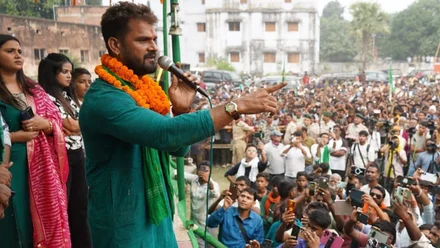
Bhojpuri superstar and political voice Khesari Lal Yadav is once again at the center of public attention. Known for his outspoken nature and straightforward comments, Khesari Lal Yadav recently made a thought-provoking statement that has stirred a storm across social media and political circles alike. During an interaction with his supporters, he remarked, “If temples decide the future of children, then build 200 temples.”
The statement, seemingly simple, carries profound implications about the current state of education, politics, and social priorities in India. Through his words, Khesari Lal Yadav appeared to question the misplaced focus on religious symbolism over tangible developmental issues such as quality education, youth employment, and social equality.
This blog delves into the deeper meaning behind Khesari Lal Yadav’s statement, exploring its political, cultural, and social context, while analyzing how his words resonate with the aspirations and frustrations of India’s young generation.
1. The Context Behind Khesari Lal Yadav’s Remark
Khesari Lal Yadav, beyond being a celebrated actor and singer in the Bhojpuri film industry, has increasingly positioned himself as a voice of the masses — especially the youth and the underprivileged. His statement came during a discussion on the state of education and youth employment in Bihar and Uttar Pradesh, regions where Bhojpuri culture thrives but where developmental challenges remain stark.
According to reports, Khesari Lal Yadav was responding to political leaders who often use religion and temple politics to divert attention from fundamental issues like education reform, job creation, and healthcare. His statement — “If temples decide the future of children, then build 200 temples” — was a satirical jab at political hypocrisy, highlighting how priorities are often misplaced in public discourse.
2. The Broader Message: Education Over Symbolism
At the heart of Khesari Lal Yadav remark lies a powerful critique of misplaced priorities. By juxtaposing temples with children’s futures, he did not demean religion or faith — instead, he questioned why religious construction is given more urgency than educational reform.
India, home to over 1.4 billion people, continues to grapple with serious educational inequalities. In many regions, schools lack proper infrastructure, teachers are overburdened, and millions of children drop out before completing high school. Yet, massive resources are often poured into symbolic or religious projects that, while culturally significant, do not directly address the pressing needs of India’s young population.
Khesari’s words thus echo a common sentiment among ordinary citizens — that education must be the real temple, where children’s futures are built through learning, not superstition.
3. Religion and Politics: A Delicate Intersection
India’s political landscape has always seen a complex relationship between religion and governance. Temples, mosques, and other religious symbols often become rallying points during elections. Political parties across the spectrum have been accused of leveraging faith for votes, rather than focusing on developmental work.
Khesari’s statement challenges this dynamic. His sharp sarcasm — suggesting the construction of 200 temples — reflects public frustration with politicians who use religion as an emotional tool to distract from real socio-economic challenges.
By bringing this issue into public conversation, Khesari Lal Yadav adds his voice to a growing movement demanding that leaders be held accountable for education, jobs, and progress — not just promises wrapped in religious rhetoric.
4. Khesari Lal Yadav: From Folk Artist to People’s Voice
Khesari’s rise from a humble background in Bihar to becoming one of Bhojpuri cinema’s biggest icons is itself a story of resilience and hard work. Born into poverty, he once sold litti-chokha (a traditional Bihari dish) before finding fame in music and films. This life experience has given him a unique connection to the struggles of the common man.
Unlike many celebrities who shy away from controversial topics, Khesari Lal Yadav has never hesitated to speak on social and political issues. His comment about temples and education is consistent with his previous statements that emphasize human values, equality, and awareness over blind faith.
He has also been known to stand up against trolling and hatred, urging fans to remain united beyond caste, religion, and language divisions. Thus, his recent remark can be seen as an extension of his social consciousness and frustration with the political climate.
5. Reaction from the Public and Political Circles
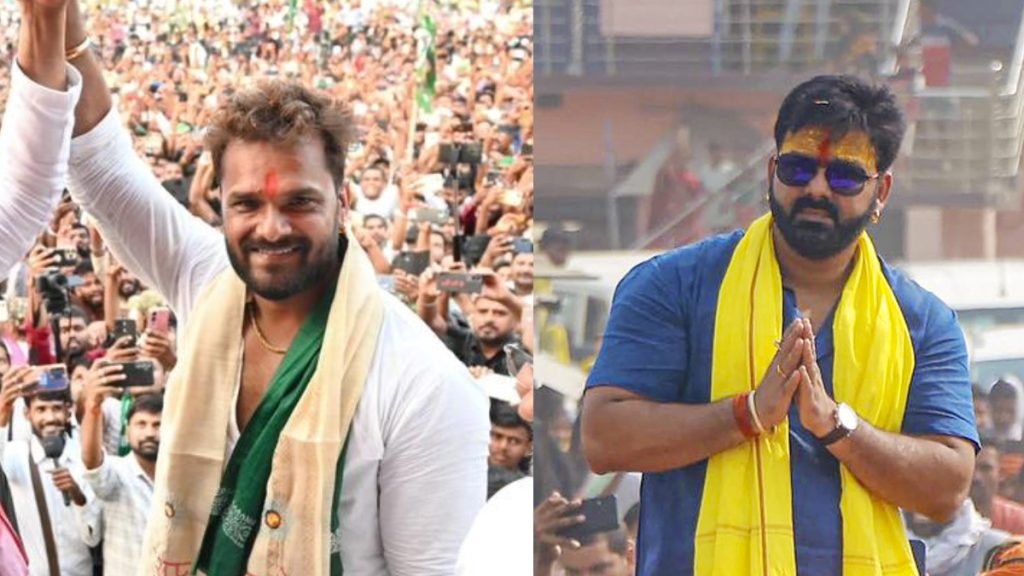
Unsurprisingly, Khesari’s statement created waves across both traditional media and social media platforms. On Twitter, hashtags like #KhesariLalYadav and #EducationNotReligion trended for hours, with thousands debating whether his remark was bold truth or unnecessary provocation.
Many youth leaders, activists, and educators praised his courage, saying that artists like Khesari Lal Yadav have a moral duty to speak truth to power. They applauded him for using his platform to highlight the crisis of education and unemployment.
However, some political and religious figures criticized his tone, claiming that his words could be interpreted as an insult to faith. Yet, even many of his critics conceded that the underlying issue he raised — about education and youth — was valid and urgent.
6. Education as the True Temple
Let’s take a closer look at what KKhesari Lal Yadav might have meant philosophically. When he said, “If temples decide the future of children, then build 200 temples,” he was underscoring the irony that real empowerment comes not from rituals but from knowledge.
India’s ancient tradition itself regards knowledge as divine. The goddess Saraswati — symbol of wisdom — has always been revered even before material wealth or strength. Thus, Khesari Lal Yadav argument can be seen as a modern reinterpretation of India’s own spiritual values — reminding society that the truest form of devotion is investing in education.
Building schools, libraries, and digital classrooms are the temples of the 21st century — sanctuaries where young minds are shaped, and where the nation’s destiny is decided.
7. The Crisis of Youth Unemployment
India is home to one of the largest youth populations in the world, with more than 65% of its citizens under the age of 35. However, unemployment among young people remains a serious concern.
Millions of graduates struggle to find jobs due to mismatched skills, inadequate training, and a lack of opportunities. This gap between education and employment has created deep frustration among youth, particularly in states like Bihar and Uttar Pradesh, where migration for jobs is a painful reality.
Khesari’s statement reflects this discontent — a call for the system to wake up and prioritize real empowerment over political theatrics. He gives voice to the millions who believe that faith should inspire compassion and education — not become an excuse to ignore it.
8. The Role of Artists in Social Change
Throughout history, artists have played a vital role in shaping public opinion. Whether it was poets during India’s freedom movement or actors raising awareness about social issues, art has always been a powerful tool for reform.
Khesari Lal Yadav, through his films and songs, connects with millions of people across North India. When he speaks, his words carry emotional and cultural weight. His recent statement serves as a wake-up call not only for politicians but for society itself — urging people to demand education, equality, and accountability.
In doing so, Khesari continues a long tradition of socially conscious entertainers who use fame to uplift public consciousness.
9. Faith and Progress: Can They Coexist?
Critics of Khesari’s statement might argue that religion and development are not mutually exclusive — and they are right. Faith has always been a source of moral strength and community unity. The problem arises when religion is used as a shield against accountability or as a tool to polarize society.
Khesari’s words do not reject temples or devotion; instead, they challenge the overemphasis on external symbols while internal values — like knowledge, compassion, and progress — are ignored. His call is for balance: build temples if you must, but build schools too.
Only by integrating spiritual values with scientific thinking can a nation truly prosper.
10. Lessons for India’s Leadership
Khesari Lal Yadav’s statement indirectly throws a challenge to political leaders: What legacy are we building for the next generation?
If the goal is to make India a global superpower, investing in temples alone won’t suffice — we must invest in the minds of our youth.
Education reforms, skill development programs, and employment opportunities are the real pillars of national strength. Leaders across party lines must listen to this message and prioritize substance over symbolism.
11. Social Media and the Power of Public Discourse
What’s remarkable about Khesari’s statement is how it transcended the boundaries of Bhojpuri cinema and entered mainstream national discussion. It shows the democratizing power of social media, where one statement can spark a movement.
Thousands of users expressed support, saying they wanted to see more schools, libraries, and technology hubs instead of mere political symbolism. Memes, videos, and discussions flooded platforms like X (Twitter), Instagram, and Facebook — showing that public sentiment is evolving toward a more practical and education-focused outlook.
12. The Road Ahead: From Awareness to Action
Words, however powerful, must lead to action. Khesari’s comment opens a conversation that must now translate into policy and community engagement. Civil society groups, NGOs, and governments need to work together to ensure access to quality education, especially in rural and underprivileged areas.
If people channel the same passion they have for temples into building schools and nurturing innovation, India’s youth could truly become its strongest asset.
Conclusion
Khesari Lal Yadav’s statement — “If temples decide the future of children, then build 200 temples” — is not an attack on faith but a plea for reason. It is a mirror held up to society, asking whether we are investing our energy in the right places.
His words remind us that true devotion lies in action, and the greatest offering we can make to God is to educate and empower every child.
In a time when political narratives often revolve around emotion rather than development, Khesari’s remark stands out as a voice of clarity, courage, and conscience. Whether or not politicians listen, his message has already reached the people — urging them to see education as the real temple of India’s future.
Read More latest news

