
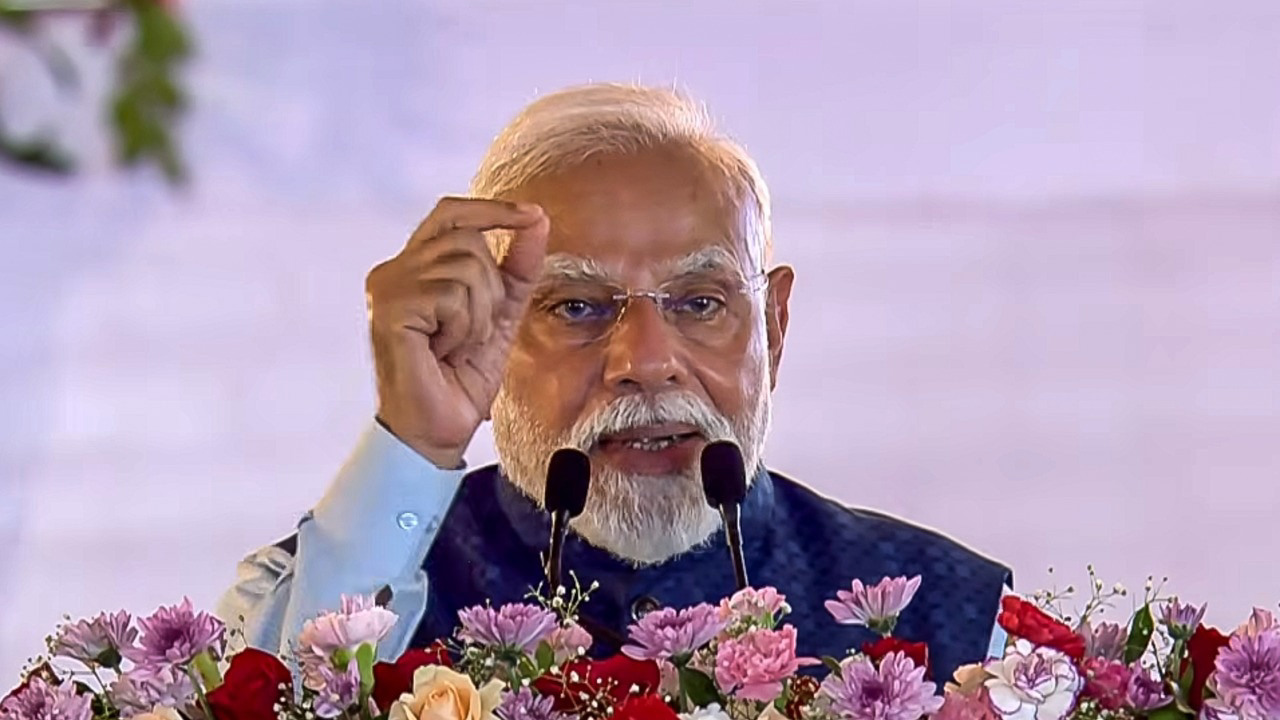
PM Modi Said in a Public Meeting in Delhi: “Those Who Danced With the Constitution on Their Heads Were the Ones Who Crushed It”
Introduction
The Constitution of India is often described as the soul of Indian democracy—a sacred document that lays down the framework of rights, duties, governance, and justice for 1.4 billion people. Political parties across the spectrum frequently invoke the Consti-tution to either defend their actions or accuse their opponents of violating its principles.
In this backdrop, Prime Minister Narendra Modi’s recent remarks at a public meeting in Delhi created a storm in political circles. He declared:
“Those who danced with the Constitution on their heads were the ones who crushed it.”
This pointed statement was aimed at the opposition parties, many of whom have recently staged dramatic protests, rallies, and symbolic acts claiming they are “protecting the Consti-tution” against what they allege is authoritarianism by the Modi government.
But Modi’s counter-attack reframes the debate: who truly upholds the Constitution, and who has undermined it historically?
Let’s dive deep into the meaning of this remark, its historical context, political messaging, and the possible impact on India’s democratic discourse.
Decoding Modi’s Remark
PM Modi’s statement has two clear layers:
- Symbolism vs. Reality: The phrase “danced with the Consti-tution on their heads” refers to symbolic gestures made by opposition leaders, such as carrying a copy of the Constitution in rallies or holding it above their heads in protest.
- Historical Betrayal: By saying these very people “crushed” the Consti-tution, Modi reminded the public of instances where opposition parties, especially the Congress, have been accused of violating constitutional values—most prominently during the Emergency of 1975 declared by Indira Gandhi.
Thus, Modi was suggesting that today’s self-proclaimed “defenders of the Consti-tution” are in fact its biggest violators in history.
Historical Context: The Emergency and Beyond
To understand Modi’s statement, one must revisit India’s darkest chapter of consti-tutional history—the Emergency (1975–77).
- Indira Gandhi’s Decision: Facing political instability and a court ruling against her election, Prime Minister Indira Gandhi imposed Emergency, suspending fundamental rights.
- Constitution Suspended: Freedom of speech, press, and political opposition were brutally suppressed. Thousands were jailed.
- Forced Sterilization: The infamous sterilization campaign, led by Sanjay Gandhi, violated human dignity.
- Democracy Crushed: Parliament became a rubber stamp, and dissent was silenced.
This was the clearest instance where the Consti-tution was “crushed” by those in power. Modi’s remark was therefore not just a political jab but a historical reminder of who actually betrayed the Constitution.
Opposition’s Recent Symbolism
In recent years, opposition leaders—especially from the Congress, Samajwadi Party, and INDIA bloc—have frequently used the Consti-tution as a political symbol:
- Rahul Gandhi holding the Constitution during rallies.
- Opposition MPs carrying copies of the Consti-tution inside Parliament to protest the ruling government.
- Public speeches claiming BJP and Modi are trying to “destroy the Consti-tution.”
Modi’s attack was meant to expose what he sees as hypocrisy: those who perform symbolic theatrics today are the same political forces that have historically weakened constitutional values.
BJP’s Political Narrative on the Constitution
The BJP under Modi has consistently framed itself as a protector of the Constitution while accusing Congress of historical betrayal.
- Ambedkar’s Legacy: Modi frequently invokes Dr. B.R. Ambedkar, the principal architect of the Constitution, reminding citizens that Ambedkar faced opposition from Congress leaders during his time.
- Emergency Reminder: At almost every political opportunity, BJP reminds the nation of how Congress imposed Emergency and curtailed rights.
- Welfare Schemes: Modi presents his government’s social programs (Jan Dhan Yojana, PM Awas Yojana, Ayushman Bharat) as a fulfillment of constitutional promises of equality and social justice.
Thus, Modi’s remark fits into a broader narrative where the BJP positions itself as the true upholder of constitutional values.
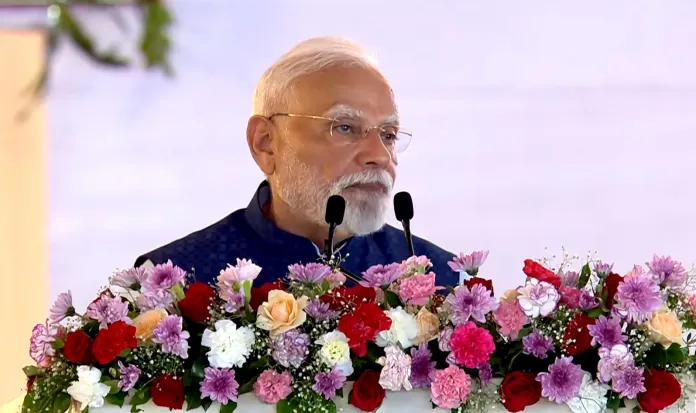
The Symbolism of “Dancing With the Constitution”
The phrase used by Modi is sharp, poetic, and politically loaded. Symbolically, it paints a picture of:
- Drama vs. Substance: Opposition leaders using the Constitution for optics but not substance.
- Mockery of Democracy: Treating the Constitution as a prop rather than a living document.
- Contrast With Governance: Modi suggests that while others play theatrics, his government actually implements constitutional ideals through governance.
This rhetorical device helps connect with ordinary voters, many of whom may not follow constitutional debates closely but understand the difference between “acting” and “doing.”
Opposition’s Counterattack
Predictably, opposition parties hit back after Modi’s remarks:
- Congress accused Modi of twisting history and claimed his government is the real threat to constitutional values today.
- INDIA alliance leaders said Modi fears the Constitution because it guarantees fundamental rights and reservation, which BJP allegedly wants to dilute.
- Rahul Gandhi retorted that Modi talks about the Emergency of the past but is blind to what he called the “undeclared emergency” of today.
This exchange reflects how the Constitution has become not just a legal document but a political weapon in modern Indian discourse.
Why Delhi? The Political Message
It is significant that PM Modi made this remark at a public meeting in Delhi:
- Delhi as Symbolic Space: Being the capital, it is seen as the seat of India’s constitutional and democratic institutions—Parliament, Supreme Court, Rashtrapati Bhavan.
- Target Audience: Delhi has a politically aware population, including youth, students, and civil servants.
- National Echo: Statements made in Delhi are picked up by national media instantly, amplifying their impact.
By choosing Delhi, Modi ensured his message resonated both symbolically and politically.
Public Perception
Among the general public, Modi’s statement has two possible effects:
- Supporters’ View: Many see it as a justified reminder of the Congress’s historical failures and hypocrisy. It strengthens Modi’s image as a strong leader who “tells it as it is.”
- Critics’ View: Some believe Modi uses the Emergency card too often and avoids addressing current challenges like unemployment, inflation, or press freedom.
Either way, the remark ensures the Constitution—and its interpretation—remains a central election theme.
Media Reactions
The statement sparked fiery debates across TV channels and newspapers:
- Pro-BJP Media: Highlighted historical betrayals of the Constitution by Congress and praised Modi for “setting the record straight.”
- Opposition-Friendly Media: Argued Modi is trying to distract from current issues and that his government is centralizing power in ways that weaken democratic institutions.
- Neutral Analysts: Pointed out the irony that every political party invokes the Constitution as per convenience.
International Perspective
The world closely observes India’s democratic narrative. Modi’s statement could be read abroad in two ways:
- Positive Spin: India’s Prime Minister is reminding people about the sanctity of the Constitution and holding past leaders accountable.
- Critical Spin: Global critics might argue Modi himself faces accusations of undermining democratic institutions, so the remark is ironic.
Either way, it reaffirms that the Constitution is central to India’s global democratic identity.

Linking to the 2026 Elections
As India gears up for the 2026 general elections, Modi’s remarks fit neatly into the BJP’s election messaging:
- Protectors vs. Betrayers: Casting BJP as the guardian of the Constitution and Congress as the historical betrayer.
- Ambedkar Factor: Strengthening BJP’s outreach to Dalit voters by linking Ambedkar’s vision with Modi’s governance.
- Nationalist Narrative: Positioning Modi as the leader who exposes hypocrisy and stands firm for the nation’s democratic values.
Conclusion
PM Modi’s remark—“Those who danced with the Constitution on their heads were the ones who crushed it”—is more than just a political punchline. It is a layered statement combining history, symbolism, and electoral strategy.
By invoking the Emergency, Modi reminded the nation of Congress’s past sins. By mocking symbolic gestures, he framed the opposition as hypocritical dramatists. And by speaking in Delhi, he gave the statement maximum symbolic weight.
The real question for voters is: Who truly protects the Constitution—not in words, but in deeds? Modi clearly wants the answer to be his government, while the opposition will continue to claim otherwise.
In the end, the Constitution remains not just a legal framework but also a battlefield of political legitimacy. And in this battlefield, words like Modi’s are as powerful as laws themselves.
Read more latest news

