
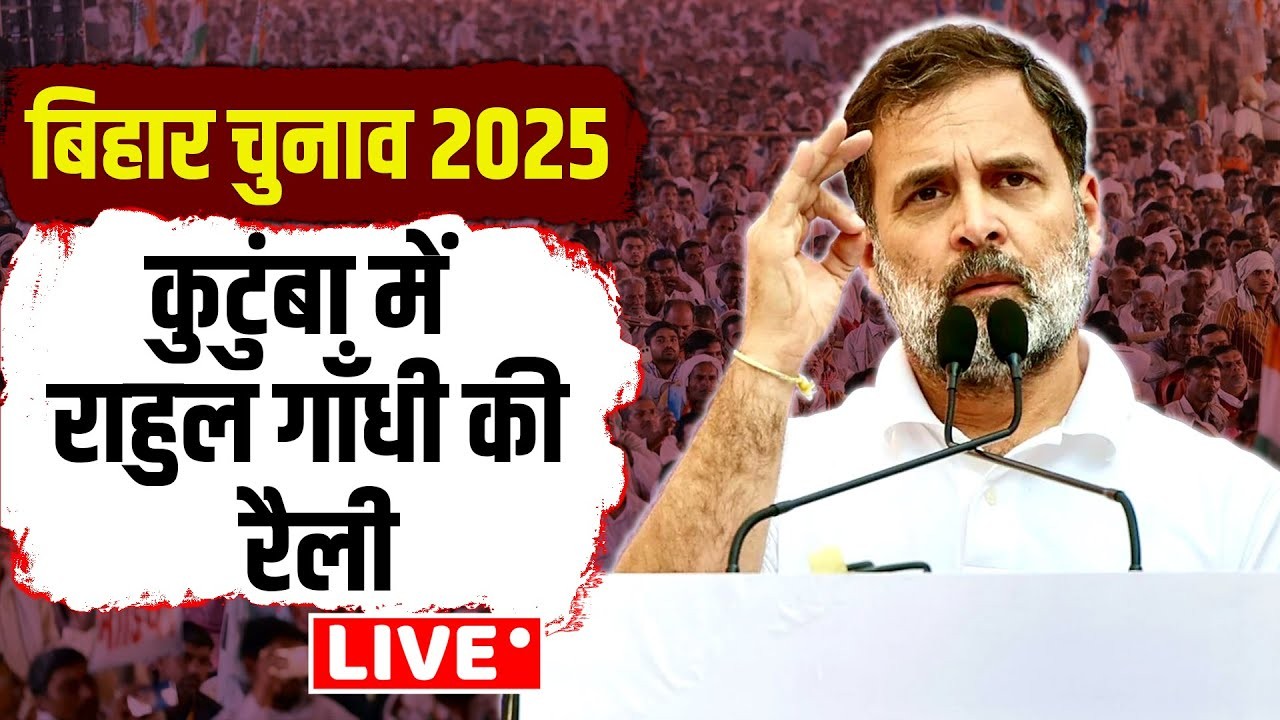
Rahul Gandhi in Kutumba: “90% of India is Dalit, Backward, or Minority — Yet Absent from the Top 500 Companies” | A Bold Call for Social and Economic Justice
Introduction: Rahul Gandhi’s Bihar Rally Sparks National Debate
Congress leader Rahul Gandhi said The political atmosphere in Bihar turned charged when Congress leader Rahul Gandhi, during a rally in Kutumba, made a striking statement that has once again placed caste and economic representation at the center of India’s political discourse. Addressing a massive gathering, Gandhi said,
“If you see, 90 percent of the country’s population is Dalit or Maha Dalit, backward, extremely backward, minority. But if you take out the list of India’s 500 biggest companies, you will not find them there.”
This remark — simple yet piercing — has opened the floodgates of debate on economic disparity, caste inclusion, and social justice. It also signals a strategic shift in Congress’s political narrative ahead of the upcoming elections, placing social equity and representation in wealth creation at the forefront.
The Context: Bihar’s Ground and the Politics of Representation
Bihar, historically the epicenter of caste-based politics, has witnessed leaders like Karpoori Thakur, Lalu Prasad Yadav, and Nitish Kumar shape their political identity around social justice. Rahul Gandhi’s statement in this land was no coincidence. Bihar represents the social composition of India in microcosm — where Dalits, Mahadalits, OBCs, and minorities form the overwhelming majority, yet continue to struggle for equal participation in the power and economic structure.
By invoking this theme in Kutumba, Rahul Gandhi was not merely addressing a local audience — he was sending a message to the entire nation. The Congress scion sought to highlight how caste inequality and economic monopoly remain deeply intertwined in India’s corporate and administrative ecosystem.
Decoding Rahul Gandhi’s Statement: A Data-Based Reality
Rahul Gandhi’s statement — that 90% of India’s population belongs to marginalized communities — is broadly reflective of the Mandal-era demographic understanding of India.
Let’s break down the numbers:
- Scheduled Castes (Dalits): Around 16.6% of the population.
- Scheduled Tribes (Adivasis): Approximately 8.6%.
- Other Backward Classes (OBCs): Estimated 40-45%, though not officially enumerated since the 1931 census.
- Minorities (including Muslims, Christians, Sikhs, etc.): Around 19-20%.
Taken together, these groups indeed constitute nearly 85–90% of India’s population.
Yet, when one examines the list of India’s top 500 companies — whether by market capitalization or ownership — the representation of these groups is negligible. Corporate leadership remains dominated by upper-caste individuals, particularly from business families and privileged social backgrounds.
This stark mismatch between demographic majority and economic control forms the core of Rahul Gandhi’s argument — that India’s economy does not reflect its social reality.
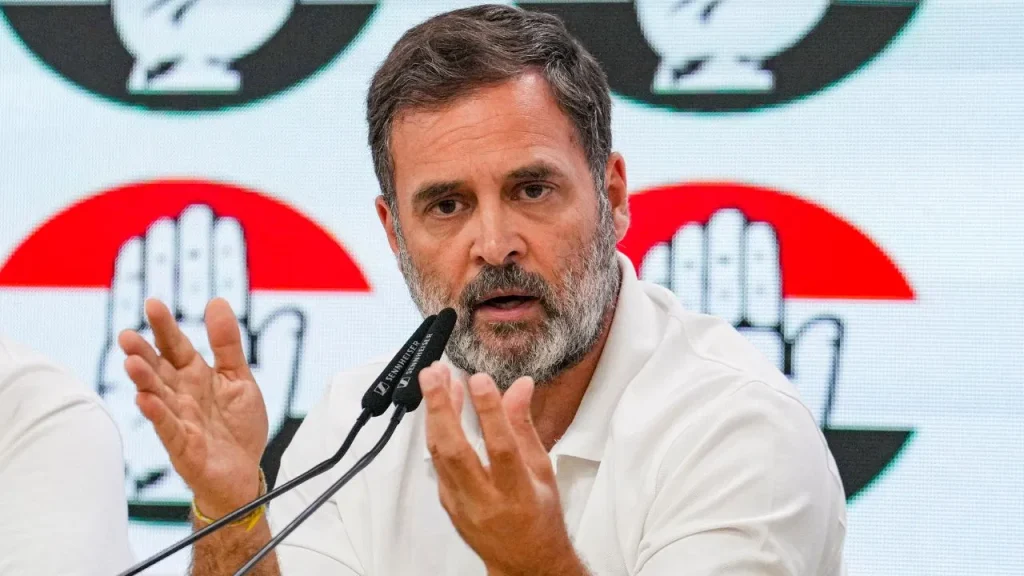
Caste and Capital: The Missing Link in India’s Growth Story
For decades, India’s economic growth story has been told in terms of GDP, foreign investment, and infrastructure expansion. But representation and ownership remain largely untouched subjects. While political reservations have given visibility to marginalized sections in governance, economic power remains concentrated in the hands of a few.
Studies have shown that corporate boardrooms, venture capital networks, and senior managerial positions are still dominated by individuals from upper-caste Hindu backgrounds — often with family ties to pre-existing business empires or elite educational institutions.
This is the inequality that Rahul Gandhi sought to expose — a silent economic apartheid where the marginalized are confined to labor, not leadership.
He argued that true democracy must extend beyond political voting rights; it must also ensure economic representation and ownership in the structures that control the nation’s wealth.
Rahul Gandhi’s Vision of a Caste Census: Connecting the Dots
Rahul Gandhi’s remarks also revive his long-standing demand for a nationwide caste census — a political promise that has become central to the Congress campaign.
The caste census, according to Gandhi, is not just about numbers; it’s about redistribution of opportunity. He has repeatedly said:
“You cannot make policies for the people unless you know who the people are.”
By highlighting that Dalits, OBCs, and minorities are absent from India’s top corporate spaces, Gandhi is effectively making the case for data-driven affirmative action — one that expands beyond government jobs and educational quotas into private sector inclusion.
This is not an isolated campaign statement but part of a larger ideological blueprint that the Congress is crafting — a revival of the Mandal 2.0 narrative in modern economic terms.
Political Implications: Congress’s Social Justice Push
Rahul Gandhi’s Kutumba speech must also be seen as part of Congress’s electoral strategy to reclaim the social justice narrative that it once lost to regional players like RJD, SP, and JD(U).
By combining economic disparity with caste under-representation, Gandhi aims to weave a pan-India narrative that resonates from Uttar Pradesh to Tamil Nadu, from Bihar to Maharashtra.
This narrative seeks to unite the marginalized castes and minorities under a single political and economic identity — the “excluded majority.”
In Bihar, this strategy directly challenges Lalu Yadav’s traditional backward-class politics and Nitish Kumar’s governance narrative, offering instead a national-scale vision of social equity that extends into corporate India.

Why This Statement Matters Now
Rahul Gandhi’s comments come at a time when India’s economic inequality has reached record levels. According to reports, the top 10% of Indians own more than 77% of the wealth, while the bottom 60% together hold less than 5%.
This economic gap also mirrors caste and social hierarchies, where marginalized communities continue to be underrepresented in the private sector, universities, and even media houses.
By invoking this issue in a state like Bihar — which symbolizes both poverty and resilience — Gandhi is positioning himself as a voice for inclusive economic democracy.
He is essentially saying: India cannot be truly developed until its economic power reflects its social composition.
The Response: BJP and NDA Hit Back
As expected, Gandhi’s statement invited sharp criticism from the BJP and its allies.
BJP leaders accused him of “dividing society along caste lines”, calling his speech regressive and casteist.
A senior BJP spokesperson remarked:
“Rahul Gandhi only knows how to divide India. Instead of talking about development and merit, he talks about caste and religion. This is nothing but vote-bank politics.”
Union Minister Giriraj Singh, speaking from Bihar, went further to say:
“Rahul Gandhi should first look at his own party. How many Dalits and OBCs are in Congress leadership? He only remembers them during elections.”
The BJP also emphasized that economic growth, entrepreneurship schemes, and digital reforms have benefited all Indians, irrespective of caste. They pointed to government initiatives like Mudra Yojana and Startup India, which have provided financial opportunities to small entrepreneurs, including those from backward communities.
Support from Regional and Opposition Leaders
However, Rahul Gandhi’s statement found resonance among opposition ranks, especially within the INDIA alliance.
Leaders from RJD, SP, DMK, and JMM echoed his concerns, saying that economic inclusion must become a national agenda.
Tejashwi Yadav, Deputy CM of Bihar and RJD leader, said:
“Rahul ji has said what we have been saying for years. Caste-based discrimination is not just in jobs but also in business. We need representation everywhere — in Parliament, universities, and companies.”
Akhilesh Yadav of the Samajwadi Party called for “caste census plus corporate diversity”, arguing that real empowerment will come only when economic power mirrors social reality.
Thus, Rahul Gandhi’s speech in Kutumba has achieved what he likely intended — to unite the opposition narrative under the umbrella of social and economic justice.
Historical Parallels: From Mandal Commission to Modern India
Rahul Gandhi’s speech also invokes memories of the Mandal Commission (1990), which revolutionized Indian politics by recognizing OBCs as a distinct social and political category deserving of reservation.
While Mandal 1.0 was about government job and education quotas, Rahul Gandhi’s call seems to be for Mandal 2.0 — focusing on representation in wealth creation, entrepreneurship, and private sector decision-making.
This reflects an evolution of the social justice movement — from the demand for government employment to ownership and leadership in India’s booming economy.
If Mandal was about seats in Parliament and government offices, Gandhi’s movement is about seats in boardrooms.
A Socio-Economic Revolution in the Making?
Whether Rahul Gandhi’s campaign translates into electoral success or not, his statement touches on a fundamental truth — that representation in economic structures is the next frontier of India’s democracy.
Dalits, OBCs, and minorities may have gained symbolic political visibility, but real economic participation remains minimal. The lack of capital access, education inequality, and systemic discrimination continue to hold back large sections of India’s population from participating in the economy beyond the labor force.
By bringing this issue to the political center stage, Rahul Gandhi has forced a national conversation — one that could reshape not only electoral debates but also policy-making in the next decade.
Criticism and Challenges Ahead
Despite the moral weight of his argument, Rahul Gandhi faces two key challenges:
- Credibility Gap: Critics argue that the Congress, during its decades in power, failed to bring real structural reforms that could have democratized economic power. Even today, Congress’s internal structure is dominated by elite leadership, with limited space for Dalit or OBC voices at the top.
- Policy Blueprint: While Gandhi’s rhetoric is powerful, specific policy details remain unclear. How does he plan to ensure representation in private corporations? Through legislation, affirmative action, or incentives? The absence of a concrete roadmap leaves room for skepticism.
Nevertheless, the fact that he is raising this conversation at a time when corporate monopolies are expanding and social mobility is stagnant gives his argument substantial relevance.
Public Reaction: Ground Sentiment in Bihar
Reports from Bihar suggest that Rahul Gandhi’s speech in Kutumba struck a chord among rural voters, particularly the youth from OBC and Dalit backgrounds. Many attendees reportedly appreciated that a national leader was speaking their language — addressing caste not as a stigma but as a structural issue linked with livelihood and dignity.
In several districts, Gandhi’s remarks have sparked local discussions on access to education, entrepreneurship, and social mobility.
This indicates that the issue of representation in economic power may resonate beyond party lines, especially in states where caste remains a living social reality, not a historical relic.
Conclusion: A New Chapter in the Politics of Equality
Rahul Gandhi’s Kutumba speech marks a significant turning point in the way Indian politics approaches the question of inequality. By directly linking caste identity with economic representation, Gandhi has expanded the definition of social justice for a new generation.
His statement — that 90% of India belongs to marginalized groups yet owns almost nothing in corporate India — may be provocative, but it reflects a hard truth that many prefer to ignore.
Whether this transforms into a political movement or policy framework, only time will tell. But one thing is certain:
Rahul Gandhi has reignited India’s long-dormant conversation on caste, economy, and ownership, challenging both the government and the elite class to rethink what real equality means in a 21st-century democracy.
Read More latest news

