
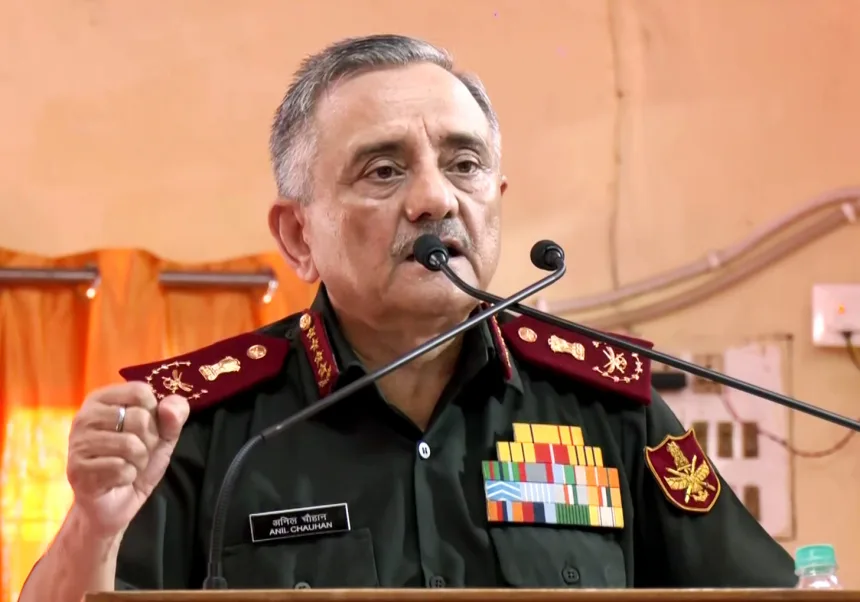
CDS Anil Chauhan: Border Dispute with China is the Biggest Challenge for India
Defence Staff CDS becomes crucial India’s national security landscape is evolving rapidly, and in this evolving scenario, the role of the Chief of Defence Staff (CDS) becomes crucial. General Anil Chauhan, the current CDS of India, has once again highlighted the gravity of the border dispute with China, calling it “the biggest challenge” India faces in terms of defence preparedness, strategic policy, and geopolitical balance. His statement not only reflects the military realities on the ground but also echoes the diplomatic and political complexities that surround the India-China relationship.
In this detailed blog, we will explore the historical background of the India-China border dispute, the current challenges along the Line of Actual Control (LAC), the strategic vision of CDS Anil Chauhan, the steps India is taking to strengthen its military position, and the broader implications for India’s foreign and defence policy.
Historical Background of the India-China Border Dispute
To understand why CDS Anil Chauhan considers the dispute with China as the biggest challenge, one must go back to the roots of the conflict.
- The India-China border stretches over 3,488 km, covering the regions of Ladakh, Arunachal Pradesh, Uttarakhand, Sikkim, and Himachal Pradesh.
- The conflict dates back to 1950s and 1960s, particularly after China occupied Tibet. India gave refuge to the Dalai Lama in 1959, worsening ties.
- The 1962 Sino-Indian War remains the most painful chapter, where India faced a humiliating defeat due to lack of preparedness.
- Despite several rounds of talks and agreements (1993, 1996, 2005, and later), the Line of Actual Control (LAC) continues to remain disputed.
The Doklam standoff (2017) and Galwan Valley clash (2020) prove that tensions can erupt suddenly, leading to casualties and heightening mistrust.
Why the China Border is the Biggest Challenge
According to General Anil Chauhan, the border issue is not just a military problem but also a strategic and diplomatic challenge. Several factors make the dispute particularly difficult:
- Undefined LAC – Unlike with Pakistan, the India-China border has no officially recognized boundary. Different perceptions of the LAC often result in patrol clashes.
- China’s Infrastructure Push – China has aggressively developed roads, bridges, airfields, and military posts along the LAC, giving its troops greater mobility.
- Two-Front Challenge – India not only faces China but also has to keep Pakistan in check. The possibility of a two-front war is a major concern.
- High-Altitude Warfare – Ladakh and Arunachal Pradesh require specialized training, equipment, and logistics, making defence preparation costly and complex.
- China’s Geopolitical Ambitions – Through projects like the Belt and Road Initiative (BRI) and its ties with Pakistan (CPEC), China aims to encircle India.
CDS Chauhan emphasized that India cannot underestimate this challenge, and preparedness must remain a top priority.
Current Situation on the India-China Border
The Ladakh region remains the flashpoint of India-China tensions. After the Galwan Valley clash in June 2020, both armies deployed tens of thousands of troops along the LAC.
- Multiple disengagement rounds have taken place, but friction points like Depsang Plains and Demchok remain unresolved.
- Both sides continue to infrastructure race – India has accelerated road, tunnel, and airfield construction to match China.
- Despite dialogue through Working Mechanism for Consultation and Coordination (WMCC) and Corps Commander-level talks, complete peace remains elusive.
General Anil Chauhan, in his statement, pointed out that the border with China will remain a long-term challenge, requiring vigilance, patience, and multi-pronged strategy.

CDS Anil Chauhan’s Strategic Vision
CDS Anil Chauhan has laid out a comprehensive framework for India’s defence in the face of the China challenge:
- Jointness of Armed Forces – The creation of integrated theatre commands to ensure Army, Navy, and Air Force work seamlessly in any conflict scenario.
- Technology-Driven Warfare – India must invest in AI, drones, space assets, and cyber warfare capabilities to counter China’s modern warfare tactics.
- Infrastructure Push – Faster completion of projects like the Atal Tunnel, border roads, and advanced landing grounds in Arunachal Pradesh.
- Self-Reliance in Defence – Promoting Atmanirbhar Bharat in defence production to reduce dependence on imports and strengthen indigenous capabilities.
- Strong Diplomacy – Keeping lines of communication open with China while simultaneously strengthening ties with allies like US, Japan, Australia (Quad nations).
India’s Military Preparedness
India has taken significant steps to strengthen its military presence along the border:
- Deployment of Rafale Jets in Ambala and Hashimara to cover both western and eastern sectors.
- S-400 missile defence systems deployed to counter aerial threats.
- Advanced light tanks and high-altitude warfare equipment being inducted.
- Enhanced troop deployment in Ladakh and Arunachal Pradesh.
- Emphasis on high-altitude training schools to prepare soldiers for mountain warfare.
These steps reflect CDS Anil Chauhan’s vision of making India’s defence forces combat-ready for any contingency.
Diplomatic Angle: India Balancing Between Dialogue and Deterrence
While military preparedness is vital, diplomacy plays an equally critical role. India has continued to engage with China at multiple levels:
- Bilateral talks at military and diplomatic levels.
- Leveraging international platforms like BRICS, SCO, G20 to raise concerns.
- Strengthening partnerships with Quad (US, Japan, Australia) and improving defence cooperation with France, Israel, and Russia.
CDS Chauhan underlined that while dialogue must continue, India cannot compromise its sovereignty.
Global Implications of the Border Dispute
The India-China border dispute is not just a bilateral issue; it has global repercussions:
- US and Western countries see India as a counterbalance to China’s rise.
- Russia’s tilt towards China complicates India’s balancing act.
- Indo-Pacific strategy increasingly revolves around ensuring China does not dominate Asia.
- Global supply chains and economic ties are impacted by security tensions.
General Anil Chauhan’s remark thus reflects not only India’s security concern but also a wider strategic reality.

Public and Political Reactions
- The Indian public strongly supports a tough stance against China.
- Political leaders across parties agree that national sovereignty cannot be compromised.
- Social media regularly trends with #BoycottChina during flashpoints.
- However, economic realities (trade worth $115+ billion between India and China) mean a complete decoupling is difficult.
The Road Ahead
CDS Anil Chauhan’s statement is a reminder that India’s security strategy must remain China-focused. Going forward:
- Faster defence modernization with focus on indigenous production.
- Closer strategic ties with like-minded nations in the Indo-Pacific.
- Sustained infrastructure push in border areas.
- Balanced diplomacy – firm on sovereignty but pragmatic in engagement.
- Internal strength – strong economy, innovation, and national unity to counter external threats.
Conclusion
The India-China border dispute remains one of the biggest challenges of our time, and General Anil Chauhan’s candid acknowledgment only reinforces its seriousness. As CDS, his vision combines military preparedness, technological advancement, and strategic diplomacy.
India must remain vigilant, resilient, and united in the face of this challenge. Whether in Ladakh’s icy heights or Arunachal’s dense forests, the Indian Armed Forces, guided by strong leadership, stand ready to defend the nation.
Read more latest news

