

Historic Turnout in the Bihar Assembly Elections: Women Lead the Way as Democracy Shines with Record 66.9% Voting
The Bihar Assembly elections have once again written a new chapter in India’s democratic history. This year’s polling witnessed an extraordinary voter turnout of 66.9%, marking the highest participation rate since 1951. What makes this moment truly historic is the unprecedented participation of women — 71% of female voters exercised their right to vote, surpassing male turnout by a wide margin.
The Election Commission of India hailed the Bihar Assembly elections as an outstanding example of peaceful, transparent, and participatory democracy. At a time when voter apathy and political disillusionment are growing concerns in many parts of the world, the citizens of Bihar have sent a resounding message — democracy in India is alive, vibrant, and people-driven.
A Landmark in Democratic Participation
The record turnout in the Bihar Assembly elections is not just a number; it is a reflection of the people’s faith in democratic institutions. Since the first election held in 1951–52, Bihar’s political landscape has evolved dramatically, witnessing waves of social, economic, and political changes. Yet, this year’s election stands apart for one reason — it united the people across all divides in a shared commitment to shaping the future of their state.
When the Election Commission announced the final figures, it was clear that Bihar had achieved something remarkable. Out of the total registered voters, nearly two-thirds turned up at the polling booths, braving the winter chill and long queues to make their voices heard.
Chief Election Commissioner Rajiv Kumar remarked, “The Bihar Assembly elections have set a new benchmark for electoral participation. The people of Bihar deserve applause for showing how democracy thrives through active involvement.”
Women Voters: The Real Champions
Perhaps the most inspiring aspect of the Bihar Assembly elections was the unprecedented turnout among women voters. Data revealed that 71% of women exercised their right to vote compared to 63% of men.
In a state often stereotyped for patriarchal traditions, this surge of female participation symbolizes transformation. Women from rural and urban areas alike turned out in massive numbers, proving that political empowerment has reached every corner of Bihar.
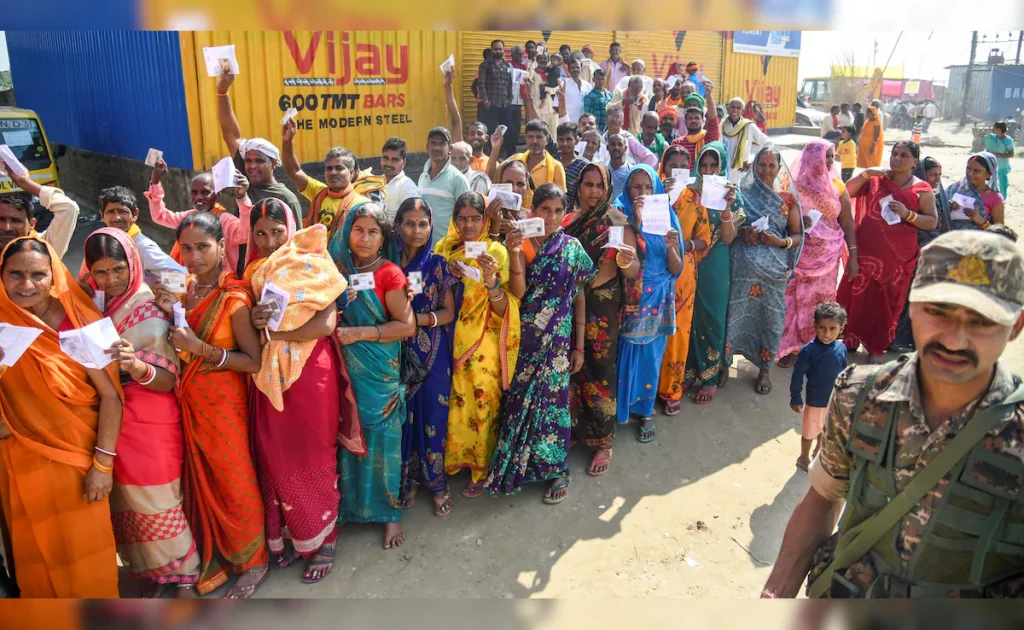
In districts like Gopalganj, Madhubani, and Nalanda, long queues of women voters could be seen early in the morning, many carrying infants or walking several kilometers just to reach the polling stations. Local officers reported that women voters not only came in record numbers but also did so peacefully and enthusiastically.
The Election Commission highlighted that the Bihar Assembly elections were a model of gender-inclusive democracy. Chief Electoral Officer H.R. Srinivasan said, “Women have rewritten Bihar’s electoral story. Their participation reflects growing awareness, empowerment, and hope for better governance.”
The Peaceful Conduct of Elections
Another remarkable feature of the Bihar Assembly elections was their peaceful execution. Despite concerns about regional tensions and political rivalries, the polls remained largely incident-free. The Election Commission deployed extensive security arrangements, involving thousands of central and state forces, drones, and live monitoring systems.
Unlike earlier decades when violence and booth capturing were major issues, this election saw a drastic improvement in law and order. Election observers noted that voting took place without fear or intimidation, even in sensitive constituencies like Munger and Arrah.
Chief Election Commissioner Kumar commended the administration’s efforts: “We are proud that the Bihar Assembly elections have shown how technology and transparency can ensure peaceful and fair voting. Every vote was protected, every voice was respected.”
Technological Advancements and Transparency
Technology played a key role in ensuring that the Bihar Assembly elections were free, fair, and transparent. The Commission used advanced systems such as Voter Verifiable Paper Audit Trails (VVPATs), live webcasting from polling booths, and GPS-enabled vehicles to track movement of election materials.
Additionally, voter helplines and mobile apps were introduced to guide citizens about their polling stations and help report any irregularities. The Election Commission’s efforts to make voting accessible to differently-abled voters and senior citizens were also widely appreciated.
Transparency became the hallmark of these elections. From digital monitoring to social media updates, the Commission made sure that the Bihar Assembly elections upheld the highest democratic standards.

The Spirit of Bihar’s Voters
Every election tells a story, and the Bihar Assembly elections tell one of resilience and responsibility. Bihar’s voters — often criticized for political volatility — have shown remarkable maturity.
From first-time voters in Patna to elderly citizens in rural Jamui, people came forward with pride and determination. A 90-year-old woman in Siwan told reporters, “This is my right and my duty. I have never missed voting, not even once since independence.” Her words capture the essence of Bihar’s democratic spirit.
Students, farmers, and women’s self-help groups all participated enthusiastically. The message was clear — Bihar’s people believe that their vote matters.
EC’s Commendation: A Model for India
In its post-election briefing, the Election Commission lauded Bihar’s performance, calling it “a lesson in democratic participation.” It emphasized that the Bihar Assembly elections were conducted with utmost fairness, setting an example for other states.
The Commission noted that zero major incidents of violence occurred, and voter satisfaction levels were among the highest ever recorded. It also appreciated the efforts of polling officers, police forces, and volunteers who worked tirelessly across 38 districts to ensure smooth voting.
This success story has sparked discussions about replicating Bihar’s election management model in future polls across India.
Political Reactions: Praise Across Parties
Political parties across the spectrum praised the voter turnout and the peaceful conduct of the Bihar Assembly elections.
Prime Minister Narendra Modi congratulated the people of Bihar, tweeting, “The record voter turnout in the Bihar Assembly elections reflects the strength of our democracy. Every citizen who participated deserves appreciation.”
Opposition leaders echoed similar sentiments. Congress leader Rahul Gandhi said, “The people of Bihar have set an example for the entire nation. High participation means people are deeply engaged in shaping their state’s destiny.”
Regional leaders from RJD, JD(U), and LJP all acknowledged that this election transcended political divides — it was a celebration of democracy itself.
Why This Election Stands Apart
The Bihar Assembly elections of this year will be remembered not just for numbers but for symbolism. It was an election where the people triumphed over cynicism.
While past elections in Bihar were marred by violence, allegations of malpractice, and social tensions, this time the narrative changed completely. From the start of campaigning to the declaration of results, the process remained calm, transparent, and participatory.
Observers from across India — including the Election Commission of Nepal and international democracy monitors — praised Bihar’s example. One observer noted, “The Bihar Assembly elections are a milestone in electoral evolution. Bihar has emerged as a pioneer of participatory governance.”
Women as Change-Makers
Women’s turnout being higher than men’s in the Bihar Assembly elections has deep social and political implications. It suggests that women voters are now a decisive factor in shaping electoral outcomes.
Their participation was not just symbolic; it was transformative. Analysts believe that political parties will now have to realign their strategies and address women’s issues — from education and health to safety and employment — with renewed seriousness.
Sociologist Neelima Sinha observed, “When 71% of women vote, it’s not just participation; it’s power. The Bihar Assembly elections have empowered women to influence policy and demand accountability.”
The Role of Youth and First-Time Voters
Youth participation was another highlight of the Bihar Assembly elections. According to Election Commission data, over 1.8 million new voters aged between 18 and 21 cast their votes for the first time.
Universities and colleges across the state ran awareness campaigns encouraging students to register. Civil society organizations also played a vital role in motivating young voters to exercise their franchise.
One young voter from Muzaffarpur said, “We are tired of corruption and unemployment. We want change, and voting is the first step.” Such sentiments reflect the growing political consciousness among Bihar’s youth.
Bihar’s Electoral Evolution Since 1951
A look back shows how far Bihar has come since the first Bihar Assembly elections in 1951. At that time, voter turnout was barely 45%, and the process was limited to a small section of the population.
Over the decades, as literacy improved and awareness spread, participation gradually increased. However, it was often marred by booth capturing, political violence, and administrative inefficiency.
The transformation witnessed today — with record participation, women’s leadership, and peaceful conduct — is nothing short of revolutionary. It marks a full-circle moment in Bihar’s democratic evolution.
Challenges That Remain
While the Bihar Assembly elections showcased progress, challenges remain. Electoral rolls still need periodic updates, migration patterns complicate voter registration, and infrastructure gaps persist in remote areas.
Additionally, political polarization and misinformation on social media continue to pose threats to free and fair elections. Experts have called for continuous voter education and digital literacy programs to ensure that democracy remains robust.
Yet, the spirit shown by the people of Bihar offers hope. As one senior Election Commission official said, “The success of the Bihar Assembly elections proves that when citizens participate with sincerity, democracy becomes unstoppable.”
Media and Civil Society’s Role
The media played an important role in amplifying awareness during the Bihar Assembly elections. News channels, social media influencers, and civic organizations ran campaigns urging people to vote responsibly.
Local radio programs in rural areas broadcast voter education messages in Bhojpuri, Maithili, and Magahi, helping bridge the information gap. Civil society groups like ADR and Lokniti-CSDS monitored the process to ensure transparency and voter rights.
This collaboration between institutions and citizens created an ecosystem of accountability, which was key to the election’s success.
Global Recognition and Lessons for Other States
International observers praised India’s electoral machinery for conducting the Bihar Assembly elections smoothly despite logistical challenges. The United Nations Democracy Fund cited it as a “model for developing democracies.”
States like Uttar Pradesh, Jharkhand, and West Bengal are already studying Bihar’s strategies to improve their own election management systems. From digital monitoring to women-centric polling initiatives, the Bihar Assembly elections have become a case study for governance experts.
The Road Ahead for Bihar
The record voter turnout in the Bihar Assembly elections has raised expectations for governance. Citizens now want concrete results — better roads, employment opportunities, and social welfare.
The new government, regardless of party lines, faces the challenge of meeting these aspirations. Analysts believe that the high turnout has increased accountability, and politicians can no longer ignore public sentiment.
As one Patna-based political analyst put it, “The people have spoken loudly. The Bihar Assembly elections are a reminder that power belongs to the voter, not the ruler.”
Conclusion: A Celebration of Democracy
The story of the Bihar Assembly elections is a story of India’s democratic heartbeat. It is about faith, participation, and the belief that every vote counts.
When 66.9% of voters turn out — and women lead that charge — it becomes more than an election; it becomes a movement. The peaceful, transparent, and inclusive conduct of this poll demonstrates what democracy truly stands for.
Bihar has shown that despite challenges, the spirit of the Indian voter remains unbreakable. The Bihar Assembly elections will be remembered not just for the numbers but for what they symbolize — empowerment, unity, and progress.
As the Election Commission rightly said, “This is democracy at its best.” Bihar has set an example for the nation, reminding us all that the strength of India’s democracy lies not in its institutions alone, but in the hearts and hands of its people.
Read more latest news

