
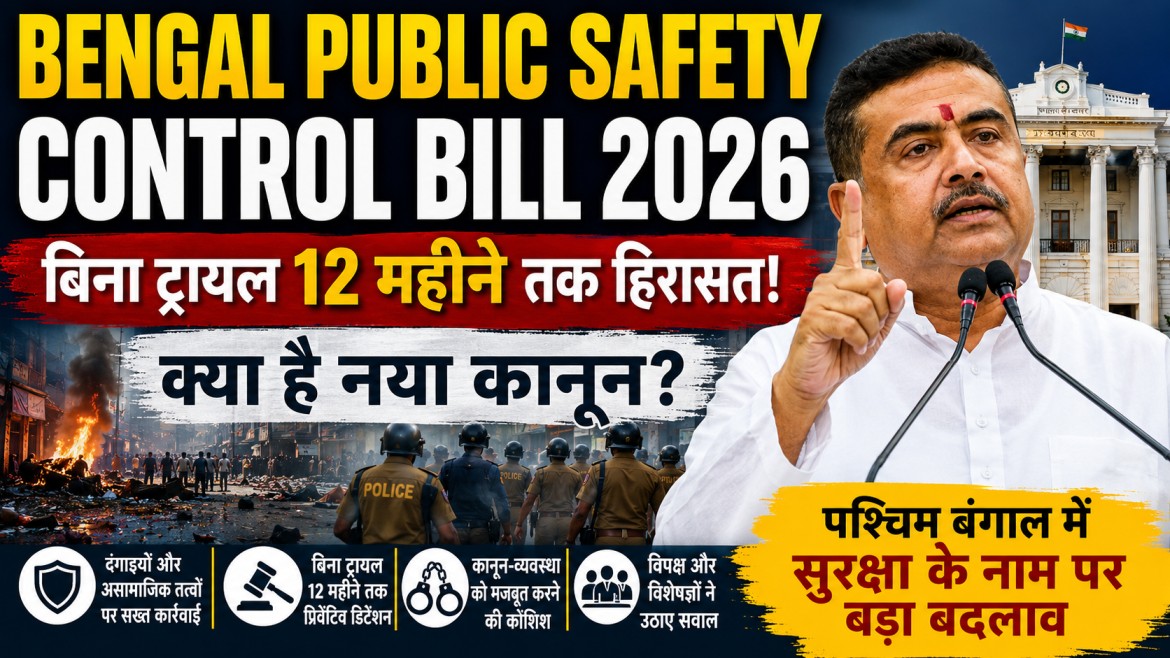
Bengal Public Safety Control Bill 2026: West Bengal Government Introduces Tough Law Against Rioters and Anti-Social Activities
Introduction
The Bengal Public Safety Control law comes at a time when several states are exploring stricter legal mechanisms to maintain law and order amid increasing incidents of political violence, communal clashes, organized crime, and public unrest.
The West Bengal government has introduced one of its most debated legislations in recent years by passing the Bengal Public Safety and Control of Anti-Social Activities Bill, 2026. The new law has triggered widespread political discussions, legal debates, and public interest because it empowers authorities to take preventive action against individuals allegedly involved in anti-social activities, organized violence, and riots.
One of the most controversial aspects of the legislation is the provision allowing preventive detention for up to 12 months without a criminal trial, provided the authorities believe that such detention is necessary to maintain public order and security. The state government argues that the law is essential for protecting citizens, preventing communal violence, and tackling organized criminal networks. Critics, however, have expressed concerns about civil liberties, constitutional rights, and the possibility of misuse.
This article examines the key provisions of the legislation, the government’s justification, political reactions, constitutional implications, and its potential impact on law enforcement and society.
Why Was the Bill Introduced?
According to the West Bengal government, recent years have witnessed several incidents involving riots, communal tensions, organized criminal activities, and violence that threatened public peace.
The government believes existing criminal laws often become ineffective because investigations take time, witnesses hesitate to testify, and dangerous individuals continue operating while cases remain pending.
Officials argue that stronger preventive measures are necessary to stop violence before it occurs rather than responding only after major damage has already taken place.
This is where the Bengal Public Safety Control framework is expected to play an important role by empowering authorities to intervene before large-scale disturbances happen.
What Is the Bengal Public Safety and Control of Anti-Social Activities Bill, 2026?
The legislation is a preventive law designed to identify individuals who are believed to be involved in activities that threaten public safety.
The law covers various categories including:
- Organized criminal groups
- Habitual rioters
- Persons involved in communal violence
- Anti-social elements
- Organized extortion gangs
- Individuals accused of disturbing public peace repeatedly
- Criminal syndicates
- Groups involved in unlawful assemblies resulting in violence
Through Bengal Public Safety Control, the state seeks to prevent these individuals from carrying out activities that may disturb law and order.
Preventive Detention: The Most Controversial Provision
The biggest highlight of the legislation is preventive detention.
Unlike normal criminal prosecution, preventive detention allows authorities to detain an individual before conviction, based on the belief that the person’s future activities may threaten public safety.
Under the Bill:
- Detention may continue for up to 12 months.
- Authorities do not need a completed criminal trial before detention.
- Review mechanisms are expected to examine detention orders.
- The government claims safeguards exist to prevent arbitrary use.
Supporters believe this power can stop riots before they begin.
Opponents argue that preventive detention without trial raises serious constitutional and human rights concerns.
The Bengal Public Safety Control legislation has therefore become one of the most debated legal reforms in the state.
Objectives of the New Law
The government says the legislation has several objectives:
Prevent riots
Authorities aim to stop violence before it escalates into communal clashes or political unrest.
Protect public property
Riots frequently result in destruction of buses, trains, government offices, schools, and private businesses.
Improve public security
Citizens should feel safer if habitual offenders are prevented from organizing violence.
Strengthen law enforcement
Police officers receive additional legal authority for preventive action under Bengal Public Safety Control.
Control organized crime
The law seeks to target criminal organizations that repeatedly disturb law and order.
Government’s Justification
The West Bengal government maintains that ordinary criminal laws are primarily punitive—they punish offenders after crimes occur.
However, preventive laws aim to stop violence before innocent people suffer.
According to the government:
- Intelligence agencies often receive advance information.
- Authorities sometimes know who is planning violent incidents.
- Existing legal procedures may not allow timely intervention.
The administration argues that Bengal Public Safety Control fills this legal gap.
Officials have also claimed that public safety should remain the government’s highest priority.
Political Reactions
The Bill immediately became a major political issue.
Ruling party’s stand
Supporters describe the legislation as necessary for maintaining peace and protecting ordinary citizens.
They argue that law-abiding citizens have nothing to fear because the law targets only anti-social elements.
Opposition criticism
Opposition parties have raised several objections.
Their concerns include:
- Possible misuse against political opponents
- Preventive detention without trial
- Threats to democratic freedoms
- Lack of judicial oversight
- Broad definitions of anti-social activities
Several opposition leaders have demanded stronger safeguards before implementation.
The debate surrounding Bengal Public Safety Control has therefore extended beyond West Bengal into national political discussions.

Legal Experts Express Mixed Views
Constitutional experts have offered differing opinions.
Some believe preventive detention laws are constitutionally permissible because similar provisions already exist under Indian law.
Others argue that detention without trial should remain an exceptional measure rather than becoming routine.
Legal scholars emphasize:
- Clear definitions
- Independent review
- Judicial accountability
- Transparency
- Protection of fundamental rights
Many experts suggest that the success of Bengal Public Safety Control will ultimately depend on its implementation rather than merely its wording.
Constitutional Perspective
India’s Constitution allows preventive detention under certain circumstances.
However, constitutional safeguards also require:
- Communication of grounds for detention
- Opportunity for representation
- Advisory Board review
- Maximum detention limits specified by law
Therefore, constitutional validity often depends on whether procedural safeguards are properly followed.
The implementation of Bengal Public Safety Control may therefore face judicial scrutiny if challenged in court.
Comparison with Other Preventive Laws
India has witnessed several preventive detention laws over the decades.
These include laws dealing with:
- National security
- Smuggling
- Drug trafficking
- Organized crime
- Terrorism
- Public order
The Bengal Public Safety Control legislation is specifically designed to address public order and anti-social activities within the state.
Supporters argue that similar laws already exist elsewhere.
Critics respond that every preventive detention law must undergo strict constitutional examination.
Possible Benefits
Supporters highlight several expected advantages.
Faster preventive action
Authorities can intervene before violence spreads.
Reduced riots
Potential organizers may hesitate due to stronger legal consequences.
Better intelligence utilization
Police can act on credible intelligence instead of waiting for violence.
Protection of citizens
Communities may experience improved safety.
Stronger administration
Law enforcement agencies receive additional legal backing.
The government believes Bengal Public Safety Control will significantly strengthen public order.
Concerns Raised by Civil Rights Groups
Human rights organizations have voiced several concerns.
These include:
- Possibility of wrongful detention
- Abuse of executive powers
- Political misuse
- Lack of speedy judicial review
- Reduced personal liberty
Civil society groups argue that preventive detention should remain a measure of last resort.
They have called for periodic reviews and transparent procedures under Bengal Public Safety Control.

Impact on Police Administration
Police officers may receive expanded responsibilities.
These include:
- Gathering intelligence
- Identifying repeat offenders
- Monitoring organized gangs
- Preparing detention proposals
- Maintaining records
Proper training will be essential to ensure fair implementation of Bengal Public Safety Control.
Public Opinion
Public reactions remain divided.
Some citizens believe strict laws are necessary because riots cause enormous damage to lives and property.
Others worry that innocent people could suffer if preventive detention powers are misused.
The overall public perception will likely depend on how fairly Bengal Public Safety Control is implemented.
Economic Impact
Frequent riots negatively affect economic activity.
Businesses often suffer losses due to:
- Property damage
- Supply disruptions
- Curfews
- Reduced tourism
- Investor uncertainty
If the law succeeds in maintaining peace, it could indirectly support economic development.
However, prolonged legal controversies surrounding Bengal Public Safety Control may also influence investor confidence depending on future judicial outcomes.
Role of Judiciary
Courts are expected to play a crucial role.
Judicial oversight can ensure:
- Constitutional compliance
- Fair detention procedures
- Protection against arbitrary action
- Timely review of detention orders
Many legal observers believe judicial scrutiny will determine the long-term credibility of Bengal Public Safety Control.
Challenges Ahead
Successful implementation will require:
- Proper training
- Transparent procedures
- Independent review
- Accountability
- Protection of constitutional rights
Without these safeguards, even well-intentioned legislation may face criticism.
The future effectiveness of Bengal Public Safety Control depends on balancing public security with individual liberty.
National Debate
The legislation has sparked discussion across India regarding preventive detention.
Supporters say strong laws are necessary in an era of organized violence.
Opponents argue democratic societies must avoid excessive executive powers.
The debate surrounding Bengal Public Safety Control reflects a broader national conversation about balancing security and civil rights.

Conclusion
The Bengal Public Safety and Control of Anti-Social Activities Bill, 2026 represents one of the most significant legal measures introduced by the West Bengal government in recent years. By allowing preventive detention for up to twelve months without trial under specified conditions, the law seeks to strengthen the state’s ability to prevent riots, organized violence, and anti-social activities before they escalate.
The government believes the legislation will improve law and order, protect public property, and enhance citizen safety. At the same time, opposition parties, constitutional experts, and civil rights organizations have raised important questions regarding individual liberty, due process, and safeguards against misuse.
As Bengal Public Safety Control begins to shape the state’s law enforcement framework, its long-term success will depend not only on the powers granted under the law but also on transparent implementation, judicial oversight, and strict adherence to constitutional principles. The coming months are likely to witness legal challenges, political debates, and public scrutiny, making this legislation one of the most closely watched policy developments in West Bengal.
Read More latest news

