
I Am Mafia No. 1: Azam Khan’s Shocking Remark After Meeting Akhilesh Yadav in Lucknow — What It Reveals About His Political Struggle and SP’s Future Strategy
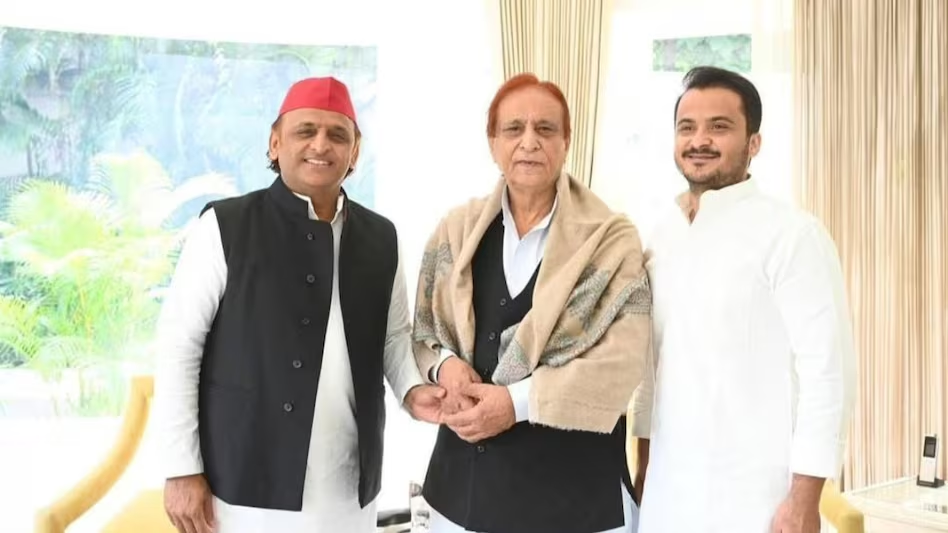
Azam Khan met party president Akhilesh Yadav In a surprising and controversial statement that sent shockwaves across Uttar Pradesh’s political landscape, Senior Samajwadi Party leader Azam Khan on Friday met with party president Akhilesh Yadav in Lucknow. Emerging from the meeting, the seasoned SP stalwart, known for his sharp tongue and fiery rhetoric, made a statement that quickly dominated headlines:
“I am Mafia No. 1… Who is a bigger mafia than me? I am standing in front of you.”
The remark, dripping with irony and emotion, came after a long silence from Azam Khan, who has faced multiple legal cases over the past few years. His words — part defiance, part self-criticism, and part political theatre — reflect not only his personal frustration with the system but also deeper undercurrents within the Samajwadi Party (SP) and Uttar Pradesh politics at large.
This 3000-word analysis dives deep into what prompted Azam Khan’s statement, the symbolism behind his words, his meeting with Akhilesh Yadav, and how this episode could reshape the political dynamics ahead of the 2027 Uttar Pradesh Assembly elections.
1. The Political Storm in Lucknow: Azam Khan Meets Akhilesh Yadav
Lucknow’s Samajwadi Party office was abuzz on Friday morning as reports surfaced that Azam Khan, the veteran SP leader and one of its founding members, was on his way to meet party president Akhilesh Yadav.
The meeting, held at the party headquarters, lasted over an hour. According to party insiders, discussions revolved around the current political climate in Uttar Pradesh, the cases pending against Azam Khan, and SP’s organizational preparations for upcoming elections.
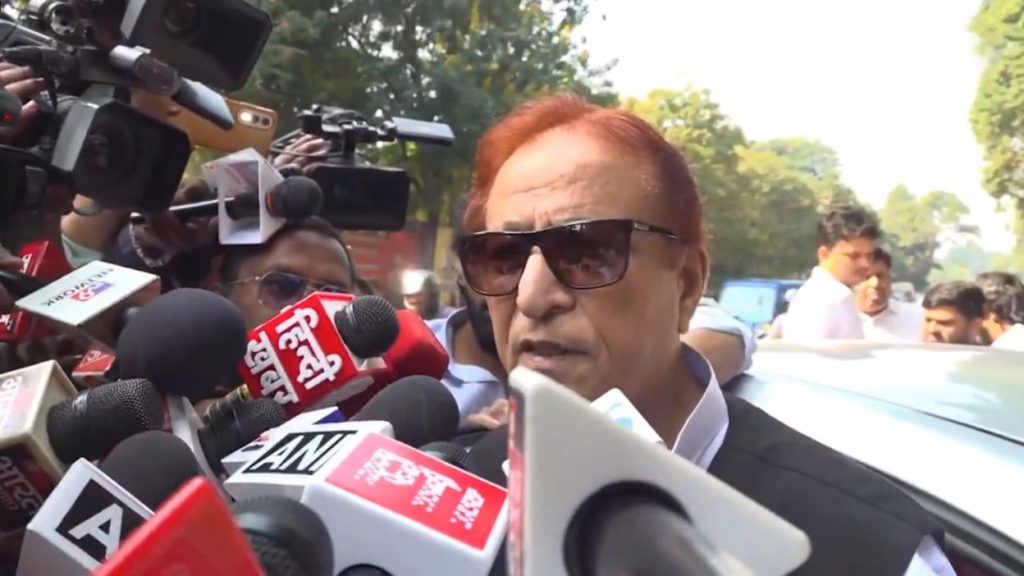
After the meeting, as media persons surrounded him, the 75-year-old leader — known for his oratory and sarcasm — delivered the now-viral line:
“Main Mafia No. 1 hoon… Mujhse bada mafia kaun hai? Main aapke samne khada hoon.”
The remark was both shocking and symbolic. For many, it sounded like an acceptance of the label that his political opponents have used against him for years. But for those familiar with Azam Khan’s political style, it was also a biting satire on the way the system has treated him — a man who once held the prestigious Urban Development portfolio in the Uttar Pradesh government now calling himself a “mafia.”

2. A Political Comeback or a Cry of Anguish?
Azam Khan’s statement can be interpreted in multiple ways.
Some see it as sarcastic defiance — a way of mocking the administration that has repeatedly targeted him through legal and administrative action. Others view it as an emotional outburst from a leader who feels politically sidelined.
Azam Khan has been facing a barrage of cases — over 80 in total, ranging from land grabbing and corruption to hate speech. Most of these cases were filed during the Yogi Adityanath government’s tenure, which has taken a tough stance against what it calls “mafia elements” in Uttar Pradesh politics.
By calling himself “Mafia No. 1,” Azam Khan appears to be turning the narrative on its head. He’s not admitting guilt — he’s challenging the narrative that labels political rivals as “mafia” to delegitimize them.
“If I am Mafia No. 1, it means anyone who raises a voice against power can be branded as a criminal,” he seemed to imply.
This act of reclaiming a slur and using it as a statement of resistance has historical resonance in Indian politics — where leaders under pressure often use irony to expose the system’s biases.
3. The Long Shadow of Legal Battles
Azam Khan’s troubles began soon after the BJP came to power in Uttar Pradesh in 2017. The Rampur MLA and former cabinet minister faced a series of investigations and charges.
His political bastion, Rampur, became the center of multiple raids, FIRs, and controversies. The administration accused him of encroaching on government land, forging documents, and using his influence to acquire properties illegally.
Among the most publicized cases was the one involving the Muhammad Ali Jauhar University, founded by Azam Khan himself. Authorities accused him of illegally acquiring land for the university — charges he strongly denied, saying it was a “vendetta-driven campaign.”
The political veteran was also convicted in a hate speech case in 2022, leading to his disqualification from the Uttar Pradesh Assembly. Although the conviction was later stayed by the court, the damage to his political standing had been done.
Since then, Azam Khan has largely stayed away from active politics, nursing both political wounds and personal frustration. Friday’s meeting with Akhilesh Yadav and his provocative comment mark perhaps his first public reemergence in months, signaling that the old warrior is not done yet.
4. The Symbolism Behind Mafia No. 1
The phrase “Mafia No. 1” is loaded with irony, especially in Uttar Pradesh, where Chief Minister Yogi Adityanath has built his reputation as a “Mafia Mukta UP” (Mafia-Free Uttar Pradesh) crusader.
By calling himself a mafia, Azam Khan is essentially mocking the state’s selective use of the term. His statement raises several implicit questions:
- Why are political opponents often branded as mafia while allies escape scrutiny?
- Is the term being used as a political weapon rather than a legal classification?
- Can a person like Azam Khan — an elected representative, academic, and institution-builder — truly fit the image of a criminal don?
In one sense, his words are a satirical protest against what he sees as political victimization. In another, they are a mirror held up to the current state of governance, where the line between political dissent and criminality often blurs.
5. Akhilesh Yadav’s Calculated Silence
Interestingly, Akhilesh Yadav did not respond publicly to Azam Khan’s “Mafia No. 1” comment. His silence is strategic — the SP chief knows the sensitivity of the issue.
Akhilesh’s meeting with Azam Khan was reportedly aimed at rebuilding unity within the Samajwadi Party’s old guard, especially after internal rifts and defections weakened the party’s presence in western Uttar Pradesh.
Azam Khan, a founding member of SP, commands deep respect among Muslim voters in Rampur and nearby regions. However, his absence from the political front has left a vacuum that the party cannot afford ahead of the next elections.
By meeting Azam, Akhilesh appears to be sending a message of reconciliation and inclusion, signaling that the SP values its veterans even as it courts younger leaders.
6. The Changing Political Equations in Uttar Pradesh
Uttar Pradesh’s politics is in constant motion. The BJP, under Yogi Adityanath, remains dominant, but both SP and BSP are trying to reinvent themselves.
Azam Khan’s reappearance comes at a time when:
- The Samajwadi Party is trying to consolidate its minority and backward class vote banks.
- The INDIA alliance (if revived) could play a major role in countering BJP in the 2027 UP elections.
- Muslim representation in the assembly and political discourse has significantly declined.
Azam Khan’s statement — though controversial — could help revive political discussion around Muslim representation, political justice, and state bias. His emotional self-reference as “Mafia No. 1” could resonate among those who feel marginalized or unfairly targeted by administrative policies.
7. Political Reactions: Shock, Criticism, and Sympathy
As expected, the comment triggered strong reactions from across the political spectrum.
BJP’s Response:
The BJP seized the opportunity to reinforce its narrative.
UP BJP spokespersons claimed that Azam Khan had “finally accepted his true identity.”
One leader said, “The law is exposing the real faces of those who misused power. Azam Khan himself has confessed what we’ve been saying for years.”
Congress’s Response:
Congress leaders reacted cautiously, criticizing both SP and BJP for what they called “the politics of labeling and victimhood.”
Samajwadi Party’s Defense:
SP insiders quickly clarified that Azam Khan’s statement was sarcastic and rhetorical.
Party leaders said it was “unfair” to take his words literally and that he was highlighting the misuse of power against opposition figures.
Public Sentiment:
On social media, reactions were divided.
Some saw Azam’s remark as a bold act of truth-telling in a climate of fear; others viewed it as an ill-timed comment that could harm the SP’s image.
Hashtags like #AzamKhan #MafiaNo1 #AkhileshYadavMeeting trended on X (formerly Twitter), with netizens debating whether his words were satire or confession.
8. The Azam Khan–Akhilesh Equation: A Complex Relationship
Azam Khan and Akhilesh Yadav share a long, complicated political relationship.
Azam, one of the founding members of the Samajwadi Party in 1992, played a key role in shaping its ideological identity. However, over the years, differences between the old guard and the new leadership emerged.
While Akhilesh modernized the party’s image, bringing in youth-centric and development-oriented rhetoric, Azam represented its traditional, emotional, and community-driven base.
During Akhilesh’s first tenure as CM (2012–2017), Azam Khan was one of his most influential ministers, handling portfolios like Urban Development and Minority Affairs. Yet, reports of disagreements often surfaced, particularly regarding candidate selections and administrative control.
Despite these tensions, Friday’s meeting indicates that both leaders recognize the strategic necessity of unity — especially as the political environment grows increasingly competitive.
9. The Emotional Undertone: A Leader’s Disillusionment
To understand Azam Khan’s “Mafia No. 1” remark, one must look at the emotional context.
Here is a man who:
- Served as a nine-time MLA from Rampur,
- Was one of the architects of the SP’s minority outreach,
- Built a world-class educational institution from scratch,
- And yet spent years behind bars, stripped of his political stature.
His remark carries the weight of personal humiliation and systemic frustration. It’s a lament — that in today’s politics, even decades of public service can be overshadowed by allegations, and a dissenting voice can be painted as criminal.
In his own words to the media later, Azam Khan said:
“I have been accused of everything. If building a university for poor children is a crime, then yes — I am a criminal. If helping people is mafia work, then I am Mafia No. 1.”
That one line captures the pain of a leader who feels persecuted yet refuses to surrender.
10. What This Means for the Samajwadi Party’s Future
Akhilesh Yadav’s meeting with Azam Khan is more than just a courtesy call — it’s a strategic reset.
The SP is aware that without the strong backing of leaders like Azam Khan, its influence among Muslim voters could weaken further. The Muslim-Yadav (MY) alliance, which once formed the bedrock of SP’s electoral success, has fractured in many regions.
Rehabilitating Azam Khan could:
- Reunite old cadres and minority supporters in western Uttar Pradesh.
- Project Akhilesh as a unifying leader who values loyalty and experience.
- Counter BJP’s “Mafia” narrative by highlighting political victimization.
However, this move also comes with risks. The BJP will likely exploit Azam Khan’s legal controversies to attack SP during election campaigns.
The challenge for Akhilesh will be to reframe Azam’s image — from that of an accused politician to a symbol of resistance and injustice.
11. The Broader Picture: Politics of Perception in UP
The “Mafia” label has become a powerful political tool in Uttar Pradesh. From Mukhtar Ansari to Atiq Ahmed, several leaders have been portrayed through this lens — often blurring the line between criminality and political opposition.
Yogi Adityanath’s “bulldozer politics” has become both a slogan and a symbol of law enforcement. However, critics argue that the same law is not applied uniformly — that it selectively targets opposition leaders.
Azam Khan’s statement, therefore, is not just about him; it’s a commentary on the political climate of UP — where justice, power, and perception often intersect.
12. Conclusion: The Return of the Rebel Voice
Azam Khan’s declaration — “I am Mafia No. 1” — will likely be remembered as one of the most provocative political statements of 2025. It is not a confession, but a challenge — a challenge to the narrative, to the establishment, and to the politics of labeling.
In a single sentence, Azam Khan summed up the dilemma of many opposition leaders in today’s India: when dissent becomes criminalized, irony becomes the only weapon left.
His meeting with Akhilesh Yadav has reopened conversations about political justice, party unity, and the cost of resistance. For the Samajwadi Party, this may mark the beginning of a renewed push toward inclusivity and ideological strength. For Uttar Pradesh, it’s another reminder that beneath the slogans and speeches, the state’s politics still revolves around power, identity, and survival.
As Azam Khan walked away from the cameras, his words echoed in the corridors of Lucknow’s politics — a mix of pain, defiance, and truth.
“I am Mafia No. 1… Who is a bigger mafia than me? I am standing in front of you.”
It wasn’t just a statement.
It was a mirror to the political system itself.
Read more latest news

