

A Prayer Meeting at Sadaiv Atal Sthal: Nation Remembers Atal Bihari Vajpayee on His 7th Death Anniversary
On 16th August 2025, India once again united in remembrance of one of its tallest leaders, former Prime Minister Atal Bihari Vajpayee, as the nation observed his 7th death anniversary. At Sadaiv Atal Sthal in New Delhi—the memorial dedicated to his legacy—a solemn prayer meeting was organised where leaders across party lines, dignitaries, admirers, and citizens paid homage to the visionary statesman.
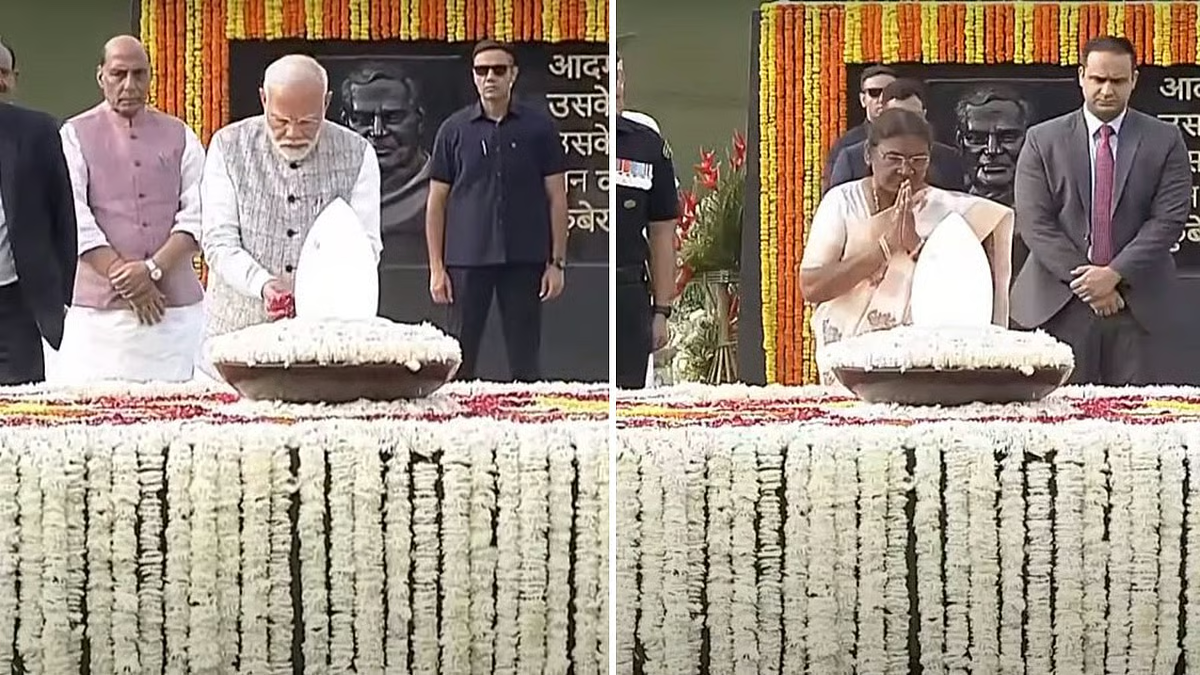
Among the first to arrive at the memorial was President Droupadi Murmu, who led the nation in tribute. She offered a floral homage at Vajpayee’s samadhi, bowing in respect to the leader who had dedicated his life to the service of the nation.
This annual commemoration was not merely a ritual but a collective expression of gratitude towards Vajpayee, who is remembered not only as a Prime Minister but as a poet, statesman, orator, and consensus-builder. His leadership style continues to inspire generations, and his contributions remain deeply etched in India’s political, cultural, and diplomatic fabric.
The Atmosphere at Sadaiv Atal Sthal
The morning at Sadaiv Atal Sthal was filled with a serene yet emotional aura. The beautifully maintained memorial, surrounded by lush greenery and the calm of the Yamuna River, became a sacred ground for reflection. The prayer ceremony began with chanting of Vedic mantras, followed by devotional songs that resonated with Vajpayee’s spiritual side and his deep appreciation for Indian traditions.
President Murmu, clad in a simple yet graceful saree, placed a wreath at the memorial, symbolising the nation’s collective respect. Cabinet ministers, senior BJP leaders, and members of Vajpayee’s family stood in silence as the prayer progressed. Leaders from opposition parties also joined, underlining the universal respect Vajpayee commanded across political divides.
Remembering Vajpayee: A Leader Beyond Politics
Atal Bihari Vajpayee remains one of the most respected and admired Prime Ministers of India. His political journey—from being one of the founding members of the Bharatiya Jana Sangh to becoming the first Prime Minister from the BJP—was marked by perseverance, dignity, and unmatched oratory.
Unlike many politicians who thrived on confrontation, Vajpayee believed in consensus-building. He famously said, “You can change friends but not neighbours,” highlighting his pragmatic approach to foreign policy. His government’s efforts in improving relations with Pakistan through the Lahore Bus Yatra in 1999 reflected his courage to pursue peace despite challenges.
On the domestic front, Vajpayee’s tenure was marked by transformative initiatives—the Golden Quadrilateral project that revolutionised India’s road infrastructure, the promotion of nuclear capability through the Pokhran-II tests of 1998, and significant reforms in telecom and economic liberalisation.
Even his critics admired his ability to balance ideology with inclusiveness. He was often referred to as the “Ajatshatru” (the man without enemies) in Indian politics.
President Murmu’s Tribute
In her brief message at the ceremony, President Droupadi Murmu called Vajpayee a “true son of India”, whose leadership continues to guide the nation. She noted that Vajpayee’s contribution was not confined to politics alone but extended to nation-building, democratic values, and cultural renaissance.
She emphasised that Vajpayee’s vision for an empowered India still resonates today—be it his focus on connectivity, economic reforms, or diplomacy rooted in India’s civilisational ethos. President Murmu also underlined Vajpayee’s humility, saying, “He was a leader who could win hearts with words, and more importantly, with silence.”
Leaders Across the Spectrum Pay Homage
Apart from the President, Vice President Jagdeep Dhankhar, Prime Minister Narendra Modi, Home Minister Amit Shah, Defence Minister Rajnath Singh, BJP President J.P. Nadda, and senior opposition leaders gathered at the site to offer floral tributes.
PM Modi, in his message, described Vajpayee as the “architect of modern India’s aspirations”, recalling how his leadership provided stability at a time when coalition politics had become fragile. Amit Shah remembered Vajpayee as a leader who balanced ideology and governance, while Rajnath Singh called him a source of inspiration for every karyakarta of the BJP.
Congress leaders and representatives of regional parties also attended the ceremony, reflecting Vajpayee’s stature as a leader who went beyond party lines.
Vajpayee’s Poetic Soul
What made Atal Bihari Vajpayee unique was not just his politics but his poetic soul. His poems, filled with philosophical depth and patriotic fervour, captured the emotions of the common man. He used poetry as a medium to express pain, hope, and vision.
During the prayer meeting, school children recited some of his immortal verses, reminding everyone of his sensitive side. His famous lines, “Haar nahi manunga, raar nahi thanunga, kal ke kanṭon mein raah banaunga” still inspire Indians to persevere despite adversities.
Vajpayee’s Enduring Legacy
Seven years after his passing, Vajpayee’s presence is still felt strongly in Indian politics and society. His legacy can be summarised in several spheres:
- Political Legacy – He was instrumental in bringing the BJP from the margins to the mainstream. His ability to lead coalitions with dignity ensured political stability.
- Economic Reforms – His government opened India to private investment in infrastructure, aviation, and telecom, laying the foundation for the digital revolution.
- Infrastructure Development – The Golden Quadrilateral project is still considered one of the most ambitious infrastructure initiatives.
- Nuclear Power & Security – By conducting the Pokhran-II tests, he placed India on the global nuclear map.
- Foreign Policy – His attempts at peace with Pakistan, strengthened ties with the US, and engagement with ASEAN showcased his vision of India as a global power.
- Democratic Spirit – Despite differences, he maintained cordial relations with opposition leaders, respecting parliamentary democracy.
The Nation’s Emotional Connect
The 7th death anniversary observance was not just a political event—it was a people’s tribute. From students to professionals, from rural farmers to urban youth, millions across India remembered Vajpayee with affection. Social media was flooded with hashtags like #AtalBihariVajpayee, #SadaivAtal, and #7YearsWithoutAtalJi.
Many recalled his stirring speeches in Parliament, his humour-filled retorts, and his calm yet powerful presence. For the younger generation, who know him only through stories and videos, Vajpayee represents a leader of integrity, intellect, and inclusiveness—qualities much needed in contemporary politics.
Why Vajpayee is Still Relevant Today
The relevance of Vajpayee in today’s India cannot be overstated. His style of politics—firm yet inclusive, ideological yet pragmatic—offers valuable lessons for leaders across the spectrum.
- In a time of polarisation, his emphasis on dialogue and consensus serves as a reminder that democracy thrives on cooperation, not confrontation.
- In a time of global uncertainty, his vision of India as a peaceful yet strong power is highly instructive.
- In an era of economic aspirations, his commitment to infrastructure, reforms, and technology remains a guiding light.

Conclusion: Sadaiv Atal – Forever Atal
The prayer meeting at Sadaiv Atal Sthal on Vajpayee’s 7th death anniversary was not just a ceremony—it was a reaffirmation of India’s respect for a leader who combined politics with poetry, pragmatism with principles, and leadership with humility.
As President Murmu offered floral tributes and leaders across the spectrum joined hands in remembrance, the message was clear: Atal Bihari Vajpayee is not just a memory, but a continuing inspiration.
The flame of his legacy burns bright at Sadaiv Atal, reminding every Indian of his words:
“The man who is not ready to risk his life for a cause is like a man who is already dead.”
Vajpayee’s journey may have ended physically seven years ago, but his ideals remain sadaiv atal—forever steadfast in the heart of the nation.

