
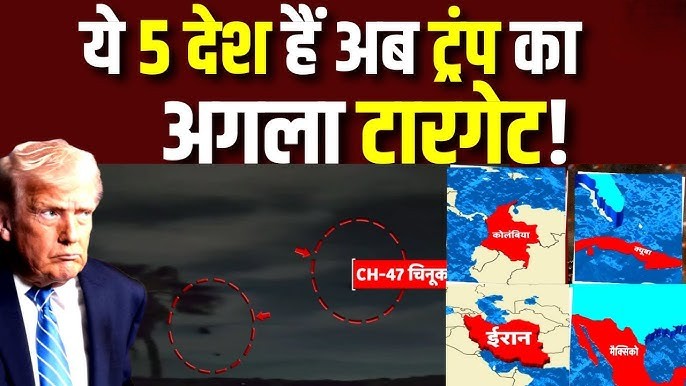
Donald Trump Drops a Major Hint: Who Will Be America’s Next Target After Venezuela?
America foreign policy is possible, Donald Trump has dropped a major hint about who America’s next target will be after Venezuela on 5 Jan. His statement clearly indicates a shift in America foreign policy is possible. Trump’s revelations have sparked new debate and turmoil in global politics.Global geopolitics is once again at a crossroads after former US President Donald Trump dropped a major hint about who America’s next target could be following Venezuela. His statement, though indirect, has ignited intense debate among diplomats, strategic experts, and political analysts worldwide. Trump’s words strongly suggest that a significant shift in America foreign policy may be underway—one that could reshape alliances, disrupt global stability, and redefine power equations in the coming years.
The world has seen this before. Under Trump’s leadership, the United States pursued an aggressive, interest-driven approach that often bypassed traditional diplomacy. From sanctions and trade wars to open threats and unilateral decisions, Trump’s worldview was clear: America’s interests come first. Now, with his recent remarks, that approach appears poised for a possible revival, raising questions about which nation might be next in Washington’s strategic crosshairs.
Venezuela A Prelude to a Larger Strategy
Venezuela has long been a focal point of US hostility. Sanctions, diplomatic isolation, and support for opposition leadership were all key elements of Washington’s approach toward the South American nation. Trump’s administration justified its actions by citing democracy, human rights, and economic mismanagement, but critics argued that oil interests and geopolitical influence were the real motivations.
This confrontation with Venezuela was not an isolated event. Instead, it served as a template for how America foreign policy could be deployed against nations that resist US dominance. Economic pressure, political isolation, and strategic signaling became powerful tools in America’s arsenal. Trump’s recent comments suggest that this model may soon be applied elsewhere.
Trump Statement A Strategic Signal Not a Slip
Donald Trump is known for his blunt communication style, but his recent hint was carefully worded. Rather than naming a specific country outright, he spoke of “regimes that challenge American interests” and “nations that think they can stand against US strength without consequences.” For seasoned observers, this was not casual rhetoric—it was a calculated signal.
Such language reflects the core philosophy behind America foreign policy during Trump’s tenure: deterrence through dominance. The message is simple—compliance ensures stability, resistance invites confrontation. This approach contrasts sharply with multilateral diplomacy and consensus-building, emphasizing instead unilateral power projection.

A Possible Shift in Global Power Dynamics
Any major change in America foreign policy has global consequences. The United States remains the world’s most influential military and economic power, and its actions ripple across continents. Trump’s hint has therefore sparked anxiety among countries that have strained relations with Washington.
Nations such as Iran, China, North Korea, and even Russia are closely analyzing Trump’s words. While Venezuela was relatively isolated, targeting a larger or more strategically significant country could escalate tensions dramatically. The possibility of renewed sanctions, military posturing, or proxy conflicts has become a real concern in diplomatic circles.
The Role of Elections and Domestic Politics
Trump’s statement cannot be separated from domestic American politics. As he seeks to remain relevant—or potentially return to power—foreign policy rhetoric plays a crucial role in energizing his support base. A strong, aggressive stance reinforces his image as a decisive leader who refuses to bow to global pressure.
Historically, America foreign policy has often been influenced by internal political considerations. Trump’s approach emphasizes strength, nationalism, and direct action, themes that resonate strongly with his supporters. His hint about the next target may therefore be as much about domestic messaging as it is about international strategy.

Economic Tools as Weapons
One of the defining features of modern America foreign policy is the use of economic pressure as a strategic weapon. Sanctions, tariffs, and financial restrictions have increasingly replaced direct military intervention. Venezuela experienced this firsthand, as sanctions crippled its economy and isolated it from global markets.
Trump’s remarks suggest that similar tools could be deployed again. Countries heavily dependent on global trade, US dollar transactions, or Western financial systems are particularly vulnerable. This raises concerns about economic instability, currency crises, and humanitarian fallout in any nation that becomes America’s next target.
Allies Watching Closely
America’s allies are also paying close attention. A shift in America foreign policy affects not only adversaries but partners as well. European nations, for example, often find themselves caught between supporting US actions and protecting their own economic interests.
During Trump’s presidency, traditional alliances were strained as America pursued a more unilateral path. If this approach returns, allies may once again be forced to recalibrate their positions. The uncertainty created by Trump’s hint has already sparked quiet discussions in diplomatic corridors across Europe and Asia.
The China Factor
No discussion of future US targets can ignore China. As America’s primary strategic rival, China sits at the center of global power competition. While Trump did not explicitly mention Beijing, his emphasis on “economic exploitation” and “unfair global practices” echoed past criticisms aimed at China.
A tougher stance against China would represent a major escalation in America foreign policy, given the deep economic interdependence between the two nations. Trade wars, technology restrictions, and military posturing in the Indo-Pacific could intensify, affecting global supply chains and regional stability.

Russia and the Shadow of the Cold War
Russia is another key player that could be affected by shifts in America foreign policy. While Trump previously expressed a desire for better relations with Moscow, tensions over Ukraine, NATO expansion, and energy politics remain high.
Any aggressive move against Russia would revive Cold War-style confrontations, with proxy conflicts and ideological battles resurfacing. Trump’s hint, though vague, has reopened speculation about whether Russia could once again become a primary focus of American strategic pressure.
Middle East: A Perpetual Flashpoint
The Middle East has long been a testing ground for America foreign policy. Iran, in particular, remains a major point of contention. Trump’s withdrawal from the Iran nuclear deal and subsequent sanctions campaign set the stage for ongoing hostility.
Analysts believe that Trump’s recent statement could signal renewed pressure on Tehran. Such a move would have far-reaching implications, potentially destabilizing the region and impacting global energy markets. Allies and adversaries alike are therefore bracing for possible shifts in US strategy.
The Global South and Emerging Economies
Beyond major powers, emerging economies in Africa, Latin America, and Asia are also vulnerable to changes in America foreign policy. Countries that pursue independent development models or align with rival powers could find themselves under scrutiny.
Venezuela’s experience serves as a cautionary tale. Trump’s hint has therefore sparked concern among leaders in the Global South, who fear becoming collateral damage in great power competition.
Media and Public Reaction Worldwide
Trump’s statement has dominated international headlines, fueling debates across media platforms. Supporters praise his assertiveness, arguing that a strong America foreign policy deters aggression and protects national interests. Critics, however, warn that such an approach risks escalating conflicts and undermining global cooperation.
Public opinion remains divided, reflecting broader ideological splits about America’s role in the world. Should the US act unilaterally, or should it lead through diplomacy and multilateral institutions? Trump’s hint has reignited this fundamental debate.
Experts Weigh In
Foreign policy experts are cautious in their assessments. Many argue that Trump’s words should not be dismissed as mere rhetoric, given his track record of following through on bold statements. Others suggest that the ambiguity is intentional, designed to keep adversaries guessing.
Regardless of interpretation, there is consensus that America foreign policy is at a critical juncture. Decisions made in the coming years could shape global order for decades.
What This Means for Global Stability
The possibility of a new target after Venezuela raises serious concerns about global stability. Any aggressive shift in America foreign policy risks triggering retaliatory actions, economic disruptions, and even military confrontations.
In an interconnected world, no conflict remains isolated. Supply chains, energy markets, and financial systems are all vulnerable to geopolitical shocks. Trump’s hint has therefore amplified fears of uncertainty and volatility.
Conclusion: A World on Edge
Donald Trump’s major hint about America’s next target after Venezuela has sent shockwaves through global politics. His words strongly indicate that a shift in America foreign policy is not only possible but increasingly likely. Whether driven by strategic calculation, domestic politics, or ideological conviction, such a shift would have profound implications for the international system.
As nations watch and wait, one thing is clear: the era of predictable diplomacy may be giving way to renewed confrontation and power politics. Trump’s revelation has ensured that the world remains on edge, bracing for what could be the next major chapter in global geopolitical rivalry.
Read more latest news

