

“Since 2005, You Have Given Me the Opportunity to Serve You” — Nitish Kumar’s Emotional Message to Bihar Ahead of Elections
Introduction: The Calm Before the Political Storm
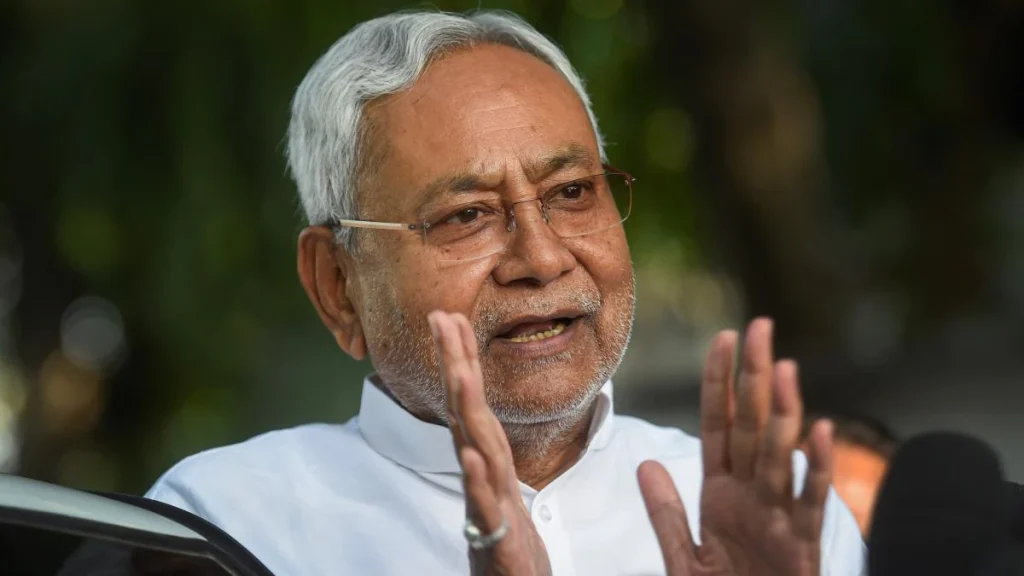
As Bihar elections gears up for yet another high-voltage election, Chief Minister Nitish Kumar has made the first major emotional outreach to the people of his state. In a heartfelt video message released on Friday, Nitish addressed Biharis directly, reminding them of his long journey in governance and their continued trust since 2005. The video begins with the simple but evocative line —
“Since 2005, you have consistently given me the opportunity to serve you.”
This statement, though gentle in tone, sets the stage for what is likely to be one of the most challenging elections of Nitish Kumar’s career. With shifting alliances, an assertive opposition, and the new-age dynamics of caste, youth aspirations, and employment issues, Nitish’s message is both a nostalgic reminder and a political signal.
The video, running just under five minutes, feels less like a campaign advertisement and more like a reflection of a long-serving leader trying to connect emotionally with the people who made his political journey possible. But behind the simplicity of his words lies a carefully crafted message — one that seeks to rebuild the emotional bridge between Nitish and the Bihar elections voter.
A Message of Gratitude and Continuity Bihar elections
Nitish Kumar’s video begins not with promises or criticisms, but with gratitude.
He says in a composed voice:
“Since 2005, you have consistently given me the opportunity to serve you. Together, we have walked a long way. From the days of darkness to an era of development, from fear to confidence, and from backwardness to progress — Bihar elections has come a long way.”
This introduction immediately strikes a chord with those who have witnessed Bihar elections transformation since the early 2000s. It was under Nitish Kumar’s first term that the state began shedding its image of lawlessness, infamously tagged as “Jungle Raj,” and moved toward a more governance-centric approach.
In the next part of the message, Nitish highlights his government’s key achievements — road construction, electricity expansion, girls’ education through cycles and uniforms, and women’s empowerment through reservations in panchayats. He recalls these not as mere statistics but as milestones of collective progress.
“The roads that were once filled with potholes now connect every village. Electricity that was once a dream is now lighting every household. The daughters of Bihar elections, who were once confined to their homes, now study, work, and make us proud.”
Such emotional storytelling serves a dual purpose — it reminds the voters of the Nitish era’s stability while countering the aggressive youth-focused narrative of opposition leaders like Tejashwi Yadav.

Nitish Kumar’s Political Evolution: From ‘Sushasan Babu’ to a Political Survivor
Nitish Kumar’s message cannot be separated from his image — an image that has evolved dramatically over two decades. Once called “Sushasan Babu” (Mr. Good Governance), Nitish built his early reputation on administrative efficiency, infrastructure development, and social reform.
However, over the years, his multiple political flips — breaking alliances, returning to old partners, and forming new ones — have earned him both admiration for pragmatism and criticism for inconsistency.
In the 2025 Bihar elections, Nitish faces the challenge of defending his record amid voter fatigue and a rapidly changing political ecosystem. His decision to release this message months before the official campaign kickoff shows that he understands the emotional aspect of modern-day politics. It is no longer enough to display numbers; leaders must emotionally reconnect with the people.
This emotional tone is deliberate. The video feels like a man revisiting his legacy, subtly appealing to the people to judge him on the basis of his long service rather than short-term controversies.
The Subtle Political Signals in Nitish’s Message
Though Nitish’s video is framed as a personal message, political observers note several subtle signals embedded in it:
1. Reminder of Longevity and Stability
By emphasizing “since 2005,” Nitish implicitly positions himself as a pillar of continuity in Bihar elections governance. It’s a way of contrasting his stable leadership with the perceived instability of other political forces.
2. Indirect Attack on Opposition Without Naming Them
Without naming any rival, Nitish refers to the “dark days” before 2005 — a veiled reference to the Rashtriya Janata Dal (RJD) era under Lalu Prasad Yadav. The mention of “fear and backwardness” is a subtle reminder of the “Jungle Raj” narrative that the BJP and JD(U) have long used against the RJD.
3. A Call for Emotional Reciprocity
Nitish’s use of personal pronouns like “we” and “together” creates a shared ownership of Bihar elections progress. This rhetorical strategy blurs the line between government achievements and public participation, thereby making every citizen feel part of his legacy.
4. Soft Launch of Campaign Narrative
This video appears to be a soft launch of Nitish Kumar’s election campaign — one built on nostalgia, emotional connection, and governance credibility rather than confrontation. It lays the foundation for a broader message that could later incorporate development statistics, welfare schemes, and new policy announcements.
Analyzing Nitish’s Communication Strategy
Political communication experts see this video as part of a larger strategy to humanize Nitish Kumar ahead of the polls. For years, Nitish has been perceived as an efficient but distant administrator. This message, however, brings warmth to his image.
The backdrop of the video — simple, rural visuals interspersed with shots of infrastructure projects and schoolchildren — reinforces the “Bihar elections of Progress” narrative. The tone of the video is emotional but restrained, avoiding theatrics.
Communication strategist Rajeev Pandey observes:
“Nitish Kumar is not trying to reinvent himself; he’s trying to remind voters why they trusted him in the first place. It’s nostalgia-driven communication aimed at older voters while indirectly reassuring young voters that stability is still possible under him.”
Public Reaction: Mixed Emotions Across Bihar elections
Soon after the release of the video, social media in Bihar elections was abuzz. Hashtags like #NitishMessageToBihar, #Since2005, and #SushasanReturns began trending on X (formerly Twitter).
Supporters praised the CM’s humility, while critics called it an attempt to whitewash recent controversies.
Many users commented that Nitish’s reminder of “service since 2005” felt genuine and reflective of his grounded personality. Farmers’ groups and women’s self-help groups (Jeevika) posted appreciation messages, recalling how his welfare schemes improved rural livelihoods.
On the other hand, opposition supporters argued that Nitish’s era of “development” had plateaued. They accused him of using nostalgia as a shield to divert attention from unemployment, migration, and corruption issues.
One viral comment on social media read:
“Sir, we respect what you did, but where are the jobs for our youth today? You cannot win 2025 with 2005 memories.”
This sharp divide captures Bihar elections current political mood — respect for Nitish’s legacy but frustration with current challenges.
The Changing Voter Landscape
Since 2005, Bihar elections demographics have shifted significantly. Roughly 58% of the state’s population is below 30 years of age. Many of them were toddlers or not even born when Nitish first took office. For them, the memories of bad roads and dark nights are distant tales, not lived experiences.
This makes Nitish’s nostalgic appeal effective for older voters but less persuasive for younger ones who prioritize employment, education, and entrepreneurship.
The 2025 elections will thus test whether Nitish’s governance legacy can transcend generations — whether the emotional connection with the past can coexist with the demands of the future.
Opposition’s Counter-Narrative
The RJD, led by Tejashwi Yadav, was quick to respond. In a press briefing, Tejashwi said:
“Nitish ji is remembering 2005, but people are remembering 2020 and 2024 — years of promises unfulfilled. You cannot rule on nostalgia when the youth are struggling every day.”
The RJD’s social media wing released counter-posters with the tagline “2005 ka Bihar elections aur 2025 ka Bihar — farq samajhiye” (Understand the difference between Bihar of 2005 and Bihar of 2025), suggesting that the state has stagnated in recent years.
Political analysts believe that Nitish’s emotional tone is also a preemptive strike against Tejashwi’s youth-driven campaign. While the RJD focuses on the future, Nitish is focusing on memory — turning governance history into political capital.
Alliance Arithmetic and Political Reality
Nitish Kumar currently heads the JD(U) and remains a central figure in Bihar elections National Democratic Alliance (NDA) alongside the BJP. The video’s release also signals that the alliance is ready to enter the campaign phase with Nitish as its chief face in Bihar elections.
However, the chemistry between the JD(U) and BJP has had its share of turbulence. Nitish’s past switch to and from alliances keeps everyone guessing about his long-term loyalty. Yet, this video seeks to project a leader above political chaos, focusing purely on service and governance.
Sources within JD(U) confirm that the video was conceptualized by a small team of communication experts, with Nitish’s approval on every line. “He wanted it to sound like a personal letter, not a political slogan,” said one senior party insider.
Major Themes in Nitish’s Message
- Governance and Development:
He re-emphasized the progress made in roads, electricity, education, and healthcare. - Social Justice with Growth:
Nitish reminded citizens that his model of governance combines development with inclusivity — women’s empowerment, backward-class welfare, and caste harmony. - Public Participation:
By using words like “we did it together,” Nitish placed citizens as partners, not beneficiaries. - Hope and Continuity:
The underlying theme of the message was that Bihar elections progress story must not be disrupted.
Behind the Tone: Nitish’s Legacy Moment
At 74, Nitish Kumar is one of the longest-serving Chief Ministers in India. This video is more than an election message; it feels like part of his legacy narrative — a way of etching his contribution in public memory.
Observers note that Nitish is entering a phase where his focus may be as much on how history will remember him as on winning another term. His message was therefore less aggressive and more reflective, a sign of a leader aware that the baton will soon pass to a younger generation.
Challenges Ahead
Despite his emotional appeal, Nitish faces formidable challenges:
- Unemployment: Bihar elections unemployment rate remains among the highest in India.
- Migration: Lakhs of youth migrate every year to Delhi, Punjab, and Maharashtra for work.
- Alliance Coordination: Ensuring smooth cooperation with BJP amid mutual suspicions.
- Youth Connect: Winning over a generation that associates progress more with job apps than power supply.
- Anti-Incumbency: Two decades in power naturally bring voter fatigue.
His campaign, therefore, must balance emotional nostalgia with forward-looking policy commitments.
The Road Ahead: What to Expect Next
Political insiders reveal that Nitish’s video is the first of a planned series of digital messages titled “Bihar Ki Baat, Nitish Ke Saath” (Bihar’s Talk, With Nitish). Each episode will focus on a theme — women’s welfare, youth, farmers, infrastructure, and education — combining achievements with emotional storytelling.
The JD(U) digital team aims to reach both rural and urban voters through social media platforms like YouTube, Facebook, and Instagram. This digital-first approach indicates Nitish’s recognition that the battle for Bihar elections 2025 will be fought as much on screens as in rallies.
Expert View: Emotional Politics in the Digital Era Bihar elections
Political analyst Dr. Manisha Jha observes:
“In an era where short videos and emotional appeals dominate the internet, Nitish’s message is timely. He’s trying to bridge old-school politics with digital storytelling. The tone of gratitude makes him stand out in a season of aggressive attacks.”
She further adds that this strategy may resonate well with women voters — a constituency that has remained loyal to Nitish for years due to his social schemes like the Mukhyamantri Cycle Yojana and women’s reservation in local bodies.
Emotional Politics Meets Governance Narrative
What makes Nitish’s message noteworthy is how it blends emotion with governance. He doesn’t just list projects; he narrates them as human stories — a mother who can cook at night because there’s electricity, a girl who cycles to school, a farmer whose road to the market has been paved.
This narrative style humanizes governance and makes it relatable, cutting across literacy and class barriers. In a state like Bihar elections, where emotional connect often outweighs ideological rigidity, such communication could prove powerful.
Conclusion: The Emotional Reboot of Nitish Kumar
As Bihar heads into election mode, Nitish Kumar’s message — “Since 2005, you have consistently given me the opportunity to serve you” — is both a reflection and a plea. It reflects two decades of governance and pleads for one more chance to complete the journey.
This is not just a campaign launch; it’s a political reset — a reminder that amid the noise of populism and promises, gratitude and humility still have political value.
Whether this emotional outreach will translate into electoral success remains to be seen. But one thing is clear: Nitish Kumar is once again betting on the emotional bond that made him Bihar’s longest-serving Chief Minister.
In a world of viral slogans and divisive rhetoric, Nitish’s quiet words — “Aapne mauka diya, humne seva kiya” (You gave me the chance, I served) — echo with sincerity, nostalgia, and the unmistakable tone of a leader looking back with pride and forward with hope.
Read More latest news

