

What is the “Panchamrit Guarantee” that the NDA promised in Bihar? — A full explainer, analysis and implications
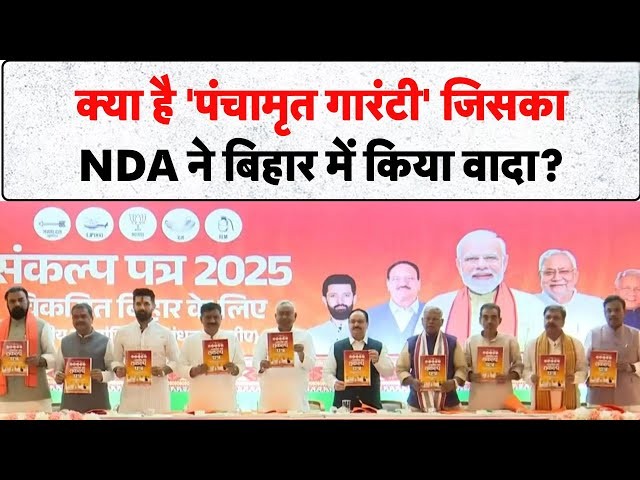
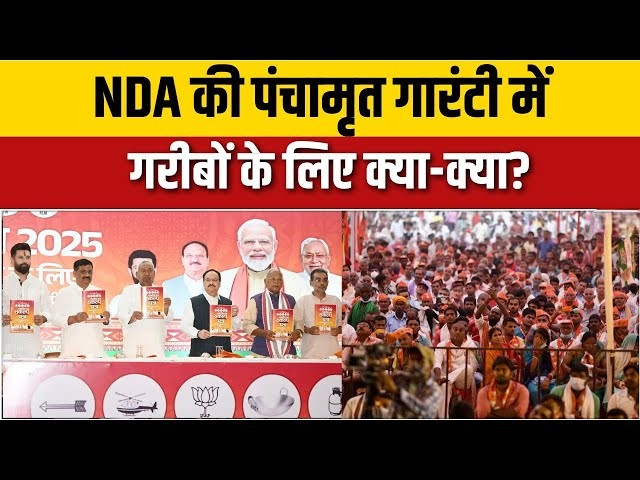
What Is the ‘Panchamrit Guarantee The National Democratic Alliance (NDA) unveiled a sweeping manifesto ahead of the Bihar Assembly elections, and at its heart sits a headline welfare pitch called the “Panchamrit Guarantee.” Framed as a five-point, high-impact social-security package, the Panchamrit is being presented by the NDA as a compact safety-and-growth promise for Bihar’s poorest and most vulnerable households — the sort of pledge that aims to be politically resonant, administratively visible, and easy to communicate in a crowded electoral battlefield.
This long-form explainer looks at what the Panchamrit Guarantee contains, why it matters in the Bihar context, how credible and deliverable it is likely to be, how rival parties have reacted, and what it means for voters, bureaucracy and the state’s fiscal math. Wherever I reference manifesto specifics or media reporting, I’ll flag the sources so you can follow the original coverage.
Quick summary: the five “Panchamrit” promises
The NDA’s Panchamrit Guarantee is a five-pronged promise in the alliance’s Bihar manifesto. In plain terms, the guarantees are directed at delivering immediate relief plus medium-term security for poor and marginal households. The exact items and the scheme names vary slightly across reports, but the package broadly includes:
- Free or highly subsidised essential food rations for eligible families.
- Free electricity up to a set limit (widely reported as 125 units per month) for poor households.
- Free or capped-in-cost medical treatment up to a substantial ceiling (reports say up to ₹5 lakh for specified cases).
- Cash/asset support for women (schemes such as “Lakhpati Didis” or direct transfers to promote entrepreneurship and financial security).
- A combination of skill-development / employment promises and targeted income-support measures (the Panchamrit is embedded within a broader 25-point Sankalp Patra that includes a one-crore-job pledge).
Those five pillars — food, power, health, women’s financial security, and jobs/skill-income support — are meant to be read together as a short, memorable list (hence “panch” — five), positioned as immediate, voter-facing guarantees rather than long-drawn policy reforms.
Why the NDA chose a “Panchamrit” — political symbolism and messaging
The term “Panchamrit” carries two communicative advantages. First, it’s short and mnemonic: five promises are easy for campaign teams, volunteers and TV anchors to repeat and for voters to recall. Second, it’s emotionally framed — the word evokes sanctity and nourishment in Indian cultural usage, which gives the promise a feel-good connotation. That emotional framing is especially valuable in a state where welfare and identity politics interact intensely with everyday needs.
Strategically, the Panchamrit moves aim to do several things for the NDA:
- Counter anti-incumbency by offering tangible, near-term benefits rather than abstract development goals.
- Expand the welfare narrative beyond old-school giveaways by packaging social-protection (food, power, health) with empowerment (women’s income, jobs).
- Target key voter blocks: women voters, marginalised households on ration lists, urban and rural poor who face power cuts, and unemployed youth.
- Simplify the manifesto into a headline claim that can be amplified: five promises that are easy to explain at a roadside meeting or in a WhatsApp forward. Reporting on the manifesto emphasised these strategic aims.
The components in detail — what the media reports say
Different outlets have parsed the manifesto and identified specific targets and numbers. Here are the main elements as reported:
1) Free or assured ration (food security)
Multiple regional outlets and national publications reported that the Panchamrit includes continued or expanded free-ration support for eligible families (a core demand of voters who rely on public distribution systems). The manifesto couples this with promises to strengthen distribution channels.
2) Free electricity (125 units)
A very visible promise is free electricity up to 125 units per month for eligible households. That kind of capped free power is an instantly tangible benefit — it helps with household lighting, fans, charging, and small appliances — and has historically been an effective populist instrument in state politics. Several major news outlets picked up this exact figure.
3) Healthcare cover (up to ₹5 lakh)
Reports indicate free or heavily subsidised medical care up to a substantial limit — figures like ₹5 lakh have been cited — for catastrophic or serious illnesses for poor families. The promise links to improving access to tertiary treatment and building capacities like medicities in the manifesto.
4) Women-focused financial support (“Lakhpati Didis” and related schemes)
The NDA manifesto includes women-centred measures — direct transfers, start-up support or asset grants to women’s self-help groups and entrepreneurs. The phrase “Lakhpati Didis” and references to supporting women-led enterprises have been highlighted as a political outreach toward female voters.
5) Jobs, skill development and income promises
While the Panchamrit is the five-point social security offer, it’s embedded within a wider 25-point charter that promises one crore jobs, massive infrastructure projects and skills initiatives meant to convert short-term relief into medium-term employment pathways. Several national outlets emphasised that the jobs pledge and Panchamrit must be read together.
How new — or old — are these promises?
At their core, the Panchamrit guarantees are not novel policy concepts. Free or subsidised rations, capped free electricity, cash for women, expanded health coverage and job guarantees have all been proposed in Indian states at different times. What is notable now is:
- The scale and packaging: the NDA is bundling these five items into a single, headlineable promise.
- The combination of immediate relief (food, power, health) with empowerment (women’s cash, jobs/skills) — a hybrid of consumption support and supply-side measures.
- The political timing: launched as the manifesto’s marquee welfare commitment, the Panchamrit is deliberately placed to counter an opposition narrative that focuses on government jobs and direct cash transfers. Reporting indicates the NDA pitched it as a guarantee for “poor and marginalised families” as part of its Sankalp Patra.
So while none of the five items is wholly unprecedented, the NDA is treating the set as an electoral differentiator — a compact promise that is easier to sell on the campaign trail than a 60-page manifesto alone.
Implementation realism: can Bihar deliver all five?
Promises and practical delivery are different things. To assess feasibility we need to examine administrative capacity, fiscal space, and political will.
Administrative capacity
Bihar’s public distribution system and rural administrative machinery have been modernised since the early 2000s, and there are existing platforms (Aadhar/PDS linkages, state health missions, women self-help structures) that can be leveraged. However, scaling services and preventing leakages remain perennial challenges — especially in last-mile logistics and beneficiary identification. The state will need tight monitoring, transparency mechanisms, and possible central assistance for medicities and large infrastructure. Media coverage notes that the manifesto also talks of bolstering these capacities.
Fiscal feasibility
Delivering capped free electricity, extensive health coverage and large-scale cash/asset transfers would impose recurring costs. A big-ticket jobs commitment (one crore jobs) implies longer-term budgetary and implementation commitments through either direct government hiring, public works, or private-sector incentives.
National outlets have flagged that the NDA’s manifesto includes several expensive items (one crore jobs, new cities, medicity, airports) alongside Panchamrit. The practical question becomes: will Bihar absorb the recurrent cost or will it rely on central schemes and state–centre cost sharing? If the NDA returns to power, the budget announcements and state financial strategy will be the real test.
Political will & piloting
Electoral promises are often piloted (geographic phase-ins) before statewide rollout. If the NDA phases Panchamrit measures in high-priority districts first, it can show early wins. But any mismatch between rhetoric and delivery will be amplified by opposition critics and media scrutiny.
Costs, trade-offs and potential pressure points
There are three immediate pressure points to consider:
- Sustainability of recurring subsidies — Free electricity and free ration are ongoing liabilities. If electricity subsidies are large, they can strain discom finances and require transfers from the state budget or central support.
- Targeting vs universality — Narrowly targeting only the poorest reduces fiscal burden but risks exclusion errors. Universality increases political appeal but raises cost. The manifesto’s language stresses “eligible” and “poor households,” meaning targeting will be central.
- Health-cover moral hazard & capacity — A generous tertiary care ceiling could increase utilisation and costs; the state will have to ensure there are networks of hospitals and anti-fraud measures in place.
Any government will face the classic trade-off: breadth of coverage vs depth of benefits vs fiscal sustainability.
Opposition reactions and the political battlefield
The NDA’s Panchamrit has not gone unchallenged. Opposition parties in Bihar — chiefly the Mahagathbandhan led by the RJD and allies — framed the manifesto promises as electoral theatrics that do not grapple with unemployment, migration and governance shortfalls. They have pushed counter-narratives emphasizing immediate guaranteed employment, free electricity without caps, and monthly stipends for poor women in their own manifestos.
Political analysts pointed out that while the NDA’s Panchamrit focuses on five tangible guarantees, the opposition’s pitch relies on unambiguous universal cash transfers and job guarantees that can capture the imagination of unemployed youth. The contest therefore becomes not only a battle over who offers more, but over which promises seem more credible and deliverable.
Voter groups most likely to be influenced
- Women voters: The NDA’s women-centered components (direct transfers, entrepreneurship support) aim to consolidate women’s support — a crucial and politically active voter segment.
- BPL / ration-dependent households: Free or amplified ration support is directly aimed at families reliant on PDS; in rural Bihar, this is a solid vote bank.
- Households facing erratic electricity supply: Free 125 units will be immediately felt by many rural and peri-urban households.
- Urban & rural unemployed youth: The jobs and skilling promises in the wider manifesto are designed to neutralise opposition youth appeal, but youth voters will evaluate credibility more than slogans.
What to watch for if the NDA wins: rollout indicators
If the NDA wins and moves to implement Panchamrit, watch these early indicators for seriousness of delivery:
- Budget announcements that allocate recurring lines for free electricity and ration supplements.
- Notification of eligibility criteria and steps to reduce exclusion errors (updated PDS lists, digital beneficiary portals).
- Public procurement and contracts for medicity, tertiary care empanelment and hospital capacity expansion.
- Launch pilots in selected districts for rapid evaluation and media-ready “first wins.”
- Coordination with central schemes — whether the state seeks central matching funds or piggybacks on Ayushman Bharat-style programmes to reduce fiscal burden.
Comparative lens: how does this stack against other state-level welfare packages?
Indian states have long used a combination of food, power and health subsidies as electoral tools. Examples across decades show that well-targeted, administratively efficient programmes (like Mumbai’s or Tamil Nadu’s public supply systems) can be transformative. The Panchamrit’s novelty is mainly political packaging and scale in a high-stakes election.
Two lessons from other states are relevant:
- Good targeting plus technology reduces leakages: Aadhar seeding, e-PDS and direct benefit transfers help in accurate rollouts.
- Fiscal prudence matters: States that over-commit without revenue buffers face program truncation later — a potential vulnerability for any ambitious package.
The NDA will be judged against these benchmarks if it attempts an early rollout.
Media & civil society reaction: questions, praise and caution
Regional media and civil-society commentators have given mixed responses:
- Praise: Many praised the political imagination in packaging a five-point guarantee that speaks directly to poor households and women voters.
- Skepticism: Analysts asked how the state will finance recurrent subsidies and whether infrastructure (especially in healthcare) can keep pace with expanded entitlements.
- Demand for clarity: NGOs requested detailed operational guidelines on beneficiary selection, grievance redressal and anti-fraud safeguards. Several reports noted these caveats.
Bottom line: political risk and reward
The Panchamrit Guarantee is smart political packaging: it is easy to explain, emotionally resonant, and maps directly onto everyday hardships. That makes it an attractive campaign device. Its electoral payoff depends on two things:
- Credibility at the point of promise — clear operational details, credible fiscal backing and quick pilot wins will boost credibility.
- Opposition framing — if opponents successfully paint it as fiscally reckless or administratively unworkable, the benefit is blunted.
If the NDA can credibly translate the Panchamrit into early, visible deliveries (for example, free power in the first 100 days or a clear women’s transfer scheme roll-out), the political reward could be significant. If it fails to deliver, the opposition will have ammunition to attack both governance capacity and fiscal prudence.
Final reflections — a voter’s checklist
For the average voter wondering whether Panchamrit is a meaningful guarantee or just campaign rhetoric, here’s a simple checklist to evaluate the pledge:
- Has the party given specific eligibility criteria and a timeline?
- Is there a clear funding plan in the state budget or a commitment to central matching funds?
- Are there pilot projects or district rollouts announced to show early implementation?
- Is there a digital mechanism (portal, helpline) to track beneficiary status and to lodge grievances?
- Are anti-fraud and third-party audit provisions included?
If these operational boxes are ticked, the Panchamrit has a realistic chance of improving lives. If they’re left vague, the pledge remains politically potent but practically questionable.
Sources and important reporting
The analysis above drew on the NDA’s Sankalp Patra (manifesto) coverage and multiple news reports summarising the Panchamrit’s items and the broader manifesto commitments. Key reporting used for factual details on the Panchamrit and related manifesto promises includes ABP Live’s explainer on the Panchamrit, ThePrint’s analysis of NDA promises in Bihar, and national outlets that covered the manifesto launch (Times of India, Economic Times, India Today, Prabhat Khabar). These provided the primary facts about the five guarantees, the 1-crore-job pledge, and the larger 25-point Sankalp Patra context.
Read More latest news

