
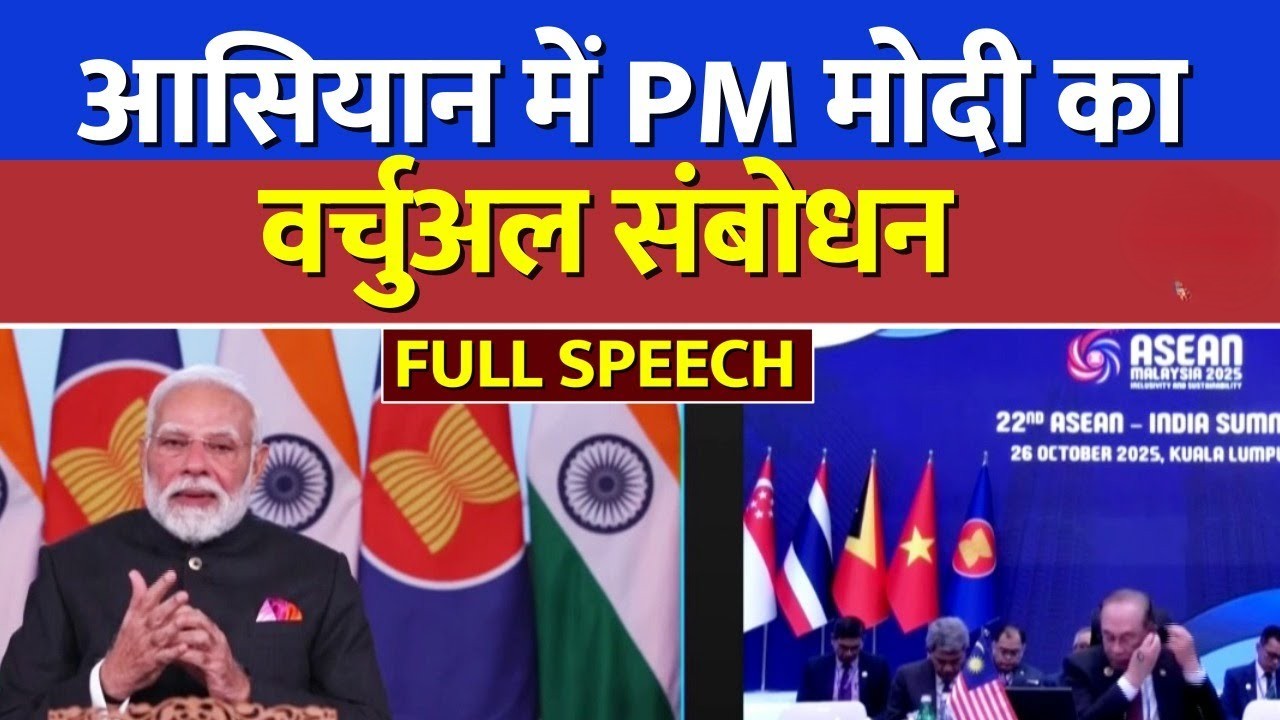
PM Narendra Modi’s Vision at ASEAN Summit 2025: Building a Century of Shared Prosperity and Stability
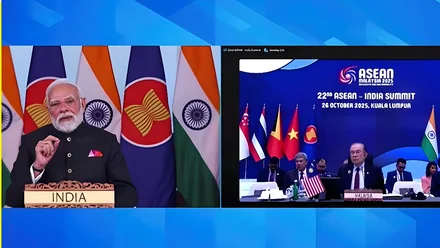
Prime Minister Narendra Modi’s virtual address at the ASEAN Summit 2025 carried a deep and powerful message about the growing importance of the India–ASEAN Summit partnership in shaping the future of the Indo-Pacific region and beyond. His speech resonated with the themes of shared values, mutual trust, cultural connections, and strategic cooperation. Modi’s words reflected not only India’s commitment to ASEAN Summit but also the evolving vision of a “Viksit Bharat” (Developed India) that seeks collective growth with regional partners.
This year’s ASEAN Summit was attended by leaders from ten Southeast Asian nations and several dialogue partners. In his address, PM Modi emphasized that India and ASEAN together represent the hopes and aspirations of more than 2 billion people and that the 21st century belongs to Asia — specifically, to India and ASEAN working hand in hand for peace, progress, and global stability.
Historical Ties Between India and ASEAN Summit
PM Modi began his speech by recalling the ancient civilizational links between India and the Southeast Asian region. He reminded that trade, religion, art, and language had connected the Indian subcontinent with countries like Indonesia, Thailand, Cambodia, Vietnam, and Malaysia centuries before the modern idea of diplomacy even existed.
Temples such as Angkor Wat in Cambodia, the Borobudur in Indonesia, and ancient trade ports in Tamil Nadu and Odisha all serve as living testimony to this long-standing relationship. Modi emphasized that these connections are not just historical facts but emotional and cultural bridges that continue to inspire cooperation today.
He said, “The relationship between India and ASEAN Summit is not of today; it is rooted in history, nurtured by culture, and strengthened by trust.”
Through this reminder, PM Modi positioned India–ASEAN Summit relations as an enduring partnership rather than a transactional one.
Shared Values: Democracy, Peace, and Cooperation
At the heart of Modi’s message was the idea that India and ASEAN Summit share similar values — democracy, inclusivity, and respect for sovereignty. These principles form the foundation of their cooperation in regional and international forums.
He said that in an era marked by geopolitical competition and economic uncertainty, ASEAN Summit and India stand as pillars of stability in the Indo-Pacific. Both regions have demonstrated the ability to balance growth with peace and uphold the principle of “Vasudhaiva Kutumbakam” — the world is one family.
Modi highlighted how ASEAN Summit “Outlook on the Indo-Pacific” aligns closely with India’s “Act East Policy” and “Indo-Pacific Oceans Initiative (IPOI)”, which together aim to ensure an open, free, and rules-based order in the region.
The 21st Century: A Century of India and ASEAN Summit
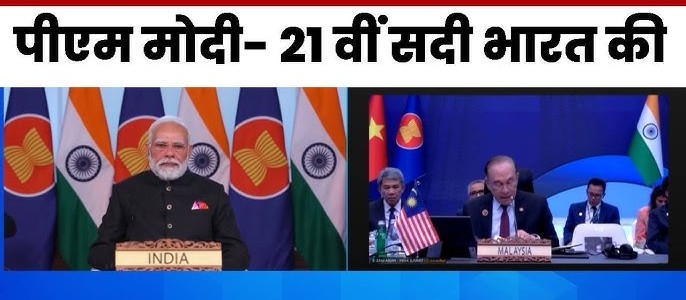
One of the most striking parts of Modi’s speech was his declaration that “The 21st century is the century of India and ASEAN.” This statement wasn’t just aspirational — it was a call to action.
He explained that with their young populations, strong economies, and shared vision for sustainable development, India and ASEAN Summit are poised to lead global growth. The focus, he said, should now shift from competition to collaboration, from confrontation to cooperation.
The 21st century, according to Modi, should be defined by:
- Regional Unity rather than fragmentation
- Sustainable Growth rather than reckless industrialization
- Digital Empowerment rather than digital divide
- People-to-People Connectivity rather than political distance
This vision underscores India’s transformation from a regional player to a global leader — one that advocates collective prosperity and equitable development.
Strengthening Global Stability
PM Modi underlined that the partnership between India and ASEAN Summit plays a crucial role in maintaining global peace and stability. The Indo-Pacific region, which encompasses some of the world’s busiest trade routes, is vital to global commerce and energy supply. Instability in this region can impact the entire world economy.
India and ASEAN, Modi said, must work together to ensure freedom of navigation, maritime security, and peaceful resolution of disputes. Without directly naming any country, his words were clearly aimed at highlighting concerns about rising tensions and assertiveness in the South China Sea.
He further stated that India supports ASEAN centrality in all regional mechanisms — including the East Asia Summit, ASEAN Regional Forum, and ASEAN Summit Defence Ministers’ Meeting Plus (ADMM-Plus) — reaffirming that ASEAN remains at the core of the Indo-Pacific strategy.
Economic Cooperation: The Engine of Growth
Another major theme of PM Modi’s address was economic integration. He called for enhancing trade, investment, and connectivity between India and ASEAN Summit nations, emphasizing that economic collaboration must be inclusive and sustainable.
He highlighted several key areas for cooperation:
- Digital Economy – promoting e-commerce, fintech, and digital payments interoperability.
- Start-up Ecosystem – encouraging young entrepreneurs from both regions to collaborate.
- Green Energy Transition – joint initiatives on solar, wind, and hydrogen energy.
- Supply Chain Resilience – developing diversified and trusted supply chains.
- Tourism and Cultural Exchange – promoting Buddhist tourism circuits and heritage conservation.
Modi also stressed that the India–ASEAN Free Trade Agreement (FTA) should be reviewed to make it more balanced and beneficial to all members. He emphasized that this partnership can unlock the economic potential of nearly 2.1 billion people, representing a combined GDP of over $5 trillion.
Connectivity: From Land to Digital Highways
Connectivity has always been a cornerstone of India’s engagement with ASEAN. PM Modi spoke extensively about improving physical, digital, and people-to-people connectivity to bring both regions closer than ever before.
- The India–Myanmar–Thailand Trilateral Highway, once completed, will connect Southeast Asia with India’s North-Eastern states.
- The Kaladan Multi-Modal Transit Transport Project will enhance maritime and inland connectivity.
- On the digital front, India proposed the creation of a Digital Connectivity Corridor, enhancing cooperation in 5G technology, AI, and cybersecurity.
He emphasized that connectivity isn’t merely about trade routes or data lines — it’s about building trust and understanding among people.
India’s “Act East” Policy in Action
Since coming to power, PM Modi has redefined India’s foreign engagement with the East under his “Act East Policy.” At the ASEAN Summit 2025, this policy was once again at the center of his message.
Unlike the older “Look East Policy,” which focused primarily on economic relations, “Act East” involves strategic, political, and cultural engagement. Modi reiterated that India’s eastern policy is not limited to diplomacy but extends to defense, trade, and cultural collaboration.
Through initiatives such as:
- ASEAN–India Maritime Exercises,
- Humanitarian Assistance and Disaster Relief (HADR) cooperation,
- Education and skills exchange programs, and
- Climate resilience projects,
India has actively contributed to ASEAN’s regional agenda.
People-to-People Ties: The Soul of the Partnership
In perhaps the most heartfelt part of his speech, PM Modi said that people are the real strength of the India–ASEAN partnership. From Indian diaspora communities thriving across Southeast Asia to cultural and spiritual exchanges, human connection has always been the backbone of this relationship.
He praised the role of students, entrepreneurs, and artists in bridging the gap between the two regions. India’s initiatives like “ASEAN-India Youth Summit”, scholarship programs, and digital education collaborations continue to strengthen this foundation.
He also proposed that 2026 be celebrated as “ASEAN–India Year of Youth Innovation”, symbolizing the next generation’s role in defining the partnership’s future.
Shared Challenges, Shared Solutions
PM Modi acknowledged that both India and ASEAN face common challenges — climate change, terrorism, cyber threats, and food security. He urged all nations to come together to find collective solutions through cooperation rather than competition.
He proposed:
- Regional Climate Innovation Hubs for renewable energy research.
- Joint Counter-Terrorism Training Programs for intelligence sharing.
- Collaborative Cybersecurity Centers to protect digital infrastructure.
- Food Security Initiatives involving smart agriculture and AI-based farming techniques.
He stated that solving these issues requires trust, technology, and teamwork — the three “T”s that define India’s modern foreign policy approach.
India–ASEAN: Partners in a Multipolar World
The global landscape today is shifting toward multipolarity. PM Modi highlighted that India and ASEAN together represent the voice of the Global South, advocating for equity, sustainability, and inclusive development.
He emphasized the need to reform global institutions like the UN and WTO to make them more representative and responsive to developing nations. Modi reiterated India’s belief in dialogue, diplomacy, and mutual respect as the only paths to sustainable peace.
Through cooperation in defense, economy, environment, and digital innovation, India and ASEAN can act as anchors of stability in a rapidly changing world order.
PM Modi’s Call to Action: From Vision to Reality
Concluding his address, PM Modi called upon ASEAN nations to transform the shared vision into practical results. He proposed the creation of:
- ASEAN–India Innovation Fund to promote start-ups and research collaborations.
- Joint Task Force on Blue Economy to sustainably harness ocean resources.
- Cultural Heritage Alliance to preserve and promote ancient links.
He said, “When India and ASEAN walk together, the path to peace and prosperity becomes brighter for the whole world.”
His message reflected India’s growing confidence on the global stage — a nation that not only dreams big but acts decisively to achieve those dreams through partnerships and trust.
Conclusion: India and ASEAN – Building a Shared Future
PM Narendra Modi’s address to the ASEAN Summit 2025 will be remembered as a defining moment in India’s foreign policy narrative. It was more than just a diplomatic statement — it was a declaration of shared destiny.
In the 21st century, as the balance of power shifts toward Asia, India and ASEAN stand ready to lead the way. Their partnership, rooted in trust and guided by mutual respect, is poised to shape the world’s future in terms of peace, prosperity, and stability.
Together, India and ASEAN represent the spirit of a rising Asia — dynamic, diverse, and determined to create a better tomorrow.
As PM Modi aptly concluded, “The 21st century will be remembered as the century of India and ASEAN — a century of cooperation, connection, and collective growth.”
Read More latest news

