
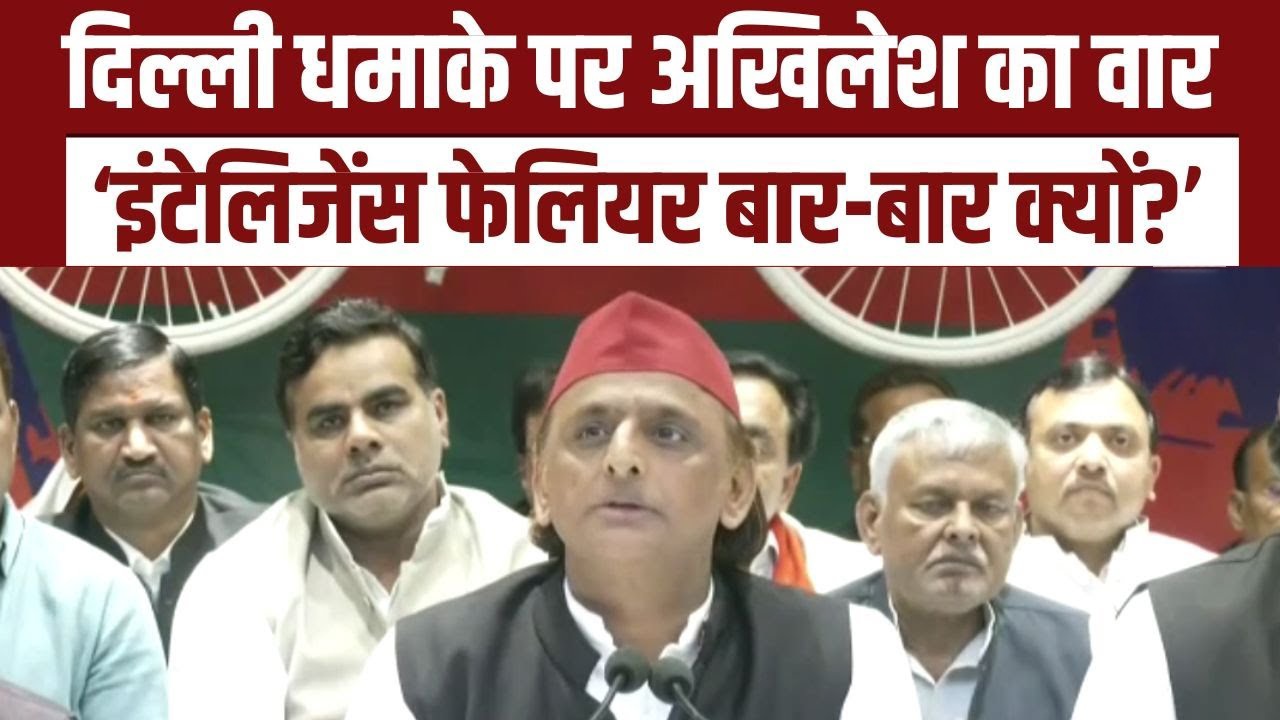
Delhi Red Fort Blast: Akhilesh Yadav Raised Questions on the Failure of the Intelligence Agency, Said – “Now We Will Have to Trust Only PM Modi”.
Introduction
The shocking incident of the Delhi Red Fort blast has once again exposed the vulnerabilities in India’s security framework. The explosion that occurred near one of the country’s most iconic heritage sites not only caused panic in the capital but also triggered a storm of political reactions. As investigators race against time to uncover the truth behind the Delhi Red Fort blast, opposition leaders have begun questioning the government and its intelligence machinery.
Among them, Samajwadi Party chief Akhilesh Yadav made a statement that captured the attention of the nation. Reacting sharply to the Delhi Red Fort blast, Yadav asked how such a tragedy could happen in the most protected area of the country. With visible concern, he remarked, “Now we will have to trust only Prime Minister Modi.” His words, layered with both sarcasm and a demand for accountability, have fueled a fresh debate on the state of India’s internal security and intelligence coordination.
The Blast That Shook the Nation
The Delhi Red Fort blast occurred on a seemingly ordinary day, disrupting the calm of the historic walled city. According to police reports, a car parked close to the Red Fort complex exploded, sending a loud shockwave across the nearby localities of Chandni Chowk and Daryaganj. Eyewitnesses described scenes of chaos, smoke, and confusion, with people running for safety as the flames engulfed the vehicle.
Within minutes, the area was cordoned off by the Delhi Police, and bomb disposal squads were deployed. Investigators from the National Investigation Agency (NIA) and the Intelligence Bureau (IB) arrived on the spot. Forensic teams collected samples to determine the nature of the explosives used in the Delhi Red Fort blast. Initial findings hinted at the possible use of an Improvised Explosive Device (IED), suggesting a planned act meant to create terror in the heart of India’s capital.

Why the Red Fort Matters
The Red Fort is not just a monument; it is a symbol of Indian independence and national pride. Every year, the Prime Minister of India hoists the tricolor from its ramparts on Independence Day, addressing the entire nation. This makes the Delhi Red Fort blast more than just an attack — it’s a direct challenge to India’s sovereignty and a reminder that even high-security areas are not immune to danger.
Experts point out that the Red Fort has been targeted before. In December 2000, terrorists linked to Lashkar-e-Taiba carried out a deadly attack inside the fort premises, killing security personnel. The Delhi Red Fort blast has revived those grim memories, signaling that the threat of terrorism continues to loom over the country’s most treasured landmarks.
Immediate Response from Authorities
As news of the Delhi Red Fort blast spread, the Ministry of Home Affairs (MHA) swung into action. Home Minister Amit Shah convened an emergency meeting with top intelligence and security officials, including the heads of the NIA, RAW, and IB. The Delhi Police Commissioner provided a detailed update on the situation, assuring that every possible angle—from terror modules to local sabotage—was being investigated.
Security across Delhi was instantly upgraded. Police checkpoints were established at major intersections, metro stations, and markets. Drones were deployed for aerial surveillance, and bomb squads conducted searches across the walled city. Prime Minister Modi, briefed about the Delhi Red Fort blast, called for a “zero-tolerance policy” toward terrorism and instructed agencies to ensure that those responsible are brought to justice swiftly.
Akhilesh Yadav’s Reaction and Political Overtones
Soon after the news broke, Akhilesh Yadav expressed strong concern and disappointment over what he termed a “complete failure of intelligence agencies.” Speaking to the media, he said:
“When something like the Delhi Red Fort blast can happen near one of the most secure zones in India, it raises serious questions about the functioning of our intelligence agencies. If such lapses continue, how can ordinary citizens feel safe? Perhaps now, we have no option but to trust only Prime Minister Modi.”
His remark, though brief, carried deep political weight. Some interpreted it as sarcasm, pointing to Yadav’s long-standing criticism of the central government’s handling of internal security. Others viewed it as a genuine expression of concern, highlighting the need for stronger leadership in counter-terrorism efforts.
Regardless of interpretation, Yadav’s statement turned into the headline of the day, fueling debate across social media and television studios. Many saw his words as reflective of a broader frustration among citizens over recurring lapses in national security.
Layers of Meaning Behind the Remark
Akhilesh Yadav’s statement about the Delhi Red Fort blast has several possible interpretations. On the surface, it questions the efficiency of India’s intelligence agencies, but it also serves as a subtle commentary on the centralization of power.
- Sarcasm as a Political Tool:
The phrase “Now we will have to trust only PM Modi” was seen by many as a pointed jab at the Prime Minister’s repeated claims of making India safer. Yadav’s tone suggested skepticism rather than confidence. - Questioning Accountability:
The Delhi Red Fort blast took place in one of the most secured areas of India. Yadav’s question, therefore, was not merely about the event but about who bears responsibility for such a failure. - Public Sentiment and Fear:
His statement also echoed the collective anxiety of citizens who increasingly feel unsafe despite promises of strong governance.
By invoking PM Modi directly, Yadav managed to turn the Delhi Red Fort blast into both a security issue and a political challenge, forcing the government to confront its own claims of invulnerability.
Was It an Intelligence Failure?
The Delhi Red Fort blast has reignited debate over India’s intelligence structure. Despite modern surveillance systems and extensive human networks, the blast has shown that gaps still exist in the way intelligence is collected, analyzed, and acted upon.
Security experts suggest that while India’s intelligence network is vast, it often suffers from inter-agency silos — meaning critical information doesn’t flow efficiently between national and local units. In many cases, alerts are generated but not treated with urgency.
A retired intelligence officer commented anonymously:
“We often have bits and pieces of information about possible threats. The challenge is connecting the dots in time. The Delhi Red Fort blast appears to be a case where either intelligence was missed or not properly coordinated.”
The recurring theme is clear — India reacts swiftly after an attack, but preventive mechanisms still lag behind.
Political Reactions Across the Spectrum
The Delhi Red Fort blast quickly became the center of political discussions. Opposition parties accused the ruling BJP of failing to safeguard even the most high-profile landmarks. The Congress demanded a comprehensive report on intelligence preparedness. Leaders from the Aam Aadmi Party (AAP) questioned whether coordination between Delhi Police and central agencies was sufficient.
The BJP, on the other hand, urged the opposition not to politicize a tragic incident. Party spokespersons highlighted the government’s track record in countering terrorism and argued that national unity was needed instead of finger-pointing.
However, Akhilesh Yadav’s remark stood out. It struck a balance between critique and challenge, leaving both supporters and critics debating its true intention. In doing so, he succeeded in ensuring that the Delhi Red Fort blast remained at the center of both political and public attention.
Social Media Storm
The impact of the Delhi Red Fort blast extended far beyond newsrooms. On social media, hashtags like #DelhiRedFortBlast, #AkhileshYadav, and #IntelligenceFailure trended for hours.
Citizens expressed shock, frustration, and anger. Many shared photos and videos from near the blast site, while others demanded transparency and answers. Memes and debates flooded the internet, with Yadav’s quote becoming a viral talking point.
Political divisions were evident online — some accused opposition parties of exploiting a national tragedy, while others held the ruling party accountable for failing to prevent it. The Delhi Red Fort blast thus became a mirror of India’s political polarization.
A Historical Parallel
The Delhi Red Fort blast has drawn inevitable comparisons to past attacks on the monument and other national sites. In 2000, the Red Fort attack shocked the nation and led to a massive overhaul of Delhi’s security. Yet, more than two decades later, the recurrence of a similar event raises uncomfortable questions:
- Have we learned enough from history?
- Why do terrorists still manage to strike symbolic targets?
- What reforms are still missing in our intelligence apparatus?
These are the questions that the Delhi Red Fort blast forces India to confront once again.
Public Fear and the Question of Safety
For citizens of Delhi, the Delhi Red Fort blast brought back haunting memories of earlier terror incidents. Markets around Chandni Chowk saw lower footfall in the following days, and many tourists avoided the Red Fort complex temporarily.
Residents expressed frustration that despite continuous assurances from the government, such breaches continue to happen. “If the Red Fort isn’t safe, what about us?” asked a local shopkeeper. This sentiment reflects a growing crisis of confidence between the public and the state’s security apparatus.
Restoring that confidence will require more than official statements — it will require tangible improvements in intelligence gathering, inter-agency communication, and urban security infrastructure.
Media Coverage and Narrative Control
Media coverage of the Delhi Red Fort blast has been extensive and intense. Television networks aired continuous updates, while newspapers ran front-page headlines. However, the focus soon shifted from the incident itself to the political controversy surrounding Akhilesh Yadav’s remarks.
This shift illustrates how in today’s media ecosystem, political soundbites often overshadow substantive debate. While Yadav’s comment did highlight real issues, the excessive focus on his words diverted attention from the need to fix systemic flaws that allowed the Delhi Red Fort blast to occur.
The Role of the Prime Minister and National Response
In the aftermath of the Delhi Red Fort blast, Prime Minister Modi held high-level meetings with the Home Ministry and intelligence officials. He emphasized the need for tighter coordination and directed agencies to identify any international links.
Analysts believe that Modi’s response will be crucial in shaping public perception. If the investigation quickly identifies the culprits and strengthens security, it could reinforce his image as a decisive leader. However, prolonged uncertainty could damage public confidence and give more ammunition to critics like Akhilesh Yadav.
Rebuilding Security Infrastructure
To prevent another Delhi Red Fort blast, experts suggest a multi-layered approach:
- Improving inter-agency coordination to ensure seamless data sharing.
- Integrating AI-based surveillance in high-risk zones.
- Training local police to act on early alerts more effectively.
- Community intelligence programs, where citizens participate in vigilance.
These steps could transform how threats are detected and managed, reducing the likelihood of another devastating event.
Political and Electoral Implications
The Delhi Red Fort blast may also influence upcoming elections. National security has always been a key plank for the BJP, while opposition parties often accuse the government of focusing on rhetoric over results.
Akhilesh Yadav’s statement positions him as a vocal leader unafraid to challenge the central government on sensitive issues. His criticism, wrapped in irony, resonates with voters who feel disillusioned by recurring failures despite tall claims.
Thus, the Delhi Red Fort blast has not only become a test of security but also a test of political credibility.
Conclusion: Lessons from the Blast
The Delhi Red Fort blast is more than an isolated incident; it’s a reminder that national security is a continuous process, not a one-time achievement. It underscores the urgent need for modernization, coordination, and accountability in India’s intelligence and law enforcement systems.
Akhilesh Yadav’s statement may have been politically charged, but it reflects a sentiment shared by millions — the need for leadership that not only promises safety but also delivers it.
As the investigation continues, India waits for answers. Until then, the Delhi Red Fort blast stands as a warning — that even the most guarded symbols of our freedom can become targets, and that vigilance must never waver.
Read more latest News

