
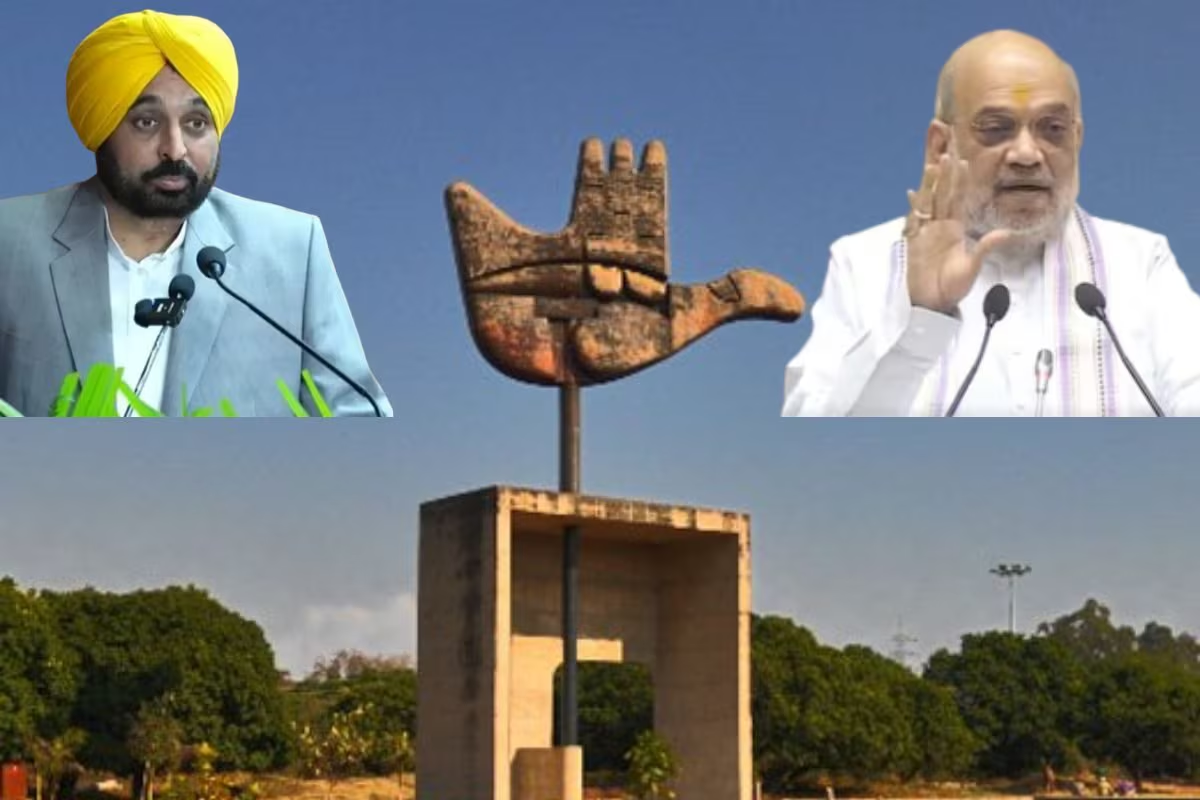
Politics Heats Up Over Chandigarh and Article 240: Home Ministry Issues Clarification.
Chandigarh under the ambit of Article 240, Indian politics has once again entered a phase of intense debate, strong reactions, and heated discussions after reports emerged suggesting that the Central Government was considering bringing Chandigarh under the ambit of Article 240. This development instantly triggered political uproar, especially among the parties governing Punjab and Haryana, who view Chandigarh as a deeply emotional and administrative issue. However, the temperature dipped slightly after the Union Home Ministry issued an official clarification, attempting to put an end to the controversy—at least for now.
In this detailed 3000-word blog, we break down the political storm, the constitutional context, the significance of Article 240, the reactions of political parties, and what this entire episode means for the future governance of Chandigarh.
Understanding the Background: Chandigarh’s Unique Administrative Role
Chandigarh is not just another Union Territory. It is a symbol of post-partition reconstruction, a city planned by Le Corbusier, and a shared capital for both Punjab and Haryana. Its administrative uniqueness has often placed it at the center of political debates.
Since both states claim historical and administrative rights over Chandigarh, any legal or constitutional proposal affecting its governance is bound to attract attention. The recent chatter about bringing Chandigarh under Article 240 is therefore not surprising, but the intensity of the reactions certainly is.
What is Article 240?
Before diving into the controversy, it is essential to understand what Article 240 actually means in the Indian Constitution. Article 240 gives the President of India the power to make regulations for certain Union Territories. These regulations can override laws made by Parliament, providing strong centralized control over these territories.
Today, Article 240 primarily applies to the Union Territories of Andaman & Nicobar Islands, Lakshadweep, Dadra and Nagar Haveli and Daman and Diu, and Ladakh.
Bringing Chandigarh under Article 240 would indicate a shift in how the city is governed—placing more power directly in the hands of the Centre rather than through existing administrative structures.
Thus, the very mention of the possibility stirred political waters instantly.
Why Did the Controversy Emerge?
The controversy gained traction after reports—some speculative, some based on leaked information—claimed that the Centre was studying the feasibility of bringing more UTs under Article 240 and that Chandigarh could be one of them.
This was enough to spark immediate reactions:
- Punjab political leaders feared this would further dilute their administrative claim over Chandigarh.
- Haryana leaders too watched cautiously, though their response was more restrained.
- Opposition parties called it an attempt to centralize power.
Within hours, the matter became a trending topic across national media and social platforms.
Home Ministry Responds: Attempts to End the Controversy
Realizing the political sensitivity of the issue, the Union Home Ministry issued an official statement clarifying that no such proposal to place Chandigarh under Article 240 was under consideration. The statement emphasized that the government has not initiated any legal or constitutional process in this regard.
But political storms rarely settle instantly, especially when the topic involves federal structure, states’ rights, and territorial administration.
Why Chandigarh Matters So Much Politically?
1. Shared Capital Problem
Chandigarh serving as the joint capital of Punjab and Haryana means:
- Any change affects both states simultaneously.
- Regional pride and territorial emotionality get involved.
- Political parties use the issue to mobilize public sentiment.
2. Federal Power Dynamics
Any attempt—real or perceived—to place Chandigarh under Article 240 is seen as:
- Strengthening the Centre
- Weakening the states
- Redefining administrative authority
This automatically becomes a hot political topic.

3. Chandigarh as a Symbol
Since its creation, Chandigarh has been a symbol of modern India. It holds cultural, economic, and administrative significance. Thus, even minor changes spark discussions.
Political Reactions Across the Spectrum
Punjab’s Strong Opposition
Punjab leaders were the first to react strongly. They argued that any move toward bringing Chandigarh under Article 240 would be unacceptable. Parties stated that this would:
- Affect Punjab’s long-standing claim over Chandigarh
- Reduce state control
- Set a concerning precedent for federalism
Several leaders demanded immediate clarification—which the Home Ministry eventually provided.
Haryana’s Mixed Response
Haryana leaders took a balanced stance. While they expressed concern, their tone was more cautious. For Haryana, Chandigarh’s status has always been an emotional issue, but their administrative approach remains moderate.
Opposition Parties Nationwide React
Beyond Punjab and Haryana, national opposition parties framed the issue in terms of:
- Threat to federalism
- Centralizing authority
- Constitutional overreach
They argued that the very idea of placing Chandigarh under Article 240 deserved broader political and parliamentary discussions.
Media Hype and Public Perception
Media houses—both television and digital—played a major role in amplifying the issue. Within hours, debates were held, hashtags trended, and panelists argued over what Article 240 could mean for Chandigarh’s future.
Experts analyzed:
- Constitutional impact
- Administrative changes
- Political motivations
- Possible implications for other UTs
Public reaction, however, remained divided. Some welcomed the possibility of more centralized and efficient governance, while others felt that state rights could be undermined.
Article 240 and Chandigarh: Constitutional Implications
If hypothetically Chandigarh were ever brought under Article 240, the following significant changes could occur:
1. Increased Presidential Authority
The President could directly issue regulations for Chandigarh, bypassing the legislative process.
2. Reduction of State Influence
Punjab and Haryana—both of which already have limited say—would lose further influence.
3. Administrative Restructuring
Key administrative decisions could come from the Centre without local consultation.
4. Impact on Federal Balance
This could set a precedent encouraging the Centre to use Article 240 for governance shifts in other UTs.
Why the Home Ministry’s Clarification Matters
The Home Ministry’s clarification serves multiple purposes:
Preventing Escalation
The issue could have escalated into:
- State-level protests
- Legislative disruptions
- Political agitation
The clarification prevented this.
Maintaining Federal Harmony
By clearly stating that Chandigarh is not being placed under Article 240, the Centre attempted to maintain political peace.
Avoiding Misinterpretation
The Centre emphasized that the reports were speculative and misleading, aiming to prevent public confusion.
Is This the End of the Debate?
Realistically, no.
Chandigarh’s political and constitutional status has been a debated topic for decades. Even if Article 240 is not being applied today, the discussion has resurfaced deeper questions:
- Should Chandigarh remain a UT?
- Should it be handed fully to Punjab or Haryana?
- Should both states create new capitals?
- Should the city receive a new administrative status?
These are questions that will continue to fuel discussions.
Social Media Trends and Public Reactions
Online platforms exploded with conversations about Article 240, Chandigarh, and federal rights. Key trends included:
- Concerns about centralization of power
- Memes about Chandigarh’s long-standing dispute
- Political parties tweeting aggressively
- Youth demanding clarity on constitutional implications
The Home Ministry’s quick response, however, cooled down much of the misinformation.
Legal Experts Weigh In
Constitutional experts offered their analyses:
1. Article 240 is a Powerful Tool
Several experts noted that Article 240 provides exceptional authority to the Centre. Hence, applying it to Chandigarh would have major legal ramifications.
2. It Would Change Chandigarh’s Administrative Framework
Experts agreed that Chandigarh’s governance structure would undergo a massive shift if placed under Article 240.
3. It Could Trigger Future Demands
Some experts suggested that if Chandigarh were brought under Article 240, other UTs might also see demands for similar changes.
The Broader Federal Debate
The issue has once again brought attention to India’s federal structure.
Centralization vs State Autonomy
India’s Constitution allows the Centre significant power, but states guard their rights fiercely. Using or even discussing Article 240 touches the core of this balance.
Political Sensitivities
Punjab and Haryana have a history of disputes over:
- Water
- Borders
- Chandigarh
Any change related to Chandigarh becomes immediately political.
Future Governance Models
The controversy raised questions:
- Should UTs have more representation?
- Should shared capitals continue?
- Should constitutional powers like Article 240 be limited to remote UTs only?
The Road Ahead: What to Expect
1. Political Discussions Will Continue
Even with the clarification, political parties will likely continue raising concerns.
2. Media Will Keep Watching
Any administrative move involving Chandigarh will be scrutinized closely.
3. Constitutional Committees Might Revisit the Issue
It is possible that future committees may re-examine whether Chandigarh’s governance structure needs reform.
4. States Will Reassert Their Claims
Punjab and Haryana will not step back from asserting their emotional and administrative claims over the city.
Why the Controversy Should Not Be Ignored
Though the Home Ministry has clarified the matter, the fact that such a controversy emerged suggests deeper issues:
1. Lack of Clear Long-Term Policy on Chandigarh
India still has no permanent solution for Chandigarh’s status.
2. High Political Sensitivity
Any administrative change can quickly become a national issue.
3. Importance of Transparency
Citizens demand clarity regarding governance changes, especially involving constitutional tools like Article 240.
Conclusion: The Debate Around Article 240 and Chandigarh Is Far From Over
The controversy over bringing Chandigarh under Article 240 may have been paused by the Home Ministry’s clarification, but it has reignited an important national debate. It has reminded India that Chandigarh is not just a city—it is a political and constitutional symbol.
As India continues to evolve, discussions around administrative models, Union Territory governance, and federal balance will only grow in importance. While Article 240 is not being applied to Chandigarh now, the conversation has brought it back into public consciousness.
Governments may issue clarifications, political parties may protest, and experts may debate—but the future of Chandigarh remains a topic that India will continue to discuss passionately.
Read More latest news

