

Farmers Protest on Nagpur Highway: Thousands of Farmers protest Led by Bacchu Kadu Take to the Streets
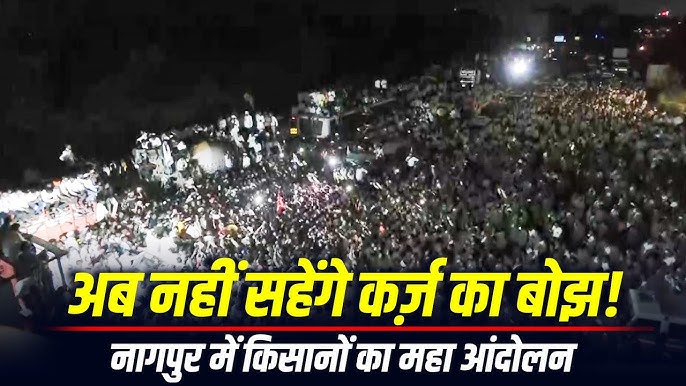
Farmers protest The state of Maharashtra witnessed a dramatic turn of events this week as thousands of Farmers protest, led by independent MLA and Prahar Janshakti Party chief Bacchu Kadu, took to the streets in a massive show of strength and defiance. The protest, which began on the Nagpur Highway, soon grew into a major Farmers protest’ movement echoing the long-standing demands of the agrarian community—loan waivers, fair crop prices, and compensation for losses due to erratic weather conditions.
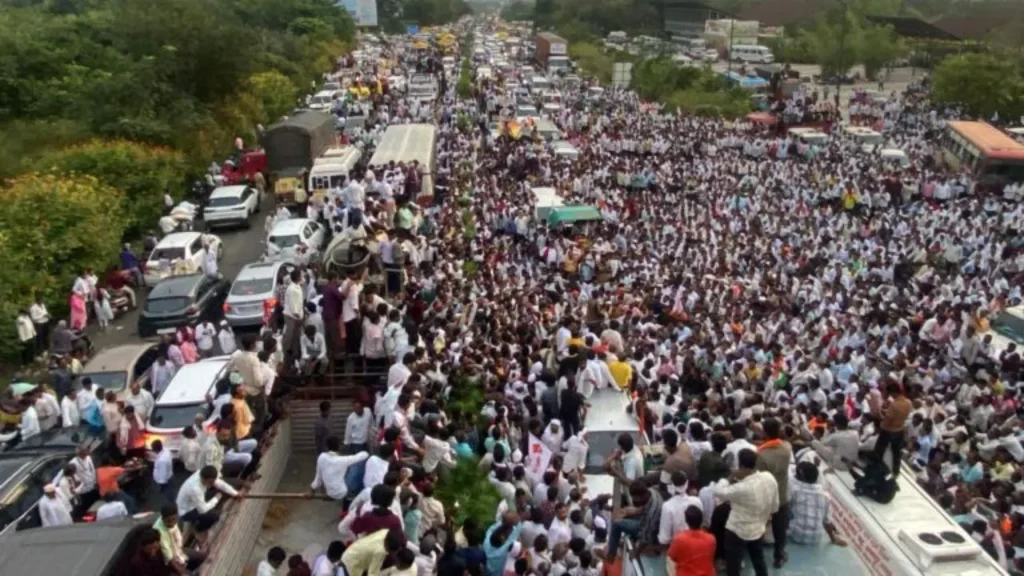
The march, which stretched over several kilometers, was marked by chants of “Jai Kisan, Jai Maharashtra” and slogans targeting the state and central governments for their alleged apathy toward rural distress. As the Farmers protest’ tractors and bullock carts filled the Nagpur Highway, the demonstration not only paralyzed traffic but also reignited debates around the core issues plaguing India’s farming sector.
A New Chapter in Maharashtra’s Farmers protest’ Movement
The Nagpur Highway protest is not an isolated incident—it’s the latest chapter in a long saga of agrarian unrest in Maharashtra, a state that has seen countless farmers’ movements, from the legendary Vidarbha suicides crisis to the Nashik-Mumbai Long March in 2018.
This time, however, the protest carries a more political tone, with Bacchu Kadu emerging as a central figure. Known for his blunt language and street-style activism, Kadu has once again placed himself at the heart of the rural agitation, accusing both the state government in Mumbai and the Centre in Delhi of neglecting the concerns of the farming community.
In his fiery speech at the protest site, Kadu declared:
“Our farmers are dying every day. Their crops are destroyed, their debts are piling up, and their children are leaving villages in search of jobs. If this government cannot ensure justice to Farmers protest, then we will bring Nagpur to a standstill.”
The symbolism of Nagpur, often referred to as the “winter capital of Maharashtra” and home to the state’s legislative assembly’s winter session, is not lost here. By choosing this strategic location, Bacchu Kadu has sent a clear message to the political establishment — the Farmers protest’ voice can no longer be ignored.
The Scale and Spirit of the Protest
Eyewitness reports suggest that over 20,000 Farmers protest participated in the Nagpur Highway march. Coming from districts like Amravati, Akola, Yavatmal, Wardha, and Chandrapur, the participants represented the heart of Maharashtra’s agrarian belt — regions that have historically faced droughts, debt traps, and fluctuating crop prices.
Many of the protestors arrived on tractors, bullock carts, and jeeps, carrying banners that read “Kisan Vina Desh Nahi” (No nation without farmers) and “Karz Mukti, Nahi To Kranti” (Loan waiver or revolution).
The sight of women Farmers protest leading sections of the march, children holding placards, and elderly cultivators sitting under makeshift tents by the roadside painted a powerful image of rural resistance.
The protestors set up temporary camps on the highway, cooked food in community kitchens (langars), and sang traditional powadas (folk protest songs). The movement had the air of both desperation and determination — a mix that makes it politically potent.
Bacchu Kadu: The Firebrand Leader at the Helm
Bacchu Kadu has long been known as a maverick politician. A four-time MLA from Achalpur in Amravati district, he has built his career on grassroots mobilization, often bypassing conventional party politics. As the leader of the Prahar Janshakti Party, his primary political base lies among Farmers protest, youth, and small traders.
Unlike mainstream politicians who often stick to legislative corridors, Kadu’s politics thrives on the street. From leading protests against unfair electricity bills to demanding better facilities for rural students, his activism has earned him both admiration and controversy.
During the Nagpur Highway protest, Kadu’s rhetoric was fierce yet emotionally charged. He accused the state administration of betrayal, saying:
“We supported governments with the hope that they will stand with the farmers. But after elections, they forget us. Our fields are dry, our warehouses are empty, and our homes are filled with debt notices. How long will this go on?”
His speech, broadcast widely on local news channels and social media, struck a chord with Farmers protest across Maharashtra. Within hours, hashtags like #BacchuKaduProtest and #NagpurHighwayAndolan began trending on X (formerly Twitter), amplifying the movement’s reach far beyond Vidarbha.
Core Demands of the Protestors
The farmers’ list of demands was detailed and long-standing, addressing both immediate and structural issues in agriculture.
Here are the key demands raised during the Nagpur Highway agitation:
- Full Loan Waiver:
Many farmers continue to be burdened by agricultural loans taken from cooperative and nationalized banks. The protesters demanded a complete loan waiver, arguing that partial waivers announced in the past benefited only a small section. - Fair MSP (Minimum Support Price):
The farmers demanded that all major crops—including cotton, soyabean, and pulses—be purchased at a guaranteed Minimum Support Price based on the Swaminathan Commission formula of C2 + 50% profit. - Compensation for Crop Damage:
Erratic rainfall and unseasonal hailstorms have damaged crops across Vidarbha and Marathwada. The protestors demanded compensation of at least ₹25,000 per hectare for affected Farmers protest. - Implementation of Crop Insurance Scheme:
Farmers alleged that private insurance companies have failed to provide compensation under the PM Fasal Bima Yojana. They demanded the government take direct responsibility for disbursing insurance amounts. - Electricity Bill Concessions:
The protest called for waiving pending electricity bills for agricultural consumers and ensuring uninterrupted power supply during irrigation hours. - Water Management and Irrigation Projects:
Vidarbha’s chronic drought problem was another major concern. Farmers protest demanded the completion of pending irrigation projects and equitable water distribution. - Ban on Foreign Seeds and Fertilizers:
Protestors opposed the growing dependence on imported seeds and fertilizers, demanding government support for indigenous, organic, and sustainable farming.
Government’s Reaction: A Balancing Act
The Maharashtra government, led by Chief Minister Eknath Shinde and Deputy Chief Minister Devendra Fadnavis, found itself in a tight spot. With the winter session of the assembly scheduled to begin soon in Nagpur, the optics of thousands of Farmers protest marching toward the city could not be ignored.
In an immediate response, state agriculture minister Dhananjay Munde urged the Farmers protest to maintain peace and invited Kadu’s delegation for talks. A high-level meeting was held at the district collector’s office to discuss the demands.
Speaking to the media, Munde said:
“We respect our Farmers protest and their contribution to Maharashtra. The government is committed to resolving their issues. We have already initiated discussions with representatives, and we will work toward a positive outcome.”
However, the protesters remained skeptical, recalling previous promises that went unfulfilled. Kadu, while agreeing to meet the delegation, warned that if the talks failed, the protest would intensify.
“We have come with ploughs, not with swords. But if the government ignores us, the agitation will move to Nagpur city,” he declared.
Political Reactions: A War of Words
As expected, the protest quickly turned into a political battlefield. Opposition leaders, especially from the Congress, NCP (Sharad Pawar faction), and Shiv Sena (UBT), expressed support for the Farmers protest, accusing the BJP-led government of insensitivity.
Congress leader Vijay Wadettiwar said,
“This protest shows how deep the anger runs among Maharashtra’s Farmers protest. The government only makes announcements but delivers nothing.”
Sharad Pawar, the veteran leader and a farmer’s voice for decades, commented from Pune:
“Farmers’ patience has limits. The government must take immediate action before this turns into a larger statewide movement.”
Meanwhile, BJP leaders countered that Bacchu Kadu’s protest was politically motivated. Some accused him of trying to regain relevance ahead of upcoming local body elections.
However, public sympathy leaned heavily toward the farmers. Across rural Maharashtra, village councils (gram sabhas) passed resolutions in support of the protest, signaling a growing sense of collective frustration.
Historical Echoes: From Long March to Nagpur Highway
The Nagpur Highway protest inevitably draws comparisons with the 2018 Kisan Long March organized by the All India Kisan Sabha (AIKS). In that iconic movement, over 40,000 Farmers protest walked 180 kilometers from Nashik to Mumbai, compelling the government to agree to several demands.
While the current protest is led by a different leader and organized independently, its symbolism and message are similar — highlighting the widening gap between promises made in political manifestos and their implementation on the ground.
What distinguishes Bacchu Kadu’s movement is its emphasis on regional identity and self-reliance. He often frames his rhetoric in terms of “Vidarbha’s dignity” and “Farmers protest’ pride,” resonating deeply with cultivators who feel marginalized by urban-centric policies.
Economic Context: The Weight of Agrarian Crisis
To understand the depth of the farmers’ anger, one must look at the economic data behind the protest.
- Debt Burden:
According to state records, the average debt of a small or marginal farmer in Vidarbha stands at ₹1.1 lakh. With repeated crop failures, the repayment cycle has become almost impossible. - Declining MSPs:
Despite inflation, MSPs for key crops like cotton and soyabean have not increased significantly in recent years, leaving farmers struggling to cover input costs. - Climate Impact:
Vidarbha’s rain-fed agriculture makes it vulnerable to erratic monsoons. The region has seen a 20% rainfall deficit this year, worsening the financial stress. - Suicide Statistics:
Tragically, Maharashtra continues to record one of the highest farmer suicide rates in India. Between January and September 2025, over 1,800 farmers reportedly ended their lives — a stark reminder of systemic failures.
Voices from the Ground
Beyond slogans and speeches, the real heart of the protest lies in the voices of those who live its pain every day.
Savita Kale, a 45-year-old widow from Yavatmal, said:
“My husband took a loan for cotton seeds and fertilizers. The rains destroyed the crop. The bank notices kept coming. He couldn’t bear it. Today, I am here to make sure no other family suffers like ours.”
Ramesh Pawar, a young farmer from Wardha, added:
“We don’t want charity. We want justice. Give us a fair price for our crops, and we will never need to protest.”
These testimonies underline that the protest is not just a political drama — it is a cry for survival.
The Role of Media and Social Networks
The Nagpur Highway protest received extensive coverage on television and digital platforms. However, much of the mobilization and awareness happened through social media networks like Facebook, X, and WhatsApp groups managed by farmer unions.
Live videos from the protest site went viral, garnering millions of views within hours. Hashtags like #FarmersOnNagpurHighway, #BacchuKaduAndolan, and #MaharashtraKisanMorcha trended for days.
This digital amplification ensured that the protest narrative remained in public focus, forcing mainstream political parties to respond.
The Road Ahead: What Next for the Movement?
As the government holds talks with Kadu’s representatives, the future of the Nagpur Highway protest remains uncertain. If the state agrees to some of the demands — such as compensation for crop damage or partial loan waivers — the agitation might be temporarily suspended.
However, if the negotiations fail or are delayed, the movement could escalate into a statewide stir, possibly coinciding with the winter assembly session in Nagpur — a moment that could bring the issue directly to the political stage.
Kadu has hinted at the possibility of extending the protest into a “Vidarbha Bandh”, which could paralyze daily life in the region and push the government into a corner.
Analysis: Why Farmer Protests Keep Returning
The Nagpur Highway protest once again raises a fundamental question — why do farmer agitations keep resurfacing despite repeated assurances and schemes?
Experts point to a structural imbalance in India’s agricultural economy:
- Input costs (seeds, fertilizers, diesel) have increased faster than the prices of farm produce.
- Climate change has made monsoon-dependent farming riskier.
- Rural credit systems favor large landowners over small cultivators.
- Policy attention remains focused on urban industry rather than rural welfare.
Until these structural issues are addressed, protests like the one on the Nagpur Highway are bound to repeat — perhaps with new faces, but the same old grievances.
Conclusion: The Spirit of Resistance
The farmers’ protest on the Nagpur Highway, led by Bacchu Kadu, is more than a political demonstration — it’s a mirror reflecting the unresolved agrarian crisis of India. It’s a movement born out of frustration, but also out of hope — hope that one day, the hands that feed the nation will not have to beg for survival.
As the dust settles on the Nagpur Highway and the sound of slogans fades into the night, one truth remains unshaken: the farmer’s struggle is not just a story of poverty, but of resilience, dignity, and unyielding courage.
And leaders like Bacchu Kadu, regardless of their political fortunes, will continue to remind India that the pulse of its democracy beats strongest not in the cities — but in the villages.
Read more latest news

