
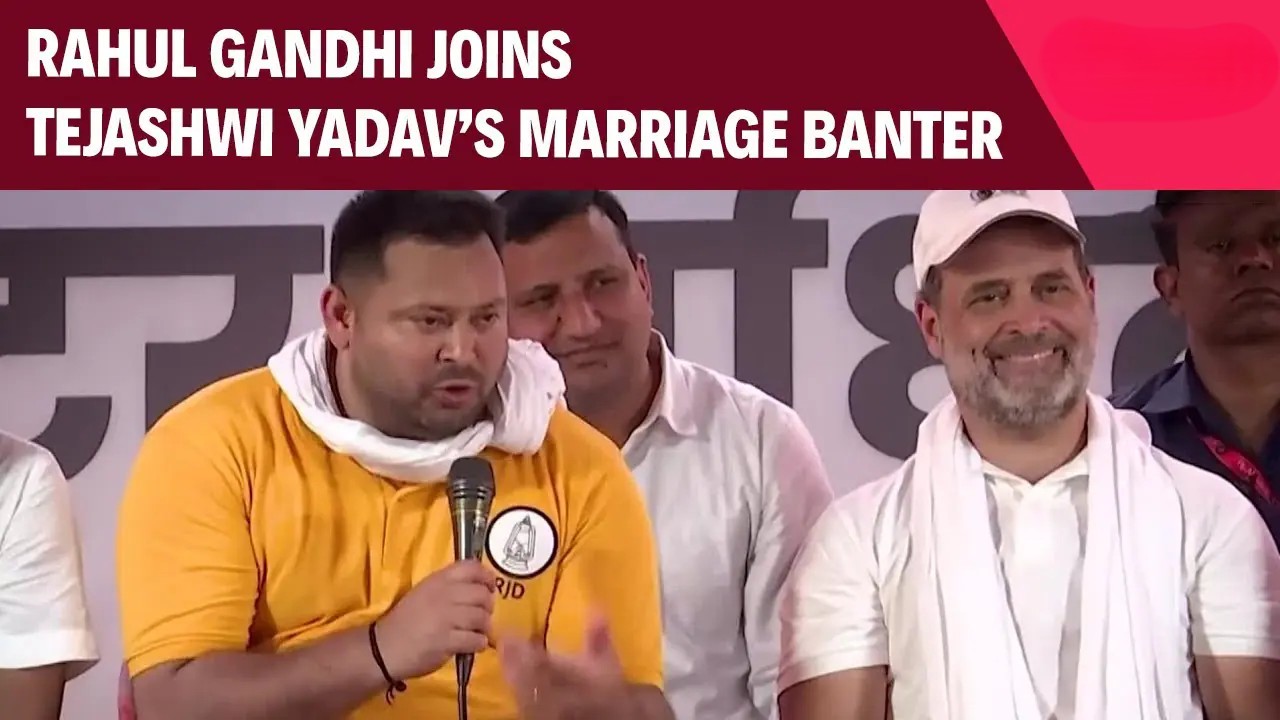
Tejashwi Advised Chirag Paswan to Get Married, Rahul Gandhi Started Smiling – A Political Banter that Stole the Spotlight
Tejashwi advised Chirag Paswan to get married, Rahul Gandhi started smiling. Indian politics is not only about debates on development, governance, and policies—it is also filled with lighter moments, witty exchanges, and instances that humanize leaders in the eyes of the public. One such moment recently went viral when Tejashwi Yadav, former Deputy CM of Bihar and leader of the Rashtriya Janata Dal (RJD), playfully advised Lok Janshakti Party (Ram Vilas) chief Chirag Paswan to get married soon. This remark, delivered in a light-hearted tone, instantly grabbed attention, and to add a touch of humor, Rahul Gandhi—seated nearby—could not help but smile.
While at first glance this might seem like just a playful remark in the midst of serious politics, it actually reveals a lot about political camaraderie, generational change in leadership, and the evolving style of Indian politics where personal lives of leaders are often intertwined with public narratives.
This blog explores the incident in detail, its political and social implications, and why such moments, though light, become significant in shaping the public image of politicians.
1. The Incident – What Exactly Happened?
During a public or parliamentary interaction, Tejashwi Yadav, known for his spontaneous humor and sharp tongue, made a friendly comment directed at Chirag Paswan. In a tone that balanced wit with warmth, he advised Chirag to “get married soon.”
The timing of the remark and the context in which it was made turned the atmosphere light. The audience laughed, but what truly caught attention was Rahul Gandhi’s reaction. The Congress leader, often accused by rivals of being too serious or too scripted, broke into a spontaneous smile. The moment was caught on camera, widely shared on social media, and quickly went viral.
It was not merely about marriage advice—it was about how young leaders interact, how political banter works, and how such personal references often become more memorable than heavy speeches.
2. Why Chirag Paswan?
Chirag Paswan, the son of late Union Minister Ram Vilas Paswan, is one of the most eligible bachelors in Indian politics. Stylish, articulate, and often described as the “poster boy” of young Bihar politics, Chirag’s personal life has often been a topic of discussion in gossip circles.
For years, journalists and political observers have speculated about his marriage plans, but the leader himself has remained tight-lipped. Tejashwi’s playful remark tapped into this curiosity, indirectly voicing what many people often wonder—“When will Chirag settle down?”
In Bihar’s political space, where family ties and legacy play a major role, this remark gained additional flavor. Both Tejashwi and Chirag represent the next-generation leadership of Bihar, carrying forward the legacies of Lalu Prasad Yadav and Ram Vilas Paswan respectively.
3. Rahul Gandhi’s Smile – More Than Just Humor
Rahul Gandhi’s smile in reaction to Tejashwi’s advice may appear trivial, but symbolically it carried weight. Rahul, who often faces criticism for being “detached” or “out of sync,” was seen enjoying the banter.
This showed a softer side of Rahul Gandhi—a leader who can enjoy friendly political humor and camaraderie with other young leaders. His natural smile was widely appreciated on social media, where many users commented that such lighter moments make politicians appear “more human” and relatable.
Interestingly, Rahul himself is another bachelor in Indian politics, often questioned about his marriage plans. Some political observers cheekily noted that Rahul’s smile might have carried an undertone of self-reference—was he smiling at Chirag’s situation or at his own?
4. The Politics of Personal Lives in India
In India, the personal lives of politicians are always under the scanner. Whether it is about their educational qualifications, lifestyle choices, or marriage, the public and media show keen interest.
When Tejashwi advised Chirag to marry, it instantly connected with the cultural psyche where marriage is seen as a significant milestone. For many Indian voters, especially in rural areas, family life is an important marker of responsibility and maturity.
Thus, although said in humor, Tejashwi’s advice also carried an indirect political undertone—“A leader who marries is seen as more settled, responsible, and family-oriented.”

5. Historical Parallels – Marriage and Politics
This incident isn’t new in Indian politics. Historically, questions about marriage have often been directed at young leaders.
- Jawaharlal Nehru faced immense public scrutiny for being a widower and devoting his life to politics.
- Atal Bihari Vajpayee, though unmarried, was admired for his bachelor life dedicated to the nation.
- Narendra Modi’s marriage became a major talking point during the 2014 elections when details emerged about his personal life.
- Leaders like Akhilesh Yadav and Tejashwi Yadav themselves have faced questions about balancing family life with politics.
Thus, Chirag Paswan becoming a subject of such banter was not unusual—it fits into the long Indian tradition where the personal and political often intersect.
6. Generational Change in Politics
The interaction between Tejashwi, Chirag, and Rahul also highlights the generational change in Indian politics. These leaders are not only inheritors of political legacies but also represent a different style of communication compared to older leaders.
- They are media-savvy, understanding that even a humorous remark can go viral.
- They are youth-centric, blending personal narratives with political speeches.
- They are more approachable, breaking the barrier between formal politics and casual conversations.
This reflects a new era in Indian politics where leaders don’t shy away from light-hearted moments. Instead, they embrace them as part of their political branding.
7. Social Media Explosion
As soon as the clip surfaced, it was widely circulated across platforms like Twitter (X), Facebook, and Instagram. Memes, GIFs, and short reels were made on Tejashwi’s remark and Rahul’s smile.
Some popular reactions included:
- “Tejashwi said what everyone is thinking about Chirag Paswan.”
- “Rahul Gandhi’s smile is priceless!”
- “First Chirag, then maybe Rahul?”
This viral spread shows how even small, humorous incidents can overshadow big political speeches in today’s digital-first environment.

8. Political Interpretations
While most took it as humor, some political analysts also read deeper meanings into it:
- Strengthening Alliances: Tejashwi’s friendly tone towards Chirag could be seen as an attempt to maintain cordial relations with the Paswan family, which continues to hold influence in Bihar.
- Youth Solidarity: The exchange between Tejashwi, Chirag, and Rahul reflects a form of generational bonding, possibly signaling the need for young leaders to stick together in the evolving landscape of Indian politics.
- Public Image Building: By making such remarks, leaders present themselves as “normal individuals” beyond politics—something that resonates strongly with voters.
9. The Cultural Context
In Indian culture, especially in the Hindi heartland, marriage is not just a personal matter—it is a social expectation. When leaders delay marriage, curiosity grows among the public. Tejashwi’s remark reflects this cultural reality, where even politicians are expected to “settle down.”
Moreover, in Bihar politics, where family dynasties dominate, the absence of a spouse or family narrative can often become a talking point.
10. Public Reactions – People Loved It
The public response to this incident was overwhelmingly positive. People appreciated seeing their leaders in a lighter mood. For many, it was a refreshing break from the usual bitterness and accusations in political discourse.
Interestingly, many ordinary citizens also connected with the situation—how often do family members or friends jokingly advise bachelors to get married? Tejashwi’s remark humanized Chirag, and Rahul’s smile made him look more relatable.
11. The Future – Will Chirag Take the Advice?
The big question remains—will Chirag Paswan actually follow Tejashwi’s advice? So far, Chirag has maintained silence on his personal life, focusing on his political career. But such public banter ensures that his marriage question will keep surfacing in political and media circles.
Whether or not Chirag takes the advice, one thing is certain: Tejashwi’s witty remark will remain etched as a memorable political moment.
12. Conclusion – Why This Moment Matters
At first glance, Tejashwi advising Chirag Paswan to marry and Rahul Gandhi’s smile may look like just a fun moment. But in the larger scheme of things, it reflects:
- The changing face of Indian politics, where humor and personal references have space.
- The generational bond among young leaders like Tejashwi, Chirag, and Rahul.
- The importance of relatability, where even a smile can humanize politicians.
In an era where politics is often dominated by aggression and polarization, such moments of light-hearted banter remind us that politicians, too, are individuals with humor, friendships, and emotions.
Tejashwi’s advice, Chirag’s silence, and Rahul’s smile created one of the most talked-about moments in recent political discourse—proving once again that sometimes, it’s not the heavy speeches but the lighter remarks that leave the deepest impact.
read more latest news

