
Introduction
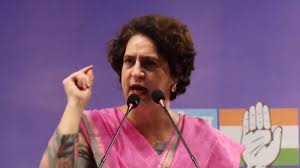
Priyanka Gandhi In a fiery political speech, Congress leader Priyanka Gandhi Vadra took aim at Prime Minister Narendra Modi and Delhi Chief Minister Arvind Kejriwal, calling them “crybabies” and “cowards.” Her remarks, delivered during a recent rally, have sparked a major debate in Indian politics. Gandhi accused both leaders of avoiding responsibility, shifting blame, and failing to address real issues affecting the people. As the country heads toward crucial elections, her statements have added fuel to the ongoing political battle between the Congress, BJP, and AAP.
In this blog, we will analyze Priyanka Gandhi’s remarks, the reactions from political leaders, and their potential impact on the upcoming elections.
Priyanka Gandhi’s Accusations
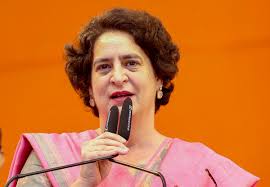
During her speech in Mustafabad, Delhi, Priyanka Gandhi launched a scathing attack on both Modi and Kejriwal. Some of her key statements include:
- PM Modi blames Nehru for everything: Gandhi criticized Modi for continuously blaming India’s first Prime Minister, Jawaharlal Nehru, for contemporary problems. She questioned why a leader who has been in power for nearly a decade still deflects responsibility onto a leader from the past.
- Kejriwal blames Modi for his failures: She also took on the Delhi CM, accusing him of always blaming the central government whenever issues arise in the national capital. According to her, Kejriwal fails to take accountability for his administration’s shortcomings and instead plays the victim.
- Lack of accountability: Gandhi said that neither Modi nor Kejriwal is willing to accept responsibility for their governance failures. Instead, both leaders engage in political blame games, leaving citizens to suffer.
Her words resonated with a section of the audience, particularly those who feel that political leaders need to focus on governance rather than rhetoric.
Modi vs. Kejriwal: The Blame Game
One of the most striking points in Gandhi’s speech was her criticism of the constant blame game between Modi and Kejriwal. Let’s break down how both leaders have engaged in this over the years:
PM Modi’s Blame on Nehru
Prime Minister Narendra Modi has frequently referenced India’s first Prime Minister, Jawaharlal Nehru, when discussing historical challenges facing the country. His main arguments include:
- Nehru’s policies laid the foundation for economic problems.
- The Kashmir issue is a result of Nehru’s handling of the situation in 1947.
- The Congress party, under Nehru and his successors, promoted dynastic politics.
However, critics argue that Modi has had ample time to fix these issues during his tenure and should focus on governance rather than historical blame.
Kejriwal’s Blame on Modi
On the other hand, Delhi CM Arvind Kejriwal frequently blames the Modi-led central government for issues in Delhi, such as:
- Delay in granting full statehood to Delhi.
- Interference from the Lieutenant Governor, whom Kejriwal claims is controlled by the BJP.
- The center’s alleged obstruction of Delhi government projects and welfare schemes.
While some of Kejriwal’s claims have merit, Priyanka Gandhi’s criticism highlights that a leader’s job is to solve problems, not just point fingers.
Reactions from BJP and AAP
Gandhi’s remarks quickly sparked responses from both the BJP and AAP.
BJP’s Response
BJP leaders dismissed Priyanka Gandhi’s statements as political rhetoric aimed at reviving the Congress party’s dwindling influence. Some key responses included:
- Union Minister Smriti Irani: She accused the Congress of trying to mislead people and questioned why Priyanka Gandhi is not holding the Congress-run state governments accountable.
- BJP Spokesperson Sambit Patra: He argued that Modi’s governance has been transformative and that Gandhi’s speech was an act of desperation.
AAP’s Response
AAP leaders also hit back at Priyanka Gandhi, calling her remarks an attempt to divide the opposition.
- Delhi Minister Atishi: She said that instead of attacking Kejriwal, Gandhi should focus on strengthening the Congress against the BJP.
- AAP Spokesperson Saurabh Bharadwaj: He accused Congress of being jealous of AAP’s rising popularity.
The responses show that Gandhi’s remarks have unsettled both parties, making her speech a focal point in political debates.
The Broader Political Impact
As India gears up for the next elections, Priyanka Gandhi’s comments can have several implications:
1. Strengthening the Congress Narrative
By attacking both Modi and Kejriwal, Gandhi is positioning the Congress as a party that is willing to challenge both the BJP and AAP. This could help Congress regain lost ground in states where it has been weakened by AAP’s rise.
2. Dividing the Opposition?
Some analysts argue that Gandhi’s criticism of Kejriwal could harm opposition unity. At a time when multiple parties are trying to form a united front against the BJP, such infighting may weaken the opposition’s chances.
3. Voter Perception
Her speech may resonate with voters who are frustrated with the blame game in Indian politics. However, it could also backfire if it is seen as an opportunistic attack rather than constructive criticism.
Conclusion
Priyanka Gandhi’s speech has undoubtedly stirred the political landscape, bringing the focus back on leadership accountability. Whether her remarks will help Congress gain traction or merely add to the ongoing political drama remains to be seen. One thing is clear: as the elections approach, such fiery debates will only intensify, shaping the political discourse in India.
read more latest news

