

Sitamarhi: Rahul-Tejashwi Reached Punaura Dham Janaki Temple for Darshan
Introduction
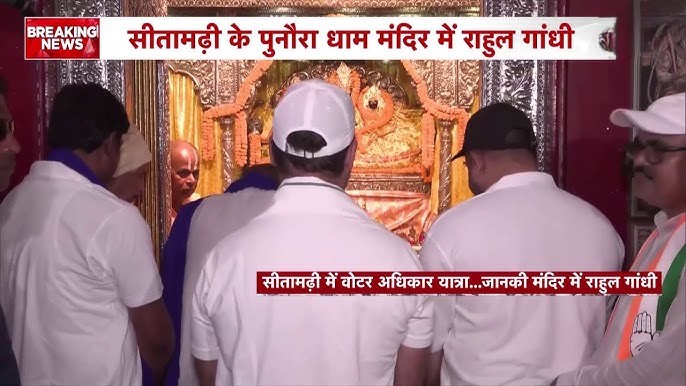
Sitamarhi: Rahul-Tejashwi Reached Punaura Dham Janaki Temple for Darshan In the political and cultural landscape of India, religion and spirituality often intersect with leadership and governance. A recent example of this was witnessed in Bihar’s Sitamarhi district, where Congress leader Rahul Gandhi and RJD leader Tejashwi Yadav visited the historic Punaura Dham Janaki Temple. Their darshan (worship) at this temple, revered as the birthplace of Goddess Sita, not only reflects devotion but also carries significant political undertones. The timing of their visit—amid the ongoing Voter Rights Yatra and rising political debates in Bihar—makes it more than just a spiritual act. It has become a talking point in Bihar’s socio-political narrative.
In this blog, we will explore the details of the visit, the religious and cultural importance of the Punaura Dham Janaki Temple, the historical connection of Sitamarhi with Goddess Sita, the political symbolism behind the darshan, reactions from various quarters, and how such events shape the broader discourse of Indian politics.
The Punaura Dham Janaki Temple – A Sacred Seat of Faith
The Significance of Sitamarhi
Sitamarhi, located in north Bihar near the Nepal border, has a unique place in Hindu mythology. It is widely believed to be the birthplace of Goddess Sita, the consort of Lord Rama. According to the Ramayana, Sita was discovered in a furrow by King Janaka while plowing the land, hence the association with agriculture and fertility. This makes Sitamarhi one of the holiest sites for Hindus.
Punaura Dham Janaki Temple
Among the many temples in Sitamarhi, Punaura Dham Janaki Temple stands out as the most revered. Devotees from across India and Nepal visit the temple, especially during festivals like Ram Navami and Vivah Panchami. The temple is not just a place of worship but a cultural landmark connecting India and Nepal through the shared heritage of the Ramayana.
Rahul Gandhi and Tejashwi Yadav’s visit here naturally attracted wide attention because it was not merely a pilgrimage—it was also a public statement of connecting with the faith of millions.
The Visit of Rahul Gandhi and Tejashwi Yadav
The Arrival
The visit took place amid tight security and in the presence of a large number of party workers and local residents. Rahul Gandhi, known for his Bharat Jodo Yatra earlier, and Tejashwi Yadav, the face of the RJD in Bihar, were warmly welcomed with garlands, chants of “Jai Siya Ram,” and the traditional offering of flowers.
The Darshan
Both leaders entered the temple premises barefoot, folded their hands before Goddess Janaki, and participated in the traditional puja rituals. The priests of the temple performed aarti, recited Vedic mantras, and offered prasad to the leaders.
The visuals of Rahul Gandhi and Tejashwi Yadav bowing before Goddess Sita quickly went viral, highlighting the blend of spirituality and politics. The leaders reportedly spent about half an hour inside the temple premises, interacting with priests and devotees.
The Message
Rahul Gandhi, while addressing the media after the darshan, said, “Bihar is the land of Goddess Sita, of culture, tradition, and strength. We have come here to seek blessings for the people of Bihar and for the unity and prosperity of India.”
Tejashwi Yadav echoed similar sentiments, adding that Bihar has always been the land of tolerance and spirituality, and leaders must draw inspiration from such sacred places.
The Cultural Symbolism of the Visit
Religion in India is deeply intertwined with culture and politics. Visiting temples, mosques, and other sacred sites often goes beyond devotion—it becomes a way to connect with people’s emotions.
In Bihar, the Janaki temple has both religious and cultural resonance:
- Cultural Identity – Bihar prides itself on being the birthplace of Sita, a figure who symbolizes strength, sacrifice, and purity.
- India–Nepal Connection – Since Sita is revered as the daughter of Janakpur (in present-day Nepal), the temple reinforces the cross-border cultural ties.
- Symbol of Women’s Strength – In the era of women’s empowerment, invoking Goddess Sita has deeper relevance, and leaders visiting her birthplace may appeal to sentiments of respect for women.
Thus, the darshan by Rahul and Tejashwi is not just a cultural activity but a symbolic alignment with values that resonate with the masses.
Political Undertones of the Visit
The Voter Rights Yatra Context
The timing of the visit is crucial. Rahul Gandhi is on a campaign mode, raising issues of electoral reforms, voter rights, and alleged misuse of institutions by the ruling government. Tejashwi Yadav, on the other hand, is strengthening his ground in Bihar politics. Their joint visit signals INDIA alliance solidarity and an attempt to project themselves as leaders rooted in culture and tradition.
Soft Hindutva or Inclusive Politics?
While BJP has often been associated with temple politics, opposition leaders like Rahul Gandhi and Tejashwi Yadav are increasingly making temple visits to counter the narrative that only one party represents Hindu faith. Their darshan at Janaki temple reflects an effort to embrace cultural identity without alienating secular credentials.
Bihar’s Political Equation
Bihar has always been politically significant. The alliance between Congress and RJD seeks to challenge the BJP-JDU combine. By visiting a major religious site, the leaders are not only appealing to spiritual sentiments but also consolidating a cultural connect with voters ahead of elections.
Public and Political Reactions
Devotees’ Response
Many devotees present at the temple saw the visit as a gesture of respect. They expressed happiness that national and state leaders came to seek the blessings of Goddess Sita, reinforcing Sitamarhi’s importance on the national map.
Supporters’ Perspective
Congress and RJD workers hailed the visit as a symbol of cultural respect and political humility. They believe such acts strengthen the bond between leaders and the public.
Opposition’s Criticism
Predictably, BJP leaders accused Rahul and Tejashwi of “political opportunism.” Some argued that their sudden display of religiosity is an attempt to woo Hindu voters, especially as elections near. Others questioned whether such temple visits can substitute for governance and development.

Historical Importance of Sitamarhi and Its Political Use
Sitamarhi has often been used as a symbolic backdrop for political messaging:
- In the past, leaders from various parties have visited Janaki temple during election campaigns.
- The temple town also reflects the agrarian roots of Bihar, which leaders use to highlight rural and farmer-related issues.
- By aligning themselves with Sitamarhi, leaders hope to gain moral legitimacy and spiritual endorsement in the eyes of the people.
Broader Implications
The visit of Rahul Gandhi and Tejashwi Yadav shows how Indian politics continues to rely on cultural symbolism. While on the surface it may appear as just a temple visit, it carries larger messages:
- The opposition is trying to challenge BJP on cultural grounds.
- Leaders are increasingly mixing faith with politics to connect emotionally with people.
- Bihar is emerging as a testing ground for INDIA alliance solidarity.
Conclusion
The darshan of Rahul Gandhi and Tejashwi Yadav at the Punaura Dham Janaki Temple in Sitamarhi is more than just a religious ritual. It is an intersection of faith, culture, and politics. For the people of Bihar, it reinforces their pride in being the birthplace of Goddess Sita. For the leaders, it is a chance to align themselves with tradition while pushing their political narrative.
In India, where religion shapes public consciousness, such visits will continue to play a crucial role. Whether it leads to electoral dividends or not is a question only time will answer, but it is clear that spirituality and politics remain deeply connected in the Indian context.
Read more latest news

