
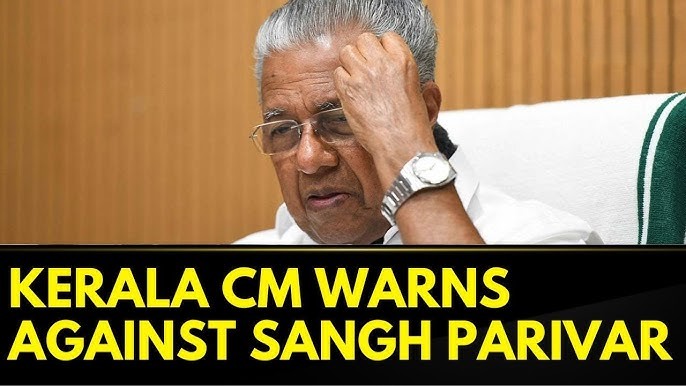
Sangh Parivar’s ‘Attempting To Rewrite Indian History’ Warns Kerala CM Pinarayi Vijayan
In recent years, the rise of the Sangh Parivar, a collective of Hindu nationalist organizations, has been accompanied by the promotion of a vision of India that many critics argue is at odds with the country’s pluralistic and diverse heritage. Kerala’s Chief Minister, Pinarayi Vijayan, has repeatedly raised alarms over the ideological undercurrents flowing from these organizations, warning that they are trying to “rewrite Indian history” to align with their narrow, sectarian worldview.
Vijayan’s concerns about the Sangh Parivar’s influence on historical narratives, education, and politics are not new. As a Marxist leader in a state known for its rich tradition of secularism, social justice, and progressive values, he has become one of the most vocal critics of what he sees as an attempt to distort the true essence of India’s historical and cultural fabric. His criticisms come at a time when the ruling government at the center, led by the Bharatiya Janata Party (BJP), is closely aligned with the Rashtriya Swayamsevak Sangh (RSS), the ideological parent of the Sangh Parivar.
In this blog, we will delve into Vijayan’s warnings, examine the broader context of the Sangh Parivar’s growing influence in India, and explore the implications of their attempts to reshape the country’s historical narrative. We will also investigate the resistance from Kerala and other regions, the debates around historical revisionism, and the role of education and media in shaping how history is understood and presented.
The Sangh Parivar and Its Ideological Roots
The Sangh Parivar, which includes organizations like the RSS, BJP, Vishva Hindu Parishad (VHP), and Bajrang Dal, is deeply rooted in the ideology of Hindutva, a vision of India that emphasizes the dominance of Hindu culture and values. Founded in 1925 by K.B. Hedgewar, the RSS sought to unite Hindus under a common identity, and over the decades, it has expanded its influence across India, particularly after the rise of the BJP in the 1990s.
At the core of the Hindutva ideology is the belief that India is, and always should be, a Hindu nation. This vision stands in stark contrast to the secular fabric of India, which was enshrined in the Indian Constitution after independence. Secularism, as defined in the Indian context, ensures equal treatment and freedom for all religious communities, not just Hindus. But the Sangh Parivar’s agenda challenges this notion, pushing for a vision of India where Hinduism holds primacy over all other religions.
One of the most contentious aspects of Hindutva politics is its approach to India’s history. The Sangh Parivar has consistently sought to rewrite India’s historical narrative, portraying a version of history that elevates Hindu religious figures, events, and ideologies while sidelining the contributions of other communities, particularly Muslims, Christians, and Dalits.
This rewriting of history, according to many critics, is not just about acknowledging Hindu history but is about erasing or distorting the historical role of religious minorities, which undermines India’s pluralistic identity.
Kerala CM Pinarayi Vijayan’s Warnings
Pinarayi Vijayan has long been a strong critic of the RSS and its affiliates. As the Chief Minister of Kerala, a state with a rich history of secularism and religious harmony, his stance is rooted in the defense of a society that values diversity and inclusivity.
Vijayan’s primary concern is the rising influence of the Sangh Parivar in the state’s political and educational spheres. Kerala has traditionally been one of the most literate and secular states in India, and its political landscape is dominated by parties that have historically been committed to secular ideals. The Communist Party of India (Marxist), of which Vijayan is a prominent member, has always been wary of the RSS’s attempt to gain a foothold in the state.
The Kerala CM has repeatedly pointed out that the Sangh Parivar’s agenda goes beyond the political domain. According to him, the real danger lies in the way the Parivar is attempting to alter the historical narrative taught to students, presented in media, and enshrined in textbooks. Vijayan believes that this is a concerted effort to distort India’s rich history and replace it with a monolithic Hindu-centric perspective that glosses over the contributions of other communities.
Pinarayi Vijayan’s Concerns:
- Distortion of History: Vijayan has accused the Sangh Parivar of systematically altering history to fit its ideological goals. This includes downplaying or erasing significant events and figures from Indian history that do not align with the Hindu nationalist agenda, such as the contributions of Muslim rulers, the role of Dalits in social reform, and the history of colonial resistance movements.
- Textbook Revisions: Kerala’s history textbooks have been a battleground in the war over historical narratives. In recent years, there have been attempts by various state governments, particularly in BJP-ruled states, to revise textbooks to present history from a more Hindu-centric perspective. Vijayan has been vocal in condemning these moves, urging that history should reflect the diversity of India’s past and honor the contributions of all communities.
- Threat to Secularism: The secular fabric of India has always been a cornerstone of Kerala’s identity. Vijayan argues that the Sangh Parivar’s influence represents a direct threat to this secular ethos. The CM has warned that any attempt to rewrite history and distort India’s pluralistic values could undermine Kerala’s strong traditions of religious coexistence.

The Growing Influence of the Sangh Parivar: A National Trend
While Kerala has been relatively insulated from the full force of the Sangh Parivar’s influence, the broader trend across India is one of growing ideological domination. The rise of the BJP at the national level, led by Prime Minister Narendra Modi, has significantly bolstered the Sangh Parivar’s agenda. Over the past few years, the party has pursued policies and strategies that align closely with the RSS’s vision of a Hindu nation.
The BJP government has enacted several policies that critics argue have furthered the Hindutva agenda, such as the Citizenship Amendment Act (CAA), abrogation of Article 370 in Jammu and Kashmir, and various changes to the school curriculum. These moves have sparked widespread protests and debates across the country about the future of India’s secularism.
The Influence of Media and Politics:
The Sangh Parivar has also capitalized on the growing influence of media outlets and social media to push its ideological agenda. Television networks, social media campaigns, and online platforms have become powerful tools for promoting the Hindu nationalist narrative. According to critics, these outlets often propagate a one-sided view of Indian history, where Hindu contributions are exaggerated, and the role of other communities is minimized or ignored.
In the political sphere, the BJP has systematically aligned itself with the Sangh Parivar, ensuring that many of the key positions within the government are filled by individuals who share the same ideological convictions. This has allowed the Sangh Parivar to wield significant influence over policymaking at the national level.
Resistance to Historical Revisionism: Kerala’s Role
Kerala stands out as one of the most significant regions of resistance to the Sangh Parivar’s efforts to rewrite history. Vijayan and the Left Democratic Front (LDF) government have consistently pushed back against any attempts to alter the historical narrative. The Kerala state government has made it clear that it will not allow the distortion of history in educational institutions, nor will it entertain efforts to propagate a narrow, exclusionary view of India’s past.
The Role of Education in Kerala:
Education in Kerala has traditionally been progressive and inclusive, and the state is known for its high literacy rates and social awareness. The state government has actively promoted education that reflects the diverse and inclusive nature of Indian history. Kerala’s textbooks have always emphasized the contributions of various communities, including Hindus, Muslims, Christians, and Dalits.
Pinarayi Vijayan’s government has reiterated its commitment to ensuring that history education in Kerala remains objective, inclusive, and free from ideological manipulation. As part of this commitment, the state government has rejected attempts to introduce a Hindutva version of history in school curricula and has emphasized the importance of teaching the true history of India, one that reflects its pluralistic values.
The Broader Debate: Should History Be ‘Rewritten’?
The debate over historical revisionism is not new. Historians have long argued about the interpretation of events, and history, by its very nature, is always subject to interpretation. However, what is concerning to critics of the Sangh Parivar’s efforts is the ideological motivation behind these revisions. Rather than presenting a balanced view of India’s past, the Sangh Parivar seeks to distort facts to fit its agenda.
While there is a legitimate argument to be made about re-examining historical narratives, especially in light of new evidence or changing social contexts, what the Sangh Parivar advocates is something more dangerous: the use of history as a political weapon to further a particular ideology.
The implications of this are far-reaching. A distorted view of history can have long-term consequences on how future generations perceive their identity, their fellow citizens, and the nation as a whole. By presenting a one-dimensional, exclusionary version of history, the Sangh Parivar risks undermining India’s long-standing traditions of tolerance, secularism, and pluralism.
Conclusion
Kerala Chief Minister Pinarayi Vijayan has emerged as one of the most vocal critics of the Sangh Parivar’s attempts to rewrite Indian history. His warnings are a reminder that the battle over historical narratives is not just about the past but also about the future of India’s democratic and pluralistic values. As the Sangh Parivar continues to push its ideological agenda, states like Kerala remain steadfast in their commitment to secularism, inclusivity, and truth in history.
The ideological struggle over India’s history is far from over, and it will be up to the people of India, including its leaders, educators, and citizens, to ensure that the true essence of India’s diversity and its rich cultural heritage are preserved for generations to come.
Read more latest news

