
Rahul Gandhi’s “Hydrogen Bomb of Vote Theft” Remark at CWC Meeting in Patna: A Deep Dive into Congress’s Strategy and BJP’s Counter.
Introduction
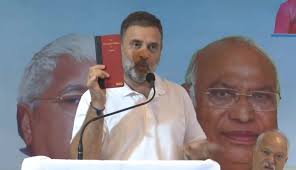
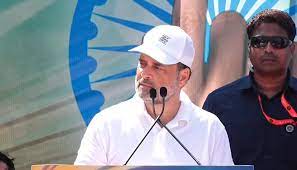
I have talked about the hydrogen bomb Rahul Gandhi The political heat in India reached a new level on Wednesday when the Congress Working Committee (CWC), the party’s highest decision-making body, held an extended meeting in Patna. The gathering brought together senior leaders, state representatives, and strategists at a time when the opposition is sharpening its campaign ahead of the coming elections.
In this meeting, Rahul Gandhi, the most prominent face of the Congress, made a striking statement that quickly grabbed headlines across the country:
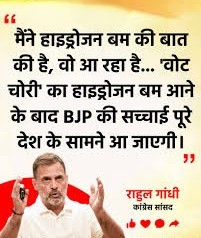
“I have talked about the hydrogen bomb, it is coming… After the hydrogen bomb of ‘vote theft’ comes, the truth of BJP will be revealed to the entire country.”
With these words, Rahul Gandhi accused the Bharatiya Janata Party (BJP) of engaging in widespread electoral manipulation and warned of explosive revelations that could reshape public opinion. The metaphor of a “hydrogen bomb” was chosen deliberately — dramatic, powerful, and impossible to ignore.
This blog will unpack the events of the CWC meeting, the meaning behind Rahul Gandhi’s words, Congress’s strategy, BJP’s likely response, and what this means for Indian democracy.
The Context: Why Patna?
Patna, the capital of Bihar, is not just any city on the political map. It has been the cradle of countless political movements — from the JP movement of the 1970s to the rise of several regional parties that continue to shape the destiny of Indian politics.
Holding the extended CWC meeting in Patna was both symbolic and strategic:
- Symbolic of Grassroots Politics: Congress wanted to emphasize its connect with the heartland, away from Delhi’s elite corridors.
- Message to Regional Parties: Bihar is home to key INDIA alliance partners like RJD and JDU. Choosing Patna signaled Congress’s willingness to collaborate and strengthen the opposition front.
- Historical Backdrop: Patna has been central to narratives of democracy and resistance, making it the perfect stage for Rahul Gandhi’s explosive remarks.
Rahul Gandhi’s “Hydrogen Bomb” Statement
At the heart of the meeting was Rahul Gandhi’s fiery comment on electoral malpractice. His words carried both a warning and a promise:
- Warning: He accused BJP of indulging in “vote theft”, suggesting large-scale manipulation of electoral processes.
- Promise: He claimed that once these details come to light, BJP’s image would be shattered before the nation.
Why Use the “Hydrogen Bomb” Metaphor?
- Scale and Impact: Just as a hydrogen bomb is many times more destructive than an atomic bomb, Rahul Gandhi suggested that the revelations of vote theft would be far more damaging than any previous allegation against BJP.
- Attention-Grabbing: The metaphor ensured instant media coverage and public curiosity.
- Mobilization Tool: It fired up Congress workers and supporters, energizing them for the upcoming campaign.
Vote Theft Allegations: A Recurring Theme
This is not the first time the opposition has raised concerns about electoral integrity. The issue of Electronic Voting Machines (EVMs) and alleged irregularities has been part of political discourse for years.
Allegations by Congress and Allies:
- Manipulation of Voter Lists: Deletion of names, especially of minority and marginalized communities.
- Use of Money and Muscle Power: Intimidation of voters in certain constituencies.
- EVM Tampering: Though the Election Commission of India (ECI) has consistently denied such claims, doubts persist among opposition ranks.
- Administrative Bias: Allegations of state machinery being misused to favor the ruling party.
Rahul Gandhi’s “hydrogen bomb” remark suggests that Congress may be preparing to release documents, testimonies, or data to substantiate these claims in the near future.
Inside the CWC Meeting
The extended CWC meeting in Patna wasn’t just about one fiery speech. It was a brainstorming session where multiple issues were discussed:
- Electoral Strategy for 2025 and Beyond
- Mobilizing grassroots workers.
- Strengthening booth-level committees.
- Building alliances under the INDIA bloc umbrella.
- Economic and Social Issues
- Unemployment and inflation were highlighted as central campaign planks.
- Concerns over farmers’ distress and rural economy revival were raised.
- Organizational Reforms
- Revamping state units in Uttar Pradesh, Bihar, and Madhya Pradesh.
- Encouraging youth participation and giving larger responsibilities to women leaders.
- Direct Attack on BJP
- Several leaders echoed Rahul Gandhi’s accusations.
- The party decided to run a campaign focusing on “saving democracy and Constitution.”
BJP’s Likely Counter-Narrative
The BJP, known for its aggressive communication strategy, will not let Rahul Gandhi’s hydrogen bomb comment go unanswered. Their counter could follow several lines:
- Mockery of Language
- BJP leaders may dismiss the “hydrogen bomb” phrase as yet another “rhetorical exaggeration” by Rahul Gandhi.
- They could compare it to his earlier controversial statements and ridicule him as an irresponsible leader.
- Assertion of Electoral Integrity
- BJP will point to the Election Commission’s consistent stand on EVM security.
- They may highlight the fact that multiple state elections have resulted in opposition victories, undermining the charge of manipulation.
- Attack on Congress’s Credibility
- BJP could counter-accuse Congress of “crying foul” because of repeated electoral defeats.
- Past instances of Congress-era malpractices may be dug up to discredit the party.
- Turning the Tables
- BJP’s IT cell is likely to amplify narratives that Rahul Gandhi is undermining democratic institutions like the ECI and judiciary.
The Larger Battle: Narrative vs. Counter-Narrative
In Indian politics, elections are not won on facts alone. They are won on narratives. By invoking a “hydrogen bomb,” Rahul Gandhi has set the stage for a battle of perception.
- Congress’s Narrative: BJP is stealing votes, democracy is in danger, and truth will soon explode like a bomb.
- BJP’s Narrative: Congress is spreading lies out of frustration, undermining democracy, and insulting voters’ intelligence.
This clash of narratives will shape the mood of the electorate.
Public and Media Reactions
The statement has already become a talking point:
- Mainstream Media: News anchors debated whether Rahul Gandhi has credible evidence or if this is just another dramatic soundbite.
- Social Media: Hashtags like #HydrogenBomb, #VoteTheft, and #RahulVsBJP trended within hours.
- Public Sentiment: Among Congress supporters, the remark generated enthusiasm. Among BJP loyalists, it triggered anger and counter-memes.
The polarization of reactions indicates that Rahul Gandhi succeeded in drawing attention — which, in political communication, is often the first victory.
Challenges Before Congress
Even with powerful statements, Congress faces serious challenges:
- Proof of Allegations: Unless Rahul Gandhi follows up with concrete evidence, the hydrogen bomb may fizzle out.
- Organizational Weaknesses: In states like UP and Bihar, Congress lacks a strong ground presence.
- Coordination with INDIA Bloc: Managing seat-sharing and avoiding infighting will be critical.
- Countering BJP’s Media Machinery: BJP’s ability to dominate headlines and social media remains unmatched.
Opportunities for Congress
Despite challenges, Congress has openings:
- Discontent on Economic Front: Rising unemployment, inflation, and farmer distress provide fertile ground.
- Regional Alliances: Strong partners in Bihar, Jharkhand, Maharashtra, and Tamil Nadu can amplify Congress’s narrative.
- Youth Mobilization: The “hydrogen bomb” metaphor may resonate with young voters who want bold, clear messaging.
- Global Attention: As the world watches India’s elections, Congress can frame itself as the defender of democratic values.
Historical Parallels
Rahul Gandhi’s use of explosive metaphors is not without precedent:
- Indira Gandhi (1970s): Used “Garibi Hatao” as a battle cry.
- Rajiv Gandhi (1985): Spoke of bringing India into the 21st century with technology.
- Narendra Modi (2014): Popularized “Achhe Din” as a slogan.
Each of these phrases captured public imagination. Rahul Gandhi hopes his “hydrogen bomb” will do the same.
Conclusion: What Lies Ahead
The extended CWC meeting in Patna was not just a routine gathering. It marked the sharpening of Congress’s political messaging for the upcoming electoral battles. Rahul Gandhi’s statement about the “hydrogen bomb of vote theft” has added dramatic flair to the campaign and thrown down a gauntlet to BJP.
Read More latest news

