
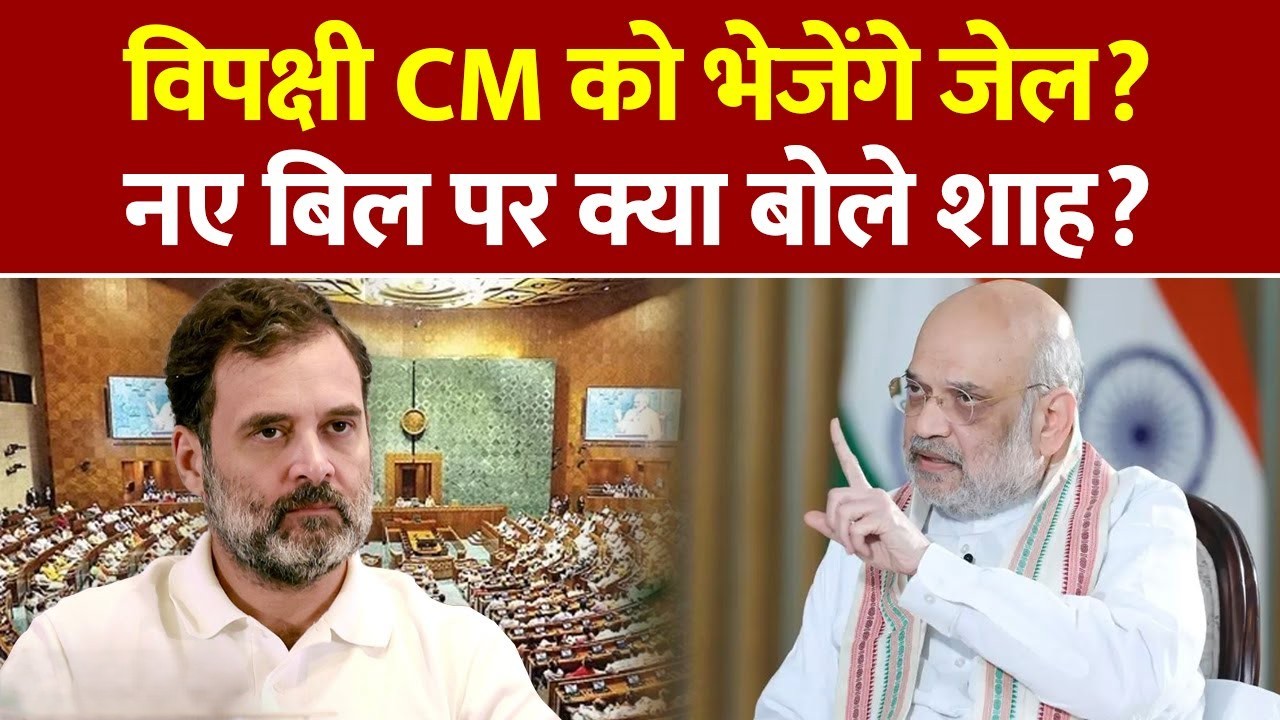
Amit Shah’s Attack on Opposition: “Running a Government from Jail is an Insult to Democracy”
Introduction
Running a government from jail is an insult to democracy, Indian politics has always been defined by high-voltage debates, fiery exchanges, and sharp ideological clashes. Every session of Parliament becomes a battlefield where words are wielded like weapons, and accusations fly across party lines. In this backdrop, Union Home Minister Amit Shah’s recent attack on the opposition—where he declared that “running a government from jail is an insult to democracy”—has not only escalated the political drama but has also stirred nationwide debate on the ethical and constitutional boundaries of leadership in Indian democracy.
This statement, delivered with Shah’s trademark directness, comes at a time when the political landscape is already polarized. With several opposition leaders facing corruption charges, ongoing investigations by central agencies, and heated discussions over governance models, Shah’s words carry both political weight and symbolic significance.
In this blog, we will break down the full meaning of Shah’s attack, the political context behind his remarks, the opposition’s counter-arguments, historical precedents of jailed leaders, and what this debate means for the future of Indian democracy.
Amit Shah’s Statement – The Core Message
During his address in Parliament, Amit Shah launched a scathing attack on opposition parties, stating:
“Running a government from jail is an insult to democracy. The people of India have given their mandate to leaders who should be accountable in front of them, not from inside prison walls.”
With this one line, Shah highlighted three crucial points:
- Legitimacy of leadership – Leaders must be accessible and accountable to the public, which is impossible from jail.
- Moral authority – Being incarcerated raises serious ethical questions about whether such leaders should represent the people.
- Democratic norms – According to Shah, governance from prison violates the spirit of democracy because it undermines voters’ trust.
Shah’s statement was not just a general remark—it was clearly aimed at specific opposition leaders who are currently under investigation or facing imprisonment in connection with corruption and money-laundering cases.
Political Context – Why Shah Chose This Attack
Amit Shah’s comment did not come in isolation. It reflects the current political tensions in India, where corruption allegations and cases against opposition leaders have become a central theme.
- Several opposition leaders are either in jail or facing charges under the Prevention of Money Laundering Act (PMLA) and other anti-corruption laws.
- Some of these leaders have continued to issue political directives from prison through statements, party meetings, or legal representatives.
- The BJP government, led by Prime Minister Narendra Modi and Amit Shah, has consistently projected itself as a clean governance model, contrasting itself with opposition parties accused of scams.
By attacking the very idea of “jail politics,” Shah aimed to:
- Expose the opposition’s vulnerabilities – highlighting their tainted leadership.
- Project BJP’s moral high ground – reinforcing the narrative of corruption-free governance.
- Mobilize public opinion – ensuring voters view BJP as the protector of democracy against corrupt practices.
Opposition’s Counterattack – Cry of Political Vendetta
The opposition, however, was quick to retaliate. Leaders from the Congress, AAP, RJD, and other INDIA bloc parties dismissed Shah’s comments as nothing more than political theater. Their counter-arguments included:
- Selective targeting by agencies – Opposition claims that central agencies like ED and CBI are being used to silence dissent.
- Mandate of the people – They argue that if the people elect a leader, he or she should be allowed to represent them, regardless of legal battles.
- Historical parallels – They point to examples like Jayaprakash Narayan during the Emergency and Nelson Mandela in South Africa, where jailed leaders became symbols of resistance rather than disgrace.

Rahul Gandhi even took a subtle jibe, stating:
“Democracy is not about where you sit—it is about who you stand with. People can lead from anywhere, even jail, if they are standing with truth.”
This shows that while BJP views jail-time as a mark of corruption, the opposition is trying to spin it as a badge of victimhood and resistance.
Historical Precedents – Can Leaders Govern from Jail?
Amit Shah’s comment also raises an important historical question: Can leaders really govern from jail?
- India’s Emergency (1975–77) – Several opposition leaders were jailed by Indira Gandhi’s government, but their leadership from prison kept the opposition alive.
- Jayalalithaa (2014) – The Tamil Nadu CM had to resign when convicted, but her party functioned in her absence until her return.
- International parallels – Nelson Mandela governed as a symbolic leader even from prison, inspiring South Africa’s anti-apartheid movement.
The difference lies in cause vs. corruption:
- Leaders jailed for political resistance often emerge stronger.
- Leaders jailed for corruption face public skepticism.
This is the distinction Amit Shah seeks to emphasize.
Legal & Constitutional Dimensions
India’s Representation of the People Act (1951) states that individuals convicted of crimes with imprisonment of 2 years or more are disqualified from contesting elections. However, undertrial leaders often continue their political influence until conviction.
- Technically possible – Leaders can still lead parties and issue directives through lawyers or family members.
- Ethically questionable – Governance from jail raises concerns of transparency and accountability.
Shah’s remark taps into this ethical vacuum—that while the law may permit, morality and democracy reject it.
Media Coverage – Amplifying the Debate
Unsurprisingly, Shah’s words dominated headlines across television, newspapers, and social media.
- Mainstream media highlighted it as BJP’s fresh attack on the INDIA bloc.
- Opposition-leaning media countered with narratives of “political vendetta” and “suppression of dissent.”
- Social media battles erupted, with hashtags like #DemocracyInsulted vs #VendettaPolitics trending on X (Twitter).
Public opinion, meanwhile, seemed divided:
- Urban middle-class voters largely echoed Shah’s views on accountability.
- Opposition loyalists framed jailed leaders as martyrs of democracy.
The Broader Democratic Question
At the heart of this clash is a bigger question:
👉 Should leaders accused of corruption be allowed to influence governance from prison?
- Pro-democracy argument – If the people have chosen them, democracy must respect their mandate.
- Pro-clean politics argument – Democracy is weakened if tainted leaders continue to hold power, even indirectly.
Shah clearly stands with the latter, portraying BJP as the protector of democratic purity.
Amit Shah’s Political Strategy
It is important to understand Shah’s political style. Known as the “Chanakya of BJP,” Shah rarely makes off-the-cuff remarks. Every word is calculated for electoral impact.
- His attack targets not just opposition leaders, but also aims to corner the INDIA bloc ahead of elections.
- It reinforces BJP’s narrative: “We are corruption-free, they are tainted.”
- It helps BJP maintain the moral high ground in front of undecided voters.
Thus, Shah’s statement is not only about democracy—it is also about electoral strategy and perception management.
Public Perception – How Voters See It
Indian voters are pragmatic. Their perception of jailed leaders depends on:
- Cause of jail – Corruption cases invite anger; political repression invites sympathy.
- Leader’s popularity – A strong mass leader may still command support despite imprisonment.
- Timing before elections – If arrests happen close to polls, it can trigger sympathy waves.
Shah’s job is to ensure voters view opposition leaders’ jail-time as corruption punishment, not political martyrdom.
Conclusion – Democracy, Accountability, and the Road Ahead
Amit Shah’s fiery declaration that “running a government from jail is an insult to democracy” has opened a new chapter in India’s political discourse. While the BJP sees it as a moral crusade against corruption, the opposition frames it as an attack on dissent and democracy.
This debate reveals the paradox of Indian democracy:
- Democracy is about respecting people’s mandate.
- But democracy also demands accountability, transparency, and clean governance.
In the end, the real verdict will not come from Parliament speeches or media debates—it will come from the ballot box, where voters will decide whether jailed leaders represent corruption or resistance, and whether Amit Shah’s warning resonates with their idea of democracy.
Read more latest news

