
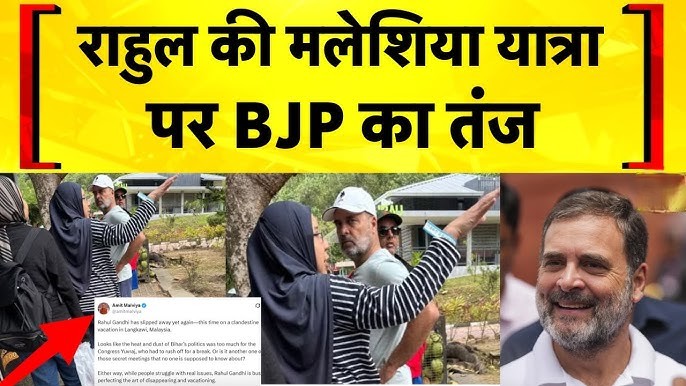
Rahul Gandhi’s Malaysia Trip: BJP Attacks, Raises Questions on Timing and Intent
Introduction
Rahul Gandhi Indian politics thrives on optics, timing, and the messaging of leaders’ actions. Every movement of a major political figure becomes a matter of discussion, debate, and criticism. Congress leader Rahul Gandhi’s Malaysia trip has recently triggered a fresh wave of political confrontation. While the Congress party has projected his foreign visits as part of global outreach and strengthening India’s image abroad, the Bharatiya Janata Party (BJP) has taken the opportunity to mount a sharp attack.
The BJP has questioned the timing, intent, and significance of Rahul Malaysia visit, especially when India is passing through crucial political and diplomatic developments. Party leaders argue that instead of engaging in domestic challenges and participating in key parliamentary discussions, Rahul Gandhi’s frequent foreign trips send the wrong signal.
This episode highlights not only the growing rivalry between the BJP and the Congress but also sheds light on the deeper battle of narratives—between global outreach and domestic accountability, between political symbolism and electoral ground reality.
In this detailed blog, we will break down:
- The details of Rahul Gandhi’s Malaysia trip.
- BJP’s attack and the questions raised.
- The Congress party’s defense.
- Historical context of Rahul foreign visits.
- Why such visits attract political controversy.
- Larger implications for India’s politics ahead of the 2025 elections.
Rahul Gandhi’s Malaysia Trip – What Do We Know?
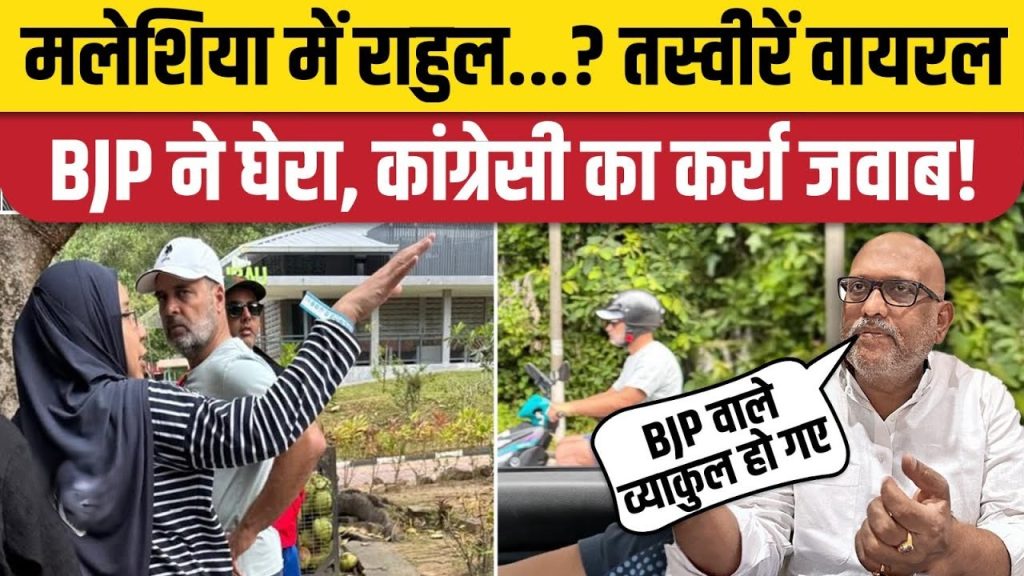
According to reports, Rahul Gandhi traveled to Malaysia for a short visit. The trip, while not officially declared in advance by the Congress, came into focus after photographs and videos surfaced online. The Congress party later clarified that Rahul was attending meetings with business leaders, members of the Indian diaspora, and academic groups.
Malaysia, with its significant Indian-origin population, has historically been an important center for India’s overseas political connections. The Congress argued that Rahul Gandhi’s interaction with the Indian diaspora is part of a larger initiative to strengthen cultural and economic ties.
However, the trip coincided with crucial debates in India, including issues related to economic policies, rising prices, unemployment, and the Modi government’s international trade negotiations. This overlap became a political tool for the BJP to criticize Rahul Gandhi’s priorities.
BJP’s Attack: Timing, Transparency, and Political Messaging
The BJP wasted no time in launching a frontal attack on Rahul Gandhi. Senior party leaders and spokespersons questioned:
- Why was the trip kept low-profile?
BJP leaders alleged that Rahul Gandhi often embarks on “secretive foreign trips,” raising doubts about transparency. - Why now?
The timing of the visit became a central issue. BJP questioned why Rahul Gandhi chose to leave at a time when crucial debates in Parliament and state elections in Bihar, Jharkhand, and Maharashtra are heating up. - What is the purpose?
BJP framed the visit as politically irrelevant to Indian voters, arguing that it has more to do with personal leisure than national service. - Lack of commitment to India’s ground issues
BJP spokespersons accused Rahul Gandhi of “running away” from responsibility, claiming that instead of engaging in grassroots politics and understanding the suffering of farmers and the unemployed, he prefers “foreign air-conditioned discussions.” - Echo of 2019 narrative
BJP tried to revive the 2019 election narrative, where Prime Minister Modi had framed himself as the “son of the soil” while Rahul Gandhi was portrayed as “out of touch elite” who spends more time abroad than in Indian villages.
Congress’ Defense: Global Outreach and Indian Diaspora
The Congress party, however, has strongly defended Rahul Gandhi’s Malaysia trip. Party leaders argue:
- Engagement with Indian diaspora: With millions of Indians living abroad, Congress believes that connecting with them strengthens India’s soft power. Rahul Gandhi’s meetings in Malaysia, they claim, are part of this larger mission.
- False narrative of secrecy: Congress asserts that the BJP deliberately paints a picture of “secretive trips” to malign Rahul Gandhi, whereas his visits are transparent and focused on policy discussions.
- Comparisons with PM Modi: Congress has also highlighted that Prime Minister Narendra Modi himself has made dozens of foreign trips. If Modi’s trips are seen as nation-building, why are Rahul Gandhi’s visits labeled as “holiday tours”?
- Global credibility: The Congress presents Rahul Gandhi as a leader who speaks not just to India but also to the world, enhancing India’s credibility on issues of democracy, climate change, and social justice.
Historical Context: Rahul Gandhi’s Foreign Visits and Controversies
This is not the first time Rahul Gandhi’s foreign visits have triggered political debates. Over the past decade, several of his international trips have drawn sharp criticism from the BJP:
- 2015: Rahul Gandhi’s extended absence led to speculation about his political seriousness.
- 2019 Elections: BJP repeatedly accused him of leaving India during crucial campaign periods.
- 2023–24: His visits to the US and Europe, where he delivered lectures at universities, were portrayed by BJP as “speaking against India abroad.”
Thus, the Malaysia trip fits into a broader pattern where BJP has weaponized Rahul Gandhi’s travel schedule to question his political commitment and credibility.
Why Do Rahul Gandhi’s Trips Become a Political Issue?
There are several reasons why Rahul Gandhi’s foreign visits repeatedly turn into a storm in Indian politics:
- Narrative of elitism
BJP has successfully created a perception that Rahul Gandhi belongs to a privileged, disconnected elite, unlike Modi who represents grassroots struggles. - Frequency and timing
The fact that many trips coincide with domestic political crises makes them easy targets. - Congress’ weak communication strategy
Often, Congress does not preemptively share details of such visits, which allows BJP to control the narrative. - Symbolism in Indian politics
Indian voters and parties value visibility. Leaders seen engaging with the masses gain credibility, while foreign trips often appear out of sync with local realities.
BJP vs. Congress Narrative: Nationalism vs. Globalism
This episode again brings out the contrasting styles of India’s two major political parties:
- BJP’s narrative: Rooted in nationalism, grassroots connect, and “India First” approach.
- Congress’ narrative: Focused on global engagement, liberal values, and outreach to the diaspora.
For BJP, painting Rahul Gandhi as a leader who looks outside India when problems lie within is politically rewarding. For Congress, however, it is essential to present him as a modern, internationally aware statesman.

Impact on Voters Ahead of 2025 Elections
As Bihar and Maharashtra head towards crucial elections in 2025, the BJP’s attack on Rahul Gandhi’s Malaysia trip is not just about optics—it is an electoral strategy. By framing him as “absent” or “disconnected,” BJP aims to weaken the Congress-led INDIA alliance’s credibility.
For Congress, the challenge lies in convincing voters that such foreign visits are not a sign of detachment but part of a broader strategy to learn, connect, and represent India on the global stage.
Conclusion
Rahul Gandhi’s Malaysia trip and the BJP’s subsequent attack illustrate how Indian politics has become a battle of perceptions. In today’s hyper-connected world, where every photo and video spreads instantly, leaders are judged not just by policies but also by their presence, timing, and symbolism.
While the BJP has once again used this trip to question Rahul Gandhi’s seriousness, the Congress maintains that his outreach efforts abroad are essential for India’s global standing. Ultimately, the question is not just about one trip—it is about whether Indian voters see Rahul Gandhi as a committed, grounded leader or as someone disconnected from India’s pressing realities.
The Malaysia episode will add another chapter to the ongoing BJP vs. Congress war of narratives, one that will shape the political battlefield as India approaches 2025.
Read more Latest news

