
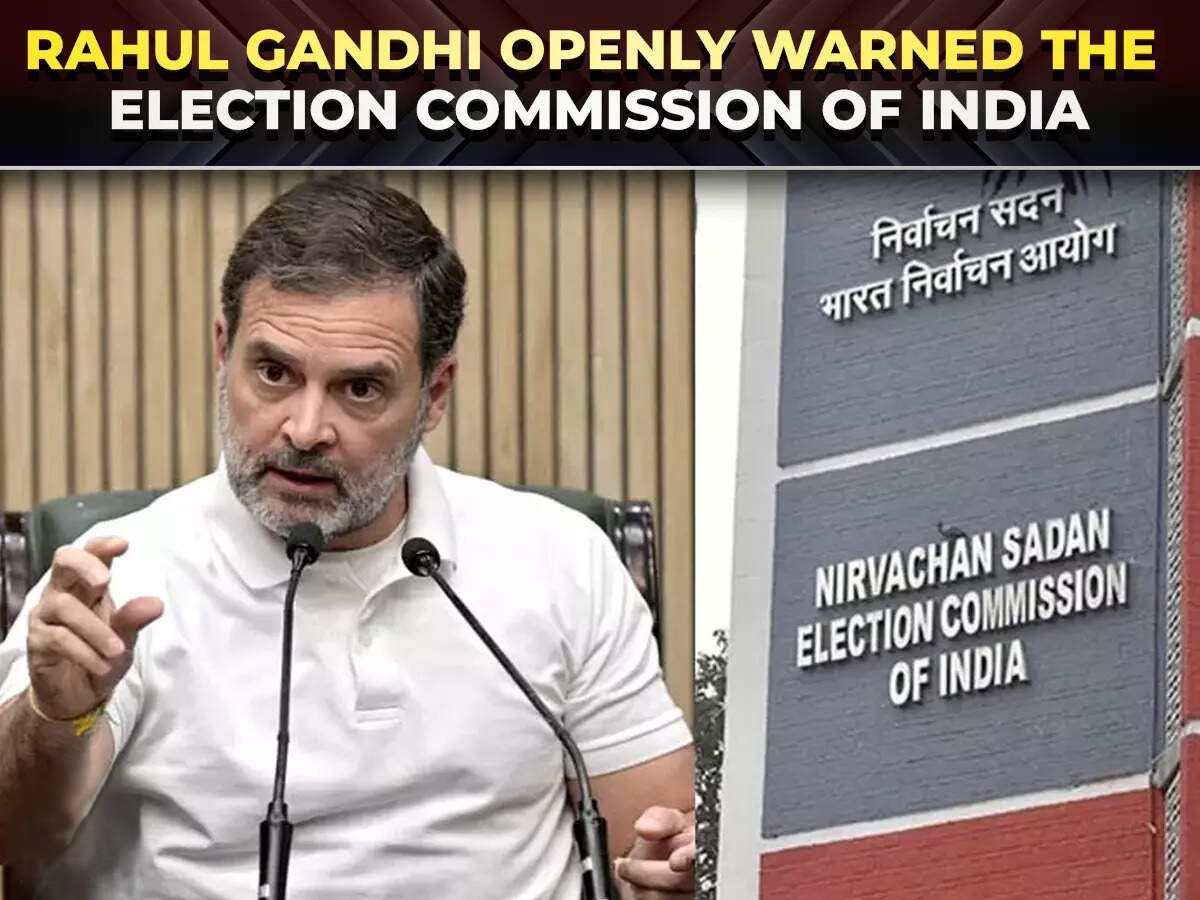
Rahul Gandhi’s Big Attack on Government and Election Commission: “Democracy in India is in Danger”.
Introduction
The political temperature in India soared yet again as Congress MP and Leader of Opposition in the Lok Sabha, Rahul Gandhi, launched a fierce attack on both the Bharatiya Janata Party (BJP)–led central government and the Election Commission of India (ECI). Speaking to the media in New Delhi, Rahul Gandhi expressed grave concerns over what he described as the “worrying” state of Indian democracy.
In a bold statement, he alleged that around 300 Members of Parliament had sought a meeting with the Election Commission to raise concerns about free and fair elections, but the Commission refused to meet them. This refusal, according to Gandhi, is not just a procedural lapse, but a sign of the deep erosion of democratic institutions in the country.
Rahul Gandhi’s Statement: A Strong Warning
Rahul Gandhi’s remarks were loaded with political weight. As the leader of the main opposition party, his statement carried both a warning and a charge against the functioning of the current government and the independence of the Election Commission.
He said:
“The condition of India’s democracy is worrying. If the Election Commission refuses to meet 300 MPs of the country, it means the democratic system is under attack.”
The Congress MP underscored that the Election Commission is constitutionally bound to listen to representatives of the people, regardless of their political affiliation. According to him, such a refusal amounts to denial of parliamentary representation on an issue that directly impacts the heart of democratic governance.
The Allegation: 300 MPs Denied an Audience
Rahul Gandhi’s claim is unprecedented in recent political history. The number—300 MPs—is significant because it represents more than half of the total strength of the Indian Parliament. If this allegation holds true, it would imply that the Election Commission refused to meet a delegation representing a parliamentary majority in terms of numbers.
Congress sources revealed that the MPs were from the INDIA alliance and other opposition parties, united in their concern over alleged voter list irregularities, misuse of central agencies, and bias in the election process.
Background: The Ongoing Debate on Election Commission’s Independence
The Election Commission of India is supposed to function as an autonomous constitutional body, free from political interference. However, in recent years, opposition parties have repeatedly accused it of acting in a biased manner, favoring the ruling BJP.

Some key past controversies include:
- Delayed Action on MCC Violations – Allegations that the Commission took delayed or no action against ruling party leaders for violations of the Model Code of Conduct.
- Timing of Announcements – Claims that election schedules were designed to suit the BJP’s campaign strategies.
- Voter List Manipulations – Alleged deletion of names and improper inclusion of others in voter rolls.
- Appointment Process – Opposition criticism of the government’s role in appointing Election Commissioners.
Rahul Gandhi’s fresh allegation has reignited this debate, putting the Election Commission under renewed public scrutiny.
Government’s Response
While the BJP is yet to issue an official statement responding to Rahul Gandhi’s latest comments, senior leaders within the party have previously dismissed such accusations as “politically motivated drama”.
The BJP maintains that:
- The Election Commission is independent.
- Opposition parties often target institutions when they foresee electoral defeat.
- The refusal to meet could have been due to procedural or scheduling constraints, not political bias.
However, the optics of refusing to meet 300 MPs—if accurate—are undeniably politically damaging.
Election Commission’s Position
At the time of writing, the Election Commission of India has not made a detailed public statement addressing the specific allegation. However, past responses from the ECI to similar charges usually stress:
- Institutional neutrality.
- Equal treatment to all political parties.
- Adherence to formal procedures for requests and representations.
It remains to be seen whether the ECI will address this matter head-on or let the political storm pass without detailed clarification.
Opposition Unity: INDIA Alliance Strategy
This allegation also reflects the INDIA alliance’s evolving political strategy. By focusing on institutional credibility, the alliance aims to:
- Frame the 2024 general elections as a battle to “save democracy.”
- Mobilize public opinion around issues beyond just economic and social policy.
- Showcase solidarity among opposition MPs across party lines.
For Rahul Gandhi, this fits into his broader narrative that India’s democratic institutions are being systematically weakened under BJP rule.
Why This Statement Matters
Rahul Gandhi’s attack is not just about a single meeting. It speaks to three larger themes:
- Institutional Accountability – Whether bodies like the ECI are genuinely accessible to elected representatives.
- Political Messaging – Using a high-impact number (“300 MPs”) to convey urgency and scale.
- Electoral Credibility – With the next general elections looming, opposition parties are laying the groundwork to question election outcomes if they perceive bias.

Historical Context: Opposition vs. Election Commission
This is not the first time the ECI has been at the center of political controversy:
- 1977 Emergency Era – Accusations of the ECI being under government control.
- 2004 Elections – Complaints about election timing favoring the ruling NDA.
- 2019 General Elections – Multiple complaints from the opposition about Modi’s speeches and the use of armed forces in campaign rhetoric.
Rahul Gandhi’s latest salvo is part of this longer history of contestation between political actors and the electoral body.
Possible Legal and Constitutional Implications
If the Election Commission did refuse to meet such a large group of MPs:
- It could be challenged in court as a breach of constitutional duty.
- It could trigger demands for parliamentary debate and possibly even a parliamentary committee investigation.
- It might accelerate discussions about reforming the appointment and accountability mechanisms for the ECI.
Public Reaction
Public opinion appears divided:
- Supporters of the opposition see this as clear proof that the government is eroding democratic institutions.
- BJP supporters dismiss it as political theatre meant to distract from other issues.
- Neutral observers are concerned about the lack of transparency and communication from the ECI.
Social media has amplified the debate, with hashtags like #SaveDemocracy, #ElectionCommission, and #RahulGandhi trending on X (formerly Twitter).
International Perspective
International human rights and democracy watchdogs have, in recent years, downgraded India’s ratings on parameters like press freedom and electoral democracy. Statements like Rahul Gandhi’s—especially if widely reported abroad—could:
- Add to the global narrative of democratic backsliding in India.
- Influence foreign policy perceptions.
- Potentially impact India’s image ahead of international summits.
The Road Ahead
This controversy is unlikely to fade quickly. The opposition is expected to:
- Hold protests outside the Election Commission’s office.
- Demand answers in Parliament.
- Take the issue to the public through rallies and press conferences.
The BJP, in turn, will try to:
- Shift the narrative to development and governance.
- Accuse the opposition of undermining public faith in elections.
- Use its communication machinery to counter the allegations.
Conclusion
Rahul Gandhi’s allegation that 300 MPs were denied a meeting with the Election Commission is more than just a political talking point—it’s a test of institutional transparency and responsiveness in the world’s largest democracy. Whether the ECI clarifies its position or maintains silence will have significant political repercussions.
As India moves closer to the next general election, the integrity and independence of electoral processes will remain under intense scrutiny. The current episode serves as a stark reminder that democracy is not just about holding elections, but about ensuring that every democratic institution functions with openness, fairness, and respect for the people’s representatives.
Read More latest news

